Tour de France race guide
Our stage-by-stage guide to the 100th edition of cycling's biggest bike race.
Last Updated: 15/07/13 1:50pm
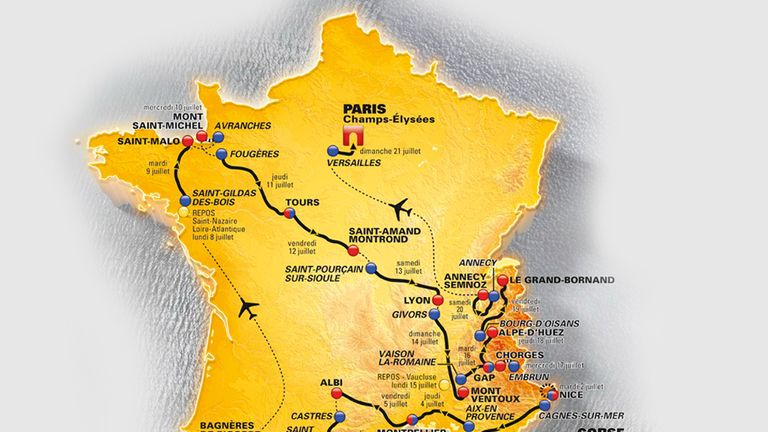
Team Sky are bidding to make it back-to-back victories at the 100th edition of the Tour de France (June 29-July 21).
Cycling’s summer showpiece is set to deliver one of its most compelling races ever, with an all-star cast being matched by an epic route that visits all of the event’s most famous landmarks.
The Tour’s Grand Depart takes place on the Mediterranean island of Corsica with a flat road stage that presents sprinters a rare opportunity to claim the coveted maillot jaune.
Later in the race, a punishing summit finish on the iconic Mont Ventoux leads into a brutally tough final week that also includes two ascents of Alpe d’Huez in one day.
And the spectacle continues all the way to Paris, when riders will enter the city as the sun sets for a sprint finale on the Champs-Elysees.
Here's what the riders will face during the 21 days of action:
Stages
Saturday 29 June – Stage one: Porto-Vecchio to Bastia, 213km

La Grande Boucle kicks off in style on the island of Corsica with a rare road stage to decide the first recipient of the maillot jaune. The opening test covers almost the entire east coast, heading out of Porto-Vecchio on a day which should showcase the island to the world. The race loops south to Bonifacio where a break will likely duke it out for the honour of the first polka dot jersey. The fourth-category Cote de Sotta (45.5km) pays out just a single point but will be fiercely fought. The route continues north on undulating coastal roads. The first intermediate sprint follows at San-Giuliano (150km) as the green jersey contenders make themselves known, but the bigger prize is up the road at the finish. A rare opportunity for the sprinters, the flat finale will provide an all-out drag race to the line.
Live on ITV4 between 1055-1630 and on British Eurosport HD between 1030-1630. Highlights on ITV4 between 1900 to 2000.
Sunday 30 June – Stage two: Bastia to Ajaccio, 156km

A much tougher prospect, the Tour’s middle day on the island produces an intriguing stage featuring four categorised climbs. A pure sprinter will struggle to keep hold of yellow as the route winds south west towards the capital of Ajaccio. The road drags up immediately out of Bastia, but after 33km there will still be chance to contest the intermediate sprint at Castello-di-Rostino. From there the profile rises in steps with four climbs, three of them categorised, over Corsica’s spine. After the third-category pairing of the Col de Bellagranajo (70km) and Col de la Serra (85km) the race hits the most significant climb of the day, the second cat. Col de Vizzavona. From there a long, initially winding, descent will allow chance to chase on. A final sting in the tail comes with the category-three Cote du Salario, 12km from a flat finish and perhaps a reduced bunch sprint.
Live on ITV4 between 1300-1630 and on British Eurosport HD between 1215-1645. Highlights on ITV4 between 1900 to 2000.
Monday 1 July – Stage three: Ajaccio to Calvi, 145.5km

As with Sunday’s test, the general classification contenders will need to be vigilant on another tough day as the race looks to finish its spell on Corsica with a bang. An up and down day, stage three heads back north on the altogether more mountainous west coastal roads. From the gun the peloton are met with the fourth-category Col de San Bastiano, 12km in. The fight for green resumes with a brief flat run through the aptly-named Sagone (28.5km), before attention turns to yet more climbing. The Col de San Martino (58km) marks the start of a relentless run to the finish over narrow winding roads which will offer little-to-no respite for the riders. The final test and highest peak of the day at 443 metres, the second-category Col de Marsolino is crested 13.5km from home. Attackers will face a largely straight descent on the run-in, making it hard to fend off the pack on the flat in Calvi.
Live on ITV4 between 1300-1530 and on British Eurosport HD between 1045-1600. Highlights on ITV4 between 1900 to 2000.
Tuesday 2 July – Stage four: Nice (team time trial), 25km

After a brutally-tough opening to the race, the riders fly into Nice on Monday night in preparation for a key early battle in the form of the team time trial. The out-and-back course takes the riders along the Mediterranean coast, skirting around Parc Phoenix before heading north for a quick loop, taking in the intermediate split at 13km. A largely pan-flat course with limited technicality should ensure a rapid pace and a real test of strength for each squad. Managing each effort will be key with the first five riders across the line all counting towards the final time. With time gaps starting to open out, the stage could also ensure a new recipient of the yellow jersey.
Live on ITV4 between 1430-1630 and on British Eurosport HD between 1345-1615. Highlights on ITV4 between 1900 to 2000.
Wednesday 3 July – Stage five: Cagnes-sur-Mer to Marseille, 228.5km

Another tricky day in the medium mountains, the fifth stage of racing cuts the corner off the south coast en route to Marseille via four categorised climbs. The peloton immediately front up to the first ascent over the Cote de Chateauneuf Grasse (22km), leaving the Alpes-Maritimes for an undulating run through Var. A section of notes sees the quick-fire passage over the Col de l’Ange (93km) before the sprint point at Lorgues 9.5km later. A sawtooth run towards Marseille brings five rises, the first and fourth paying out points but the pressure will be on over each short, sharp ramp. A wide open stage could see the contenders size up the competition or see a plucky attacker stay clear on the downhill run for home.
Live on ITV4 between 1400-1700 and on British Eurosport HD between 1245-1645. Highlights on ITV4 between 1900 to 2000.
Thursday 4 July – Stage six: Aix-en-Provence to Montpellier, 176.5km

A second stage for the sprinters, day six drops out of Aix-en-Provence before heading west to the finish. The early focus will be on the break before the riders prepare for the intermediate sprint at Maussane-les-Alpilles (63km). That sprint arrives at the foot of the day’s only categorised climb, the fourth cat. Col de la Vayede (68km). The sprinters’ teams should take over from thereon in, keeping a likely compact move under control on the run in to Montpellier. A straight road into the finish should produce a fast sprint and another compelling battle of the trains.
Live on ITV4 1400-1700 and on British Eurosport HD between 1245-1700. Highlights on ITV4 between 1900 to 2000.
Friday 5 July – Stage seven: Montpellier to Albi, 205.5km

As the race heads towards the Pyrenees the leg-testing intermediate climbs continue. A downhill run to the finish will appeal to the sprinters but they will have to battle over four categorised climbs to get there. That will be easier said than done with the early one-two punch of the Col des 13 Vents (80km, third category) and the Col de la Croix de Mounis (94.5km, second category). The terrain flattens out briefly in Tarin before a second set of climbs. The final ramp – the Cote de Teillet – is crested 34.5km from home, giving any fast men still in touch the chance to regroup for the finish in Albi.
Live on ITV4 between 1400-1630 and on British Eurosport HD between 1245-1700. Highlights on ITV4 between 1900 to 2000.
Saturday 6 July – Stage eight: Castres to Ax 3 Domaines, 195km

Week two brings the first big mountain test of the race and a stage which will tell us a lot about what to expect for the remainder of the event. The stage is all about the final pair of climbs, firstly the hors categorie hairpin drag up the Col de Pailheres (166km), the first time the centenary edition heads over 2000m. With long sections between 9-10%, the climb will significantly thin out the peloton before the riders then plummet down the descent ahead of the Ax 3 Domaines summit finish. Averaging 8.2% for 7.8km, the overall contenders will reveal themselves in a big stage in the GC shake-up.
Live on ITV4 between 1330-1630 and on British Eurosport HD between 1245-1630. Highlights on ITV4 between 1900 to 2000. Sunday 7 July – Stage nine: Saint-Girons to Bagneres-de-Bigorre, 168.5km

A monster of a stage with a relentless barrage of climbing, the ninth stage will be every bit as tough as the day before with nowhere to hide in the Pyrenees. The lack of a summit finish doesn’t detract from the spectacle on a relatively short stage which will be full gas from the off. Immediately the riders must scale the Col de Portet-d’Aspet (28.5km), the second-category ascent acting as a warm-up for tougher tests to come. Next up is the first cat. Col de Mente, the peloton thinning out before a drop down into Bagneres-de-Luchon and the famous Col de Peyresourde (90km). Still barely over half-way through, two more first-category mountains remain, the Col de Val Louron Azet/La Hourquette d’Ancizan double act providing a stiff test. A downhill run to the finish will provide plenty of intrigue, with attacks on the descents often as effective as the climbs.
Live on ITV4 between 1200-1600 and on British Eurosport HD between 0945-1600. Highlights on ITV4 between 1900 to 2000.
Monday 8 July – Rest day
Tuesday 9 July – Stage 10: Saint-Gildas-Des-Bois to Saint Malo, 197km

The climbers and GC contenders will make way for the sprinters as the race leaves the Pyrenees after the first rest day and heads to the north-west corner of France. Stage 10 is not pan-flat, with gently rolling roads and a fourth-category climb of the Cote de Dinan coming after 142km, but there is nothing significant enough to avoid a bunch finish. The sprint trains will also be aided by a largely straight road to the finish line in Saint-Malo, with a gently flowing route in the final few kilometres providing the perfect platform for a fast-paced finale.
Live on ITV4 between 1400-1630 and on British Eurosport HD between 1245-1645. Highlights on ITV4 between 1900 to 2000.
Wednesday 10 July – Stage 11: Avranches to Mont-Saint-Michel, 33km individual time trial

The first individual time trial of the race has a rolling opening half, before levelling out for a flat run to the finish line on the coast. It is not an overly-technical course, with only a handful of tight corners for the riders to navigate, the most testing being a sharp right-hander around 2km from the end. However, the latter half of the course runs parallel to the coastline and then turns towards it, so the wind could have a big say on proceedings and weak legs from the battles of the Pyrenees could be exposed by potential head-on gusts.
Live on ITV4 between 1400-1700 and on British Eurosport HD between 1245-1700. Highlights on ITV4 between 1900 to 2000.
Thursday 11 July – Stage 12: Fougeres to Tours, 218km

Another flat day sees the sprinters return to the fore as the race moves back towards the centre of France on a lengthy day in the saddle. There are no categorised climbs, but the road isn’t pan flat either, with the gently undulating parcours being punctuated by numerous short, sharp rises. There are a series of technical corners inside the final 2km as the riders cross the Loire river and then turn back on themselves for a short drag to the finish line. These could make for a hectic finale in which good positioning and avoiding potential crashes will be pivotal.
Live on ITV4 between 1400-1630 and on British Eurosport HD between 1245-1700. Highlights on ITV4 between 1900 to 2000.
Friday 12 July – Stage 13: Tours to Saint-Armand-Montrond, 173km

The race continues to move south east with another largely flat day that could be decided by a short, sharp climb 10km from the finish. Although uncategorised, the rise up from Bruere-Allichamps is enough of a challenge to potentially slow down the sprint trains and provide a platform for lone attackers to break clear. It tops out with just over 5km remaining, so anyone who has escaped will have to time trial their way frantically to the line. The run-in is straight, so should the sprint trains prevail over the climb, it will be a full-throttle dash for the line.
Live on ITV4 between 1400-1630 and on British Eurosport HD between 1245-1700. Highlights on ITV4 between 1900 to 2000.
Saturday 13 July – Stage 14: Saint-Pourcain-sur-Sioule to Lyon, 191km

Categorised climbs return to the race on stage 14 – and in numbers. There are no fewer than seven – two category threes and five category fours – for the riders to negotiate on a day that will prove a challenging hors d’oeuvres to the critical mountain stages to follow. The road starts undulating right from the flag, providing a breakaway with an ideal platform to make an early escape. They will then look to build up their advantage ahead of the stage’s crucial sector: tough climbs of the Cote de Thizy-les-Bourgs (113km) and Col du Pilon (126.5km) followed by a speedy 25km descent. Should the breakaway still have a healthy gap and numbers in their ranks, they will have every chance of holding on for a stage win in Lyon.
Live on ITV4 between 1400-1630 and on British Eurosport HD between 1230-1700. Highlights on ITV4 between 1900 to 2000.
Sunday 14 July – Stage 15: Givors to Mont Ventoux, 242.5km

An epic day and the longest of the race. Starting just below Lyon, the road undulates south for 208km into Provence, taking in three category-four climbs and one category-three climb before reaching Malaucene. From there, it winds east to the quaint town of Bedoin at the foot of the iconic and punishingly tough climb to Mont Ventoux, where the finish line awaits. The hors categorie ascent is just shy of 21km long and averages 7.5% in gradient, with a maximum of 12%. That is not the whole story, though, because after passing Chalet Reynard, 6km from the summit, the climb emerges out of the treeline and into an environment almost unique in cycling. A sea of broken white rock either side of the road forms what is widely referred to as a Moon-like environment in which there is no escape from the sun, turning the road into an oven on a clear day. The race may not be won here, but it could well be lost and the winner will enter himself into Tour de France legend.
Live on ITV4 between 1330-1630 and on British Eurosport HD between 1230-1700. Highlights on ITV4 between 1900 to 2000.
Monday 15 July – Rest day
Tuesday 16 July – Stage 16: Vaison-la-Romaine to Gap, 168km

The riders will enjoy a rest day after the rigours of Ventoux, but there is no easy return to racing on stage 16 as the race heads east into the Alps. The road takes the riders on a stunning route through cliff-lined valleys and over testing passes. There are three categorised climbs, starting with the category-three Cote de la Montagne de Bluye after 17.5km, which then rolls into the category-two Col de la Macuegne, which summits after 48km following a 7.6km ascent averaging 5.2%. The racers then ride the best part of 100km to Gap, before heading north east for an ascent of the Col de Manse and then a frantic descent back down to Gap to the finish. The stage holds potential for another breakaway rider to take victory, but there could also be gaps created among the GC contenders on the run down into Gap, particularly if it is raining.
Live on ITV4 between 1400-1630 and on British Eurosport HD between 1230-1700. Highlights on ITV4 between 1900 to 2000.
Wednesday 17 July – Stage 17: Embrun to Chorges, 32km individual time trial

The race’s final time trial is a tough one. Not only is it mid-length and contain two category-two climbs, but the latter two-thirds of the course are twisty and technical. The Cote de Puy-Sanieres is 6.4km long and averages 6% in gradient, while the Cote de Reallon is 6.9km long and average 6.3%. Of just as much concern as the climbing will be the descending, though, particularly if tight turns are made treacherous by wet weather. The stage offers plenty of potential for GC riders to take vital time on their rivals heading into the final four stages.
Live on ITV4 between 1400-1630 and on British Eurosport HD between 1245-1700. Highlights on ITV4 between 1900 to 2000.
Thursday 18 July – Stage 18: Gap to Alpe d’Huez, 172.5km

Another epic stage that will go down in history for climbing the legendary Alpe d’Huez twice in a day. Once up the Alpe has provided enough drama over the years to fill books, so twice has the makings of a classic. Before the riders even get to Le Bourg-d’Oisans at its base, they must negotiate a bruising opening 108km containing two category-two climbs and one category-three climb. Then it’s on the hairpins on the climb for the first time, with 13.2km at an average gradient of 8.1% (maximum 10.6%) awaiting. After reaching the summit for the first time, the road carries on up the category-two Col de Sarenne and then embarks on a hair-raising descent back down into the valley, before heading back up Alpe d’Huez for the second and decisive time. There is unlikely to be more than a handful of riders at the front of the race by now and then man who reaches the top first could well occupy top spot on the podium in Paris.
Live on ITV4 between 1300-1700 and on British Eurosport HD between 1045-1715. Highlights on ITV4 between 1900 to 2000.
Friday 19 July – Stage 19: Le Bourg-d’Oisans to Le Grand-Bornand, 204.5km

This most brutal of final weeks continues with another leg-breaker of a day containing two hors-cateogorie climbs, two category-one climbs and one category-two climb. Heading north from Le Bourg-d’Oisan towards Lake Annecy, the road rears up straight away to tackle back-to-back HC climbs of the Col du Glandon (2.16km, average 5.1% gradient) and the Col de la Madeleine (19.2km, average 7.9%). Long and testing descents follow each climb, before the route sends the riders up three more tough ascents ahead of a dash downhill to the finish line. Long-range breakaway experts may fancy the chances on this one.
Live on ITV4 between 1000-1630 and on British Eurosport HD between 0930-1715. Highlights on ITV4 between 1900 to 2000.
Saturday 20 July – Stage 20: Annecy to Mont Semnoz, 125km

One last day in the Alps, and although the distance is shortened to 125km, the climbs still come thick and fast. Starting and finishing on the western banks of the beautiful Lake Annecy, the riders will tackle four lesser climbs before embarking up the potentially stage-deciding duo of the category-one Mont Revard (15.9km, average gradient 5.6%) and the summit finish on the hors-categorie Annecy-Semnoz (10.7km, average 8.5km). Even the strongest legs will be desperately tired by now, but with so much scope for attacking and the knowledge that whoever leads the race at the finish line will win overall, another electric day is in the offing.
Live on ITV4 between 1400-1630 and on British Eurosport HD between 1200-1700. Highlights on ITV4 between 1900 to 2000.
Sunday 21 July – Stage 21: Versailles to Paris, 133.5km

With the general classification decided, the final stage into Paris will be its usual processional celebration turned frantic sprint for glory on the Champs-Elysees. This year, however, there is a key differences, introduced to mark the 100th staging of the race, with the riders will enter Paris at as the sun sets over the city. The stage will end with 10 laps of a circuit taking in the Arc de Triomphe and finishing on the Champs-Elysees.
Live on ITV4 between 1630-2100 and on British Eurosport HD between 1720-2130. Highlights on ITV4 between 2300 to 0000.
Team Sky history
Team Sky sealed their rise to the summit of professional cycling when Sir Bradley Wiggins became Britain’s first Tour de France winner in 2012. His overall victory was complemented by six stage wins, with Wiggins picking up two, Mark Cavendish three and Chris Froome one. In the 2011 race, Edvald Boasson Hagen claimed two stage wins for Team Sky.
Classifications and points
Four classifications will be contested at the Tour de France:
- General classification: yellow jersey
- Points classification: green jersey
- Mountains classification: polka dot jersey
- Best young rider: white jersey
- Team classification: Yellow helmets
The yellow jersey is held by the leader of the general classification, while the white jersey is held by the highest rider on the general classification aged 25 or under. The team classification is determined by adding together the times of the three best riders from each team (team time trial excluded).
Points classification
Points will be awarded in the following way:
- Intermediate sprints: 20, 17,15, 13, 11, 10, 9, 8, 7, 6, 5, 4, 3, 2 and 1 point awarded to the first 15 riders.
- Finishes on flat stages: 45, 35, 30, 26, 22, 20, 18, 16, 14, 12, 10, 8, 6, 4 and 2 points awarded to the first 15 riders.
- Finishes on medium-mountain stages: 30, 25, 22, 19, 17, 15, 13, 11, 9, 7, 6, 5, 4, 3 and 2 points awarded to the first 15 riders.
- Finishes on high-mountain stages: 20, 17, 15, 13, 11, 10, 9, 8, 7, 6, 5, 4, 3, 2 and 1 point awarded to the first 15 riders.
- Individual time trials: 20, 17, 15, 13, 11, 10, 9, 8, 7, 6, 5, 4, 3, 2 and 1 point awarded to the fastest 15 riders.
Mountains classification
Points will be awarded in the following way:
- Hors-categorie climbs: 25, 20, 16, 14, 12, 10, 8, 6, 4 and 2 points awarded to the first ten riders over the summit.
- Category-one climbs: 10, 8, 6, 4, 2 and 1 point awarded to the first six riders over the summit.
- Category-two climbs: 5, 3, 2 and 1 point awarded to the first four riders over the summit.
- Category-three climbs: 2 and 1 point awarded to the first two riders over the summit.
- Category-four climbs: 1 point awarded to the first rider over the summit.