
Tour de France race guide
Sunday 27 July 2014 20:21, UK
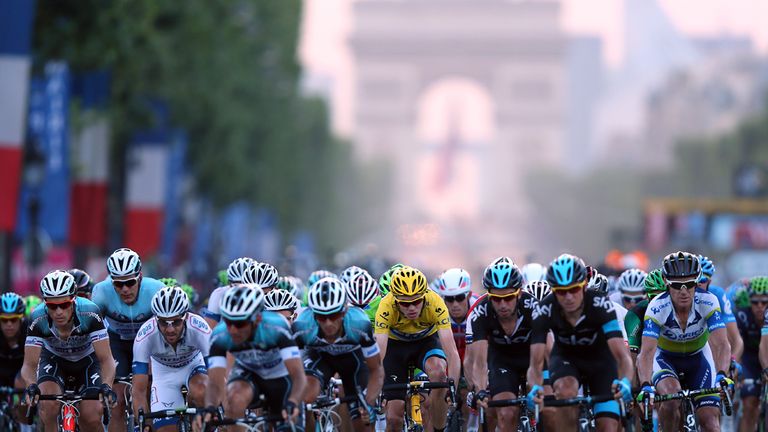
The world's biggest bike race looks set to once again provide a huge spectacle across three weeks of racing.
Preview of the 101st edition
The Tour de France is always the cycling season’s marquee race, but for the British fan, the 101st edition is set to be doubly special. For only the second time in its history, Le Grand Boucle will start on English soil with a Grand Depart comprising of two days in Yorkshire and a third from Cambridge to London. In addition to that, Team Sky’s Chris Froome is favourite to win the race for the second year in a row and hand Britain its third successive victory. His bid for the yellow jersey will be supported by Richie Porte, Geraint Thomas, Mikel Nieve, David Lopez, Bernhard Eisel, Vasil Kiryienka, Danny Pate and Xabier Zandio. The race will run from July 5-27. Here’s how the action will pan out…Stages
Stage 1: Saturday, July 5 – Leeds to Harrogate – 190.5km The race opens with what should be a sprint stage into Harrogate. There are three categorised climbs on the route, but all three come in the middle third of the stage and with the last one being followed by more than 60km of flat to the finish, there is plenty of time for the sprint teams to bring the peloton back together should there be any splits.
Stage 2: Sunday, July 6 – York to Sheffield – 201km
The race opens with what should be a sprint stage into Harrogate. There are three categorised climbs on the route, but all three come in the middle third of the stage and with the last one being followed by more than 60km of flat to the finish, there is plenty of time for the sprint teams to bring the peloton back together should there be any splits.
Stage 2: Sunday, July 6 – York to Sheffield – 201km
 Although early in the race, stage two could be one of the hardest days of the whole Tour. Likened by race director Christian Prudhomme to the Liege-Bastogne-Liege one-day Classic, the route contains no fewer than nine categorised climbs, including five in a truly brutal final 65km. The peloton should stay together for the first 170km, but once the riders enter Sheffield, the bunch could well be blown to pieces. The Cote d’Oughtibridge (1.5km at an average of 9.5 per cent gradient) is perfect for initial attacks, but it is on the now-famous Jenkin Road (800m at 10.8 per cent) where the stage-winning selection is likely to be made. A 33 per cent ramp awaits on this sharp and devilishly steep climb, and it could be that only a handful of riders are still at the head of the race over the summit. More riders should join the lead group on the 5km flat run to the finish, where a reduced-bunch sprint is likely.
Stage 3: Monday, July 7 – Cambridge to London – 155km
Although early in the race, stage two could be one of the hardest days of the whole Tour. Likened by race director Christian Prudhomme to the Liege-Bastogne-Liege one-day Classic, the route contains no fewer than nine categorised climbs, including five in a truly brutal final 65km. The peloton should stay together for the first 170km, but once the riders enter Sheffield, the bunch could well be blown to pieces. The Cote d’Oughtibridge (1.5km at an average of 9.5 per cent gradient) is perfect for initial attacks, but it is on the now-famous Jenkin Road (800m at 10.8 per cent) where the stage-winning selection is likely to be made. A 33 per cent ramp awaits on this sharp and devilishly steep climb, and it could be that only a handful of riders are still at the head of the race over the summit. More riders should join the lead group on the 5km flat run to the finish, where a reduced-bunch sprint is likely.
Stage 3: Monday, July 7 – Cambridge to London – 155km
 After the exertions of Sheffield, the peloton gets a bit of a breather with a short and flat day that is guaranteed to finish in a bunch sprint. The route enters London via the 2012 Olympic park and ends on The Mall.
Stage 4: Tuesday, July 8 – Le Touquet Paris-Plage to Lille – 163.5km
After the exertions of Sheffield, the peloton gets a bit of a breather with a short and flat day that is guaranteed to finish in a bunch sprint. The route enters London via the 2012 Olympic park and ends on The Mall.
Stage 4: Tuesday, July 8 – Le Touquet Paris-Plage to Lille – 163.5km
 The race returns to France on a fourth day that is once again set to be a battle between the sprinters. There is a small category-four climb in the last third of the stage, but it is far too far out to derail the sprint trains.
Stage 5: Wednesday, July 9 – Ypres to Arenberg Porte du Hainaut – 155.5km
The race returns to France on a fourth day that is once again set to be a battle between the sprinters. There is a small category-four climb in the last third of the stage, but it is far too far out to derail the sprint trains.
Stage 5: Wednesday, July 9 – Ypres to Arenberg Porte du Hainaut – 155.5km
 A potentially crucial day littered with hazards and danger. It’s almost entirely flat, but the route includes nine sections of dreaded cobblestones, known in France as pavé, totalling 15.4km. All of them come in what is sure to be nervous and highly charged second half of the stage. Among them are the Carrefour de l’Arbre, made famous by Paris-Roubaix, and De Wandignies-Hamage a Hornaing, which is the longest stretch at a bone-rattling 3.7km. The pavé is ripe for crashes but is also foreign territory for general classification contenders such as Froome and Alberto Contador, whose inexperience on such terrain could see them lose significant blocks of time if they are not careful. The winner on the day is likely to be a cobbled Classic specialist following a late acceleration.
Stage 6: Thursday, July 10 – Arras to Reims – 194km
A potentially crucial day littered with hazards and danger. It’s almost entirely flat, but the route includes nine sections of dreaded cobblestones, known in France as pavé, totalling 15.4km. All of them come in what is sure to be nervous and highly charged second half of the stage. Among them are the Carrefour de l’Arbre, made famous by Paris-Roubaix, and De Wandignies-Hamage a Hornaing, which is the longest stretch at a bone-rattling 3.7km. The pavé is ripe for crashes but is also foreign territory for general classification contenders such as Froome and Alberto Contador, whose inexperience on such terrain could see them lose significant blocks of time if they are not careful. The winner on the day is likely to be a cobbled Classic specialist following a late acceleration.
Stage 6: Thursday, July 10 – Arras to Reims – 194km
 Some semblance of calm should return to the peloton on a sixth stage that is once again set for a sprint finish. It’s a fairly long day and there are two categorised climbs en route, but the last of them comes more than 35km from the finish, so too far out to deny the fast men a chance to battle it out for victory.
Stage 7: Friday, July 11 – Apernay to Nancy – 234.5km
Some semblance of calm should return to the peloton on a sixth stage that is once again set for a sprint finish. It’s a fairly long day and there are two categorised climbs en route, but the last of them comes more than 35km from the finish, so too far out to deny the fast men a chance to battle it out for victory.
Stage 7: Friday, July 11 – Apernay to Nancy – 234.5km
 The second longest stage of the race takes the peloton into eastern France and is largely flat but for two category-four climbs inside the final 20km. The sprinters may well get over the Cote de Maron, but it is unlikely they will survive the steep ramps of the Cote de Boufflers. Attacks will be plentiful on this climb and a small group is likely to form over the summit and subsequent descent, before contesting a reduced-bunch sprint in Nancy.
Stage 8: Saturday, July 12 – Tomblaine to Gerardmer – 161km
The second longest stage of the race takes the peloton into eastern France and is largely flat but for two category-four climbs inside the final 20km. The sprinters may well get over the Cote de Maron, but it is unlikely they will survive the steep ramps of the Cote de Boufflers. Attacks will be plentiful on this climb and a small group is likely to form over the summit and subsequent descent, before contesting a reduced-bunch sprint in Nancy.
Stage 8: Saturday, July 12 – Tomblaine to Gerardmer – 161km
 The race enters the Vosges Mountains for the first of six summit finishes. The stage is relatively short but ends with a brutal barrage of three categorised climbs in less than 30km. The Col de la Croix des Moinats will thin the peloton right down, but it is on the deceptively difficult Col de Grosse Pierre where the most serious damage will be done. This 3km climb has a maximum ramp of 16 per cent and is likely to blow what is left of the bunch to pieces, creating a select group of riders who will battle it out on the concluding climb to Gerardmer. Whether the stage victory will still be up for grabs is not certain, because the profile looks good for a breakaway winner.
Stage 9: Sunday, July 13 – Gerardmer to Mulhouse – 170km
The race enters the Vosges Mountains for the first of six summit finishes. The stage is relatively short but ends with a brutal barrage of three categorised climbs in less than 30km. The Col de la Croix des Moinats will thin the peloton right down, but it is on the deceptively difficult Col de Grosse Pierre where the most serious damage will be done. This 3km climb has a maximum ramp of 16 per cent and is likely to blow what is left of the bunch to pieces, creating a select group of riders who will battle it out on the concluding climb to Gerardmer. Whether the stage victory will still be up for grabs is not certain, because the profile looks good for a breakaway winner.
Stage 9: Sunday, July 13 – Gerardmer to Mulhouse – 170km
 Another meaty day in the Vosges Mountains takes the riders over no fewer than six categorised climbs on a route that could once again suit a breakaway winner. The day actually ends with a long descent off the Grand Ballon climb and then 21km of flat to the finish, but the sprinters will have long-since been dropped, so the spoils should go to a strong climber with a swift turn of speed for the finish.
Stage 10: Monday, July 14 - Mulhouse to La Planche des Belles Filles – 161.5km
Another meaty day in the Vosges Mountains takes the riders over no fewer than six categorised climbs on a route that could once again suit a breakaway winner. The day actually ends with a long descent off the Grand Ballon climb and then 21km of flat to the finish, but the sprinters will have long-since been dropped, so the spoils should go to a strong climber with a swift turn of speed for the finish.
Stage 10: Monday, July 14 - Mulhouse to La Planche des Belles Filles – 161.5km
 The last stage before the first rest day, stage ten ends with a summit finish on the category-one La Planche des Belles Filles and is almost certain to produce fireworks as the general classification contenders look to put time into each other. This climb is a happy hunting ground for Chris Froome, having claimed his first Tour stage win there in 2012, and he will once again hope to use it to inflict damage on his rivals two years on. It is steep throughout its 5.9km distance, but is at its worst right at the top, where a 20 per cent wall awaits the riders just before the finish line. The ascent is actually the seventh categorised climb of a bruising day that should deliver thrilling racing.
Stage 11: Wednesday, July 16 – Besancon to Oyonnax – 187.5km
The last stage before the first rest day, stage ten ends with a summit finish on the category-one La Planche des Belles Filles and is almost certain to produce fireworks as the general classification contenders look to put time into each other. This climb is a happy hunting ground for Chris Froome, having claimed his first Tour stage win there in 2012, and he will once again hope to use it to inflict damage on his rivals two years on. It is steep throughout its 5.9km distance, but is at its worst right at the top, where a 20 per cent wall awaits the riders just before the finish line. The ascent is actually the seventh categorised climb of a bruising day that should deliver thrilling racing.
Stage 11: Wednesday, July 16 – Besancon to Oyonnax – 187.5km
 The riders ease themselves back into action after the rest day with a rolling stage containing four categorised climbs in the final 50km, but they do not look big or steep enough to split the pack and the day instead looks set to end in a bunch sprint. Much will depend on the ascent of the Cote d’Echallon, which averages 6.6 per cent in gradient over its 3km distance and could see the pure sprinters dropped if the pace is ramped up in the pack. This climb could also encourage attackers aiming for solo glory, but the likelihood is the peloton – or at least the bulk of it – will arrive at the finish as one.
Stage 12: Thursday, July 17 – Bourg-en-Bresse to Saint-Etienne – 185.5km
The riders ease themselves back into action after the rest day with a rolling stage containing four categorised climbs in the final 50km, but they do not look big or steep enough to split the pack and the day instead looks set to end in a bunch sprint. Much will depend on the ascent of the Cote d’Echallon, which averages 6.6 per cent in gradient over its 3km distance and could see the pure sprinters dropped if the pace is ramped up in the pack. This climb could also encourage attackers aiming for solo glory, but the likelihood is the peloton – or at least the bulk of it – will arrive at the finish as one.
Stage 12: Thursday, July 17 – Bourg-en-Bresse to Saint-Etienne – 185.5km
 The race continues to make its way south with a day that contains four categorised climbs but should finish in a sprint. The climbs of the Col des Brosse and Cote de Grammond are both too shallow to facilitate significant splits in the pack, and the breakaway will also struggle to stay away with the sprint trains no doubt sniffing a stage win. The only question mark is whether the purest sprinters can get over the climbs, but unless the pace is ramped up ludicrously high, they should do.Stage 13: Friday, July 18 – Saint-Etienne to Chamrousse – 197.5km
 The riders travel into the Alps for the first time as the general classification battle sparks back into life. There is a category-one climb in the final 50km, but the race favourites will save their attacks for the long and difficult climb up to the summit finish at the ski resort of Chamrousse. The ascent is at its steepest at the bottom, but those looking to make gains on this day are more likely launch their moves in the final 4km, when the gradient is around nine per cent and conducive to attacks. A big day in the race for the yellow jersey.
Stage 14: Saturday, July 19 – Grenoble to Risoul – 177km
The riders travel into the Alps for the first time as the general classification battle sparks back into life. There is a category-one climb in the final 50km, but the race favourites will save their attacks for the long and difficult climb up to the summit finish at the ski resort of Chamrousse. The ascent is at its steepest at the bottom, but those looking to make gains on this day are more likely launch their moves in the final 4km, when the gradient is around nine per cent and conducive to attacks. A big day in the race for the yellow jersey.
Stage 14: Saturday, July 19 – Grenoble to Risoul – 177km
 This is arguably the queen stage of the race, taking in three huge climbs and ending with a second consecutive summit finish. The ascent to Risoul is not actually the hardest of the race – certainly easier than Chamrousse the day before – but the fact that it comes after the Lautaret and hors-categorie Izoard means the riders will be tired by the time they reach its lower slopes and the challenge is therefore amplified. This is the last mountain stage before the second rest day, so the general classification contenders will be keen to perform well here to ensure they enter the final week in as strong a position as possible.
Stage 15: Sunday, July 20 – Tallard to Nimes – 222km
This is arguably the queen stage of the race, taking in three huge climbs and ending with a second consecutive summit finish. The ascent to Risoul is not actually the hardest of the race – certainly easier than Chamrousse the day before – but the fact that it comes after the Lautaret and hors-categorie Izoard means the riders will be tired by the time they reach its lower slopes and the challenge is therefore amplified. This is the last mountain stage before the second rest day, so the general classification contenders will be keen to perform well here to ensure they enter the final week in as strong a position as possible.
Stage 15: Sunday, July 20 – Tallard to Nimes – 222km
 The second week ends with a long transitional stage that is almost certain to end in a bunch sprint. Taking the peloton away from the Alps, through Provence and towards the Pyrenees, there are no categorised climbs en route, so nothing to concern the sprint trains.
Stage 16: Tuesday, July 22 – Carcassone to Bagneres-de-Luchon – 237.5km
The second week ends with a long transitional stage that is almost certain to end in a bunch sprint. Taking the peloton away from the Alps, through Provence and towards the Pyrenees, there are no categorised climbs en route, so nothing to concern the sprint trains.
Stage 16: Tuesday, July 22 – Carcassone to Bagneres-de-Luchon – 237.5km
 Following the second rest day, the action resumes with the longest stage of the race. Taking the riders into the Pyrenees, it rolls gently for the first 140km, but soon starts to get more challenging and ends with the hors-categorie ascent of Port du Bales and then a high-speed, 21.5km run to the finish in Bagneres-de-Luchon. The climb is tough enough to get the general classification contenders interested. A group could well break away clear over the top, and then it’s a question of whether they can hang on all the way down to the line.
Stage 17: Wednesday, July 23 – Saint-Gaudens to Saint-Lary-Soulan (Pla d’Adet) – 124.5km
Following the second rest day, the action resumes with the longest stage of the race. Taking the riders into the Pyrenees, it rolls gently for the first 140km, but soon starts to get more challenging and ends with the hors-categorie ascent of Port du Bales and then a high-speed, 21.5km run to the finish in Bagneres-de-Luchon. The climb is tough enough to get the general classification contenders interested. A group could well break away clear over the top, and then it’s a question of whether they can hang on all the way down to the line.
Stage 17: Wednesday, July 23 – Saint-Gaudens to Saint-Lary-Soulan (Pla d’Adet) – 124.5km
 Another huge and relentless day in the mountains, with three category-one climbs and then a hors-categorie summit finish awaiting the riders. The fact that the stage is so short could make for a frantic pace and significant splits in the peloton as early as the first or second climbs. By the time the front-runners hit the foot of the ascent to Pla d’Adet there might only be 30 or so riders left in contention, and that number will be whittled down further by some tough opening ramps of over ten per cent in gradient. A breakaway might be given licence to battle it out for the stage win between themselves, but back down the road, this will be a key day in the general classification battle.
Stage 18: Thursday, July 24 - Pau to Hautacam – 145.5km
Another huge and relentless day in the mountains, with three category-one climbs and then a hors-categorie summit finish awaiting the riders. The fact that the stage is so short could make for a frantic pace and significant splits in the peloton as early as the first or second climbs. By the time the front-runners hit the foot of the ascent to Pla d’Adet there might only be 30 or so riders left in contention, and that number will be whittled down further by some tough opening ramps of over ten per cent in gradient. A breakaway might be given licence to battle it out for the stage win between themselves, but back down the road, this will be a key day in the general classification battle.
Stage 18: Thursday, July 24 - Pau to Hautacam – 145.5km
 Stage 19: Friday, July 25 – Maubourguet val d’Adour to Bergerac – 208.5km
 A transitional 19th stage sees the battle for the yellow jersey take a back seat and the sprinters return to the fore. However, there’s a catch. Less than 15km from the finish is the short and sharp climb of the Cote de Montbazillac, which has the potential to catch people out, so positioning leading on to the foot of the ascent will be important.
Stage 20: Saturday, July 26 – Bergerac to Perigueux – 54km individual time trial
A transitional 19th stage sees the battle for the yellow jersey take a back seat and the sprinters return to the fore. However, there’s a catch. Less than 15km from the finish is the short and sharp climb of the Cote de Montbazillac, which has the potential to catch people out, so positioning leading on to the foot of the ascent will be important.
Stage 20: Saturday, July 26 – Bergerac to Perigueux – 54km individual time trial
 This is the day on which the race winner will finally be decided. A rolling, 54km individual time trial, it is a dauntingly difficult test that will brutally expose any general classification contender who is not at their best – and could consequently see plenty of movement in the overall standings. The first three-quarters of the route are not overly technical, but then the course starts winding as it nears Perigueux, ensuring effective cornering will be just as important as power in the finale.
Stage 21: Sunday, July 27 - Evry to Paris – 137.5km
This is the day on which the race winner will finally be decided. A rolling, 54km individual time trial, it is a dauntingly difficult test that will brutally expose any general classification contender who is not at their best – and could consequently see plenty of movement in the overall standings. The first three-quarters of the route are not overly technical, but then the course starts winding as it nears Perigueux, ensuring effective cornering will be just as important as power in the finale.
Stage 21: Sunday, July 27 - Evry to Paris – 137.5km
 Whoever is in the yellow jersey will merely have to survive this largely processional day without crashing to complete their overall victory of the Tour. For the sprinters, however, the race is very much on. The finishing straight on Paris’ Champs-Elysees is the most prestigious sprint in the sport and so all of the fast men will be going all out to claim a famous victory.
Key stages
Stage five: The cobbles of northern France could see general classification contenders lose early time, or worse, crash out of the race altogether. It should be a great watch.Stage 13: It’s difficult to pick between the mountain stages, but the long climb to Chamrousse could see significant splits and do irreparable damage.
Stage 20: The only individual time trial of the race could decide the destination of the yellow jersey.
Previous winners
2013: Chris Froome (GB)2012: Sir Bradley Wiggins (GB)
2011: Cadel Evans (Aus)
2010: Andy Schleck (Lux)
2009: Alberto Contador (Spa)
2008: Carlos Sastre (Spa)
2007: Alberto Contador (Spa)
2006: Oscar Pereiro (Spa)
The jerseys
 - Yellow: General classification.
 - Green: Points classification
- Polka dots: King of the mountains.
- White: Best young rider.
Points
Points classification Each stage of the race falls into one of six categories, or “coefficients”. Points are awarded in each coefficient in the following way…. - Coefficient one (flat stages): 45, 35, 30, 26, 22, 20, 18, 16, 14, 12, 10, 8, 6, 4 and 2 points to the first 15 riders over the line.- Coefficients two and three (medium-mountain stages): 30, 25, 22, 19, 17, 15, 13, 11, 9, 7, 6, 5, 4, 3 and 2 points to the first 15 riders over the line.
- Coefficients four and five (high-mountain stages): 20, 17, 15, 13, 11, 10, 9, 8, 7, 6, 5, 4, 3, 2 and 1 point for the first ten riders over the line.
- Time trial stage (stage 20): 20, 17, 15, 13, 11, 10, 9, 8, 7, 6, 5, 4, 3, 2 and 1 point to the 15 quickest riders. Points are also allocated at intermediate sprints in the following way… - 20, 17, 15, 13, 11, 10, 9, 8, 7, 6, 5, 4, 3, 2 and 1 points to the first 15 riders over the line. Mountains classification Points are awarded in the following way… - Hors-categorie climbs: 25, 20, 16, 14, 12, 10, 8, 6, 4 and 2 points to the first ten riders over the summit.
- Category-one climbs: 10, 8, 6, 4, 2 and 1 point to the first six riders over the summit.
- Category-two climbs: 5, 3, 2 and 1 point to the first four riders over the summit.
- Category-three climbs: 3, 2 and 1 point for the first three riders over the summit.
- Category-four climbs: 1 point for the first rider over the summit. Double points are awarded on the summit-finish climb on stages ten, 13, 14, 17 and 18.