
All-Ireland Football Championship restructure: The pros and cons of the new format after the 'green proposal' was passed
After the format of the All-Ireland Senior Football Championship was restructured last weekend, we assess the pros and cons of the new system that will come into effect from 2023 onwards
Wednesday 2 March 2022 21:27, UK
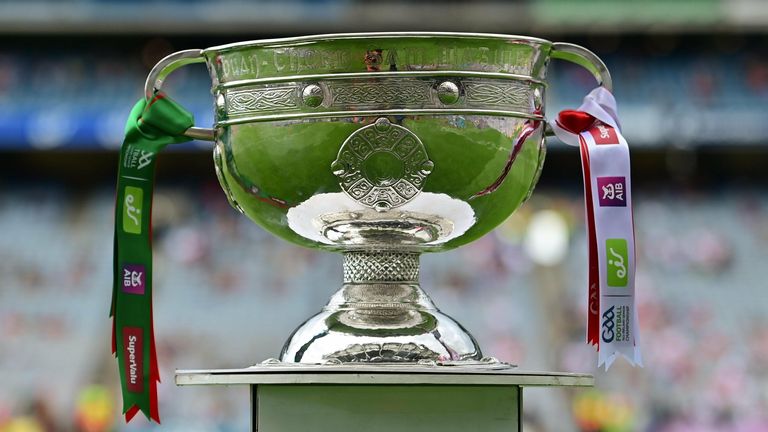
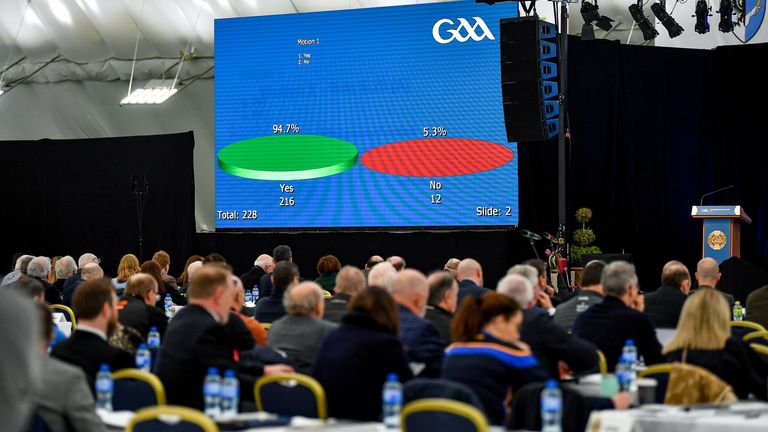
Last weekend, the GAA's Congress voted overwhelmingly in favour of a restructure to the All-Ireland Football Championship.
The 'green proposal' received 94.7 per cent support, and it will come into effect from 2023 onwards.
The format explained
The National Leagues and provincial championships will be retained in their current form. Following their conclusion, 16 teams will proceed to the All-Ireland Championships, with the remainder entering the Tailteann Cup.
All provincial finalists, as well as the next eight teams in terms of National League ranking progress to the All-Ireland Championship round-robin stages, with four groups of four.
The four group winners will qualify for the All-Ireland quarter-finals, with the second-placed teams drawn against third-placed teams in preliminary quarter-finals.
The Tailteann Cup will follow a similar structure, with New York entering at the preliminary quarter-final stage.
The pros
Improvement upon the status quo
It was clear in recent years that the system was broken. However, it took time to stumble across a format that was acceptable to the majority of stakeholders.
Although not many are hailing this move as the perfect solution, it does lay a foundation for further tweaks down the line.
National League takes on an added significance
The National Football League will be more important than ever from 2023 onwards.
With league ranking determining seedings for the group stages, and deciding whether a team enters the Sam Maguire Cup or Tailteann Cup, the springtime campaign will be hugely competitive, even more so than it is now.
More games, amongst similar standard opposition
The group stages increase the number of games for teams, and they will be competitive.
Following the conclusion of the provincial championships, top tier teams will face off against one another, while there will also be an increased number of championship games for sides in the Tailteann Cup.
Every team in the country is guaranteed at the very least four championship matches.
The cons
Does it satisfy the appetite for change?
Last October, 'Proposal B' garnered significant support at the GAA's Special Congress, but the 50.4 per cent vote fell short of the 60 per cent required for it to be introduced.
It was a far more radical change than the one that was introduced last weekend, where the National League format would be moved into the championship slot.
In comparison, the 'green proposal' is a minor tweak. Will the appetite for change remain, or has it been adequately sated?
Does the lack of jeopardy diminish the group stages?
A fear raised by many in the lead-up to the vote was the lack of jeopardy for teams in the All-Ireland Championship group stages. 24 matches will take place across the four groups, with only four sides getting eliminated at their conclusion.
The fact that there is an advantage to topping the group, rather than finishing second or third, will keep interest alive for teams already assured of progression.
But will the relatively small danger of elimination for many teams harm the appeal of this format?
Supers 8s, version 2.0?
The Super 8s never reached the third season of its three-year trial, with the truncated championships in 2020 and 2021 meaning there was no time for an All-Ireland quarter-final group stage.
However, there was no great drive for the format to return.
Although it provided matches between the top teams in the height of summer, the Super 8s never quite caught the public imagination.
Are the new group stages, wedged in between the provincial championships and All-Ireland Championship knockout games, going to be any different?
It doesn't solve the provincial conundrum
Talk of restructures peak at the time of the year when provincial championships are ongoing. One-sided games are far too common.
The dominance of Kerry and Dublin in Munster and Leinster respectively have diminished those provinces in recent years. Connacht still plays host to significant hammerings, while Ulster remains the one truly competitive competition.
Under the new format, the provinces remain untouched.
The downfall of the 'Proposal B' motion was that it failed to garner enough support from provincial councils and the Ulster counties.
The 'green' option cleared that hurdle. So for now, the provincial championships remain.