
Aaron Hernandez's family sues NFL, Patriots after CTE found in his brain
Thursday 21 September 2017 22:51, UK
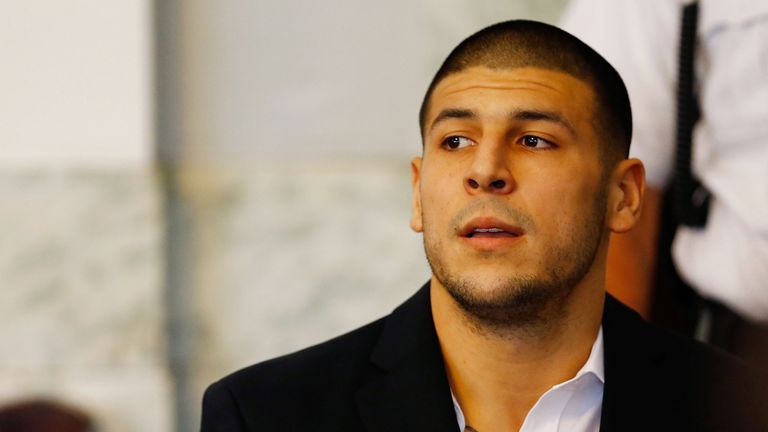
The NFL and the New England Patriots are being sued by the daughter of Aaron Hernandez after tests on his brain showed severe signs of the degenerative brain disease, chronic traumatic encephalopathy (CTE).
Relatives of Hernandez, who killed himself in April, had asked that his brain be tested for CTE after his body was found hanging in a Massachusetts prison where he was serving a life sentence for the 2013 murder of an acquaintance. He had recently been acquitted of charges of a 2012 double murder.
Live NFL


Researchers at Boston University, the leading centre studying CTE, assessed Hernandez's brain.
Hernandez's attorney Jose Baez, who successfully defended the athlete in a double-murder case this year, told reporters in Boston: "It was the most severe case they had ever seen. It was an advanced stage."

CTE is linked to the sort of repeated head traumas common in football that can lead to aggression and dementia.
Hernandez's daughter, Avielle, on Thursday sued the Patriots and the NFL in federal court in Boston, citing the CTE finding and seeking unspecified financial damages for the loss of her father.
Live NFL
Boston University's CTE centre in a statement on Thursday confirmed that its researchers found that Hernandez's brain showed signs of stage 3 of the disease, with stage 4 being the most severe form.
Research released by the BU CTE centre this summer found signs of CTE in 99 per cent of former NFL players it studied.
The disease can be diagnosed only by taking brain tissue from a dead subject. It has been found in athletes including Hall of Fame linebacker Junior Seau and Pro Bowl safety Dave Duerson, both of whom committed suicide.
Hernandez had a $41m NFL contract when he was arrested at his home in June 2013 and charged with murder. Prosecution witnesses at his two trials painted a picture of a troubled man with a history of drug use and paranoid tendencies.
Live NFL
A judge this year vacated that conviction, because Hernandez had not exhausted all his avenues of appeal by the time he died, a move allowed by a quirk in Massachusetts law. Prosecutors are appealing.
He was found not guilty in April of separate charges of fatally shooting two men outside a Boston nightclub in 2012.