
Transgender women athletes banned from female Olympic events
Transgender women athletes have been banned from competing in all female events at the Olympics; it comes in line with US President Donald Trump's executive order ahead of the 2028 Olympic Games in Los Angeles
Saturday 28 March 2026 14:39, UK
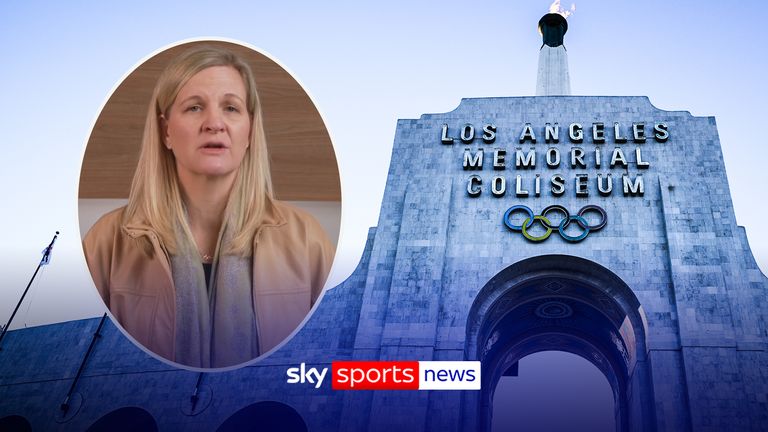
The International Olympic Committee is banning transgender women from competing in all female events.
The restriction applies to eligibility for any female category event at the Olympic Games or any other IOC event, including individual and team sports.
The policy is not retroactive and does not apply "to any grassroots or recreational sports programmes", the IOC said in a statement, adding that it "protects fairness, safety and integrity in the female category".
They will now be limited to biological females, determined based on a one-time test for the SRY gene, which "is fixed throughout life and represents highly accurate evidence that an athlete has experienced male sex development", the IOC said.
The organisation's new policy aligns with US President Donald Trump's executive order on women's sports ahead of the 2028 Los Angeles Games.
It is unclear how many, if any, transgender women are competing at an Olympic level. No woman who transitioned from being born male competed at the 2024 Paris Summer Games.
The eligibility policy that will apply from the LA Olympics in July 2028 "protects fairness, safety and integrity in the female category," the IOC said.
After an executive board meeting, the IOC published a 10-page policy document which also restricts female athletes such as two-time Olympic champion runner Caster Semenya with medical conditions known as differences in sex development, or DSD.
The IOC and its president, Kirsty Coventry, have wanted a clear policy instead of continuing to advise sports' governing bodies who previously have drafted their own rules.
Coventry set up a review of "protecting the female category" as one of her first big decisions last June as the first woman to lead the Olympic body in its 132-year history.
Female eligibility was a strong theme in a seven-candidate IOC election last year when Coventry's main rivals pledged a stronger policy to leading on the issue.
Before the 2024 Paris Olympics, three top-tier sports - track and field, swimming and cycling - already passed rules excluding transgender women who had been through male puberty.
The IOC document details its research that being born male gives physical advantages that are retained.
"Males experience three significant testosterone peaks: in utero, in mini-puberty of infancy and beginning in adolescent puberty through adulthood," the document said.
It added this gives males "individual sex-based performance advantages in sports and events that rely on strength, power and/or endurance."
Coventry: No pressure from President Trump
IOC President Kirsty Coventry...
"The policy was a priority for me way before President Trump came into his second term, so there has not been any pressure from us to deliver anything from anybody outside the Olympic movement.
"Things have evolved, things have moved forward and we need to ensure we are doing that.
"As the policy stipulates this policy will be for all Olympic events including youth Olympic events. This is where it was really important for us, I hope you can go back through the policy and look at all the recommendations and guidelines around the safeguarding that we would like to see in place.
"We really went above and beyond talking to a lot of different athletes around how the process should be followed and what that looks like, and the support networks that need to be in place for the athletes.
"I don't think it's limited to a specific age group of athletes, we want it for all athletes in this implementation process. This is the first phase, we're now stepping into the second phase and we'll work with international federations, national Olympic committees to walk through what implementation looks like and help develop these safeguarding opportunities, to help ensure there is counselling being provided and that the date and athlete is being treated in the best way."
'A notable change from IOC'
Sky News' sports reporter Rob Harris...
"This is a notable change from the IOC, thinking back to Paris in 2024 the messaging then was that it's for each individual sport to decide, they didn't want to think about these blanket bans on transgender women, they did not want anything like the sex-testing being reintroduced.
"But things changed when Kirsty Coventry was elected IOC president in March 2025. She started talking about this protection of the female category.
"She had been sensing growing pressure, including from the White House since Donald Trump was re-elected. He introduced executive orders banning transgender women from women's sport and was putting the pressure on ahead of the LA Olympics in 2028, saying that if you are a transgender women trying to compete in women events you could be denied a visa.
"So amid all that pressure has come this policy after the IOC say reassessing the scientific and medical evidence, assessing the legal viability of introducing this policy and consulting more than 1,000 athletes, ultimately deciding that the female category will be restricted to biological females."