Guide to Equestrian
Equestrianism is broken up into three disciplines at the Olympic Games - Dressage, Show Jumping and Eventing.
Last Updated: 22/07/11 12:13pm
Equestrianism is broken up into three disciplines at the Olympic Games - Dressage, Show Jumping and Eventing. The Eventing element combines Dressage, Cross-County and Show Jumping and takes place over a four-day period.
The sport is littered with multiple gold medallists down the years, while plenty of competitors come back many times over - Canada's Ian Miller competed in nine Olympics.
The Dressage has been dominated by Germany at team level in the modern era and they have won 10 of the last 12 team gold medals, although Dutchwoman Anky van Grunsven has won the last three individual golds.
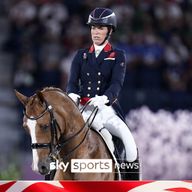
During the Dressage discipline, the rider and horse must perform figures on a course marked out with letters and judges will mark each performance out of 10, taking into account artistry, fluidity and technique.
Known as the Grand Prix, the team event takes place over one round, with four riders per team. The best three scores from each team are then added together, with the lowest total claiming the gold. The individual competition is the Grand Prix Special when the best 25 from the team event compete before the best 15 then contest the final, known as the Kur, which is set to music. The lowest combined mark wins the gold medal.
Show Jumping takes place over a course between 500 and 700 metres comprising between 10 and 15 obstacles, and is again split into team and individual events. There is a set time allowed to cover the course, with penalties incurred for, among other things, going over that time or knocking down obstacles.
The individual discipline takes place over three rounds, with 35 riders qualifying from the first stage before 20 go into the final, with the lowest combined score from the final two rounds enough to win gold. The team event contains two rounds, with four riders per team and, like the Dressage, the best three scores count. Eight teams will go through to the second round where the lowest score wins gold.
The Eventing discipline starts with the dressage before a 6km cross-country with the top 25 individual riders then going on to contest the final show jumping round. In the team event, there are four riders per team and the three best scores are tallied, with the lowest winning gold.History
The history of Equestrian sport dates back over 2000 years to when the Greeks introduced Dressage training to prepare their horses for war.
It continued to progress as a military exercise throughout the Middle Ages with the Three Day Event designed to reflect the range of challenges military horses would face.
In its modern form, Equestrianism owes much to its inclusion in the Olympic Games, which led to the creation of the FEI (International Federation for Equestrian Sports) in 1921.
Equestrian events were first included in the Olympic Games in 1900 and then in 1912, in a format very similar to that which exists today.
Show Jumping was the first Equestrian discipline to appear, forming part of the Paris 1900 Olympic Games.
In the 1906 IOC (International Olympic Committee) Congress in Athens, Count Clarence von Rosen, Master of the Horse to the King of Sweden, formed a detailed proposal to include all three Equestrian disciplines in the Olympic Games.
The Three-Day Event (Eventing) discipline was restricted to military officers, while the Show Jumping and Dressage competitions were open to civilians although only a handful competed up to 1948.
From 1952, following an IOC decision, these restrictions were lifted, and both male and female civilians were given the opportunity to compete in all three Olympic disciplines.
Olympic Greats
With the Equestrian events only opened up to both male and female civilians at the 1952 Games in Helsinki, Danish dressage rider Lis Hartel was the first women to compete at Olympic level. Despite being paralysed from the knees down due to polio which meant she had to be helped on to and from her horse, Hartel took home a silver medal and repeated the feat in Stockholm four years later.
German Reiner Klimke is a legendary figure in the Dressage discipline and holds the record for the most medals won in an Olympic equestrian event. Klimke competed in both Olympic Eventing and Dressage, but it was in the Dressage competitions that he shone winning team gold for West Germany in 1964, 1968, 1976, 1984 and 1988 and individual gold in 1984.
William Roycroft wrote himself into Olympic folklore at the 1960 Games in Rome after climbing from his hospital bed to lead Australia to team Eventing gold. Having fallen on the cross country course, he was taken to hospital to seemingly end his team's hopes. But he subsequently discharged himself and, despite his arm being in a sling, rode a clear round in the Show Jumping to lead his team to the gold medal.
Italian brothers Raimondo and Piero D'Inzeo became the first Olympians to compete in eight Olympic Games as they both rode in the equestrian events for Italy at every Olympics from 1948-76. Raimondo just eclipsed his brother in terms of medal achievement, winning one gold, two silver, and three bronze medals, while Piero won two silver and four bronze medals.
Anky van Grunsven has won the individual Dressage gold at the past three Olympic Games, with the Dutchwoman successful in Sydney in 2000, Athens in 2004 and Beijing in 2008. She was also pregnant with her first child when successful in 2004 on Salinero, who she also partnered to gold in Beijing. In total, Van Grunsven has competed at six different Olympic Games, winning individual silver in 1996 in addition to collecting a team silver medal in 1992, 1996, 2000 and 2008.
Best of British
Laura Bechtolscheimer: Great Britain's rising star on the equestrian scene and she has an excellent chance of claiming a medal in Dressage. Born in Germany, Bechtolscheimer is a granddaughter of the billionaire property magnate Karl-Heinz Kipp, who founded the Massa chain of department stores, and she moved to Britain at a young age.
Her father, Dr Wilfried Bechtolscheimer, represented Britain at the 1995 European Championship and Laura has already taken part in one Olympic Games. In Beijing in 2008, she finished 18th individually and sixth in the team event, whilst also being named the British Dressage Dressage Rider of the Year the same year.
In 2009, Laura helped Great Britain to win silver at the European Championship in the team event and also claimed individual bronze in Dressage.
Laura truly announced herself on the world stage in 2010 when recording new personal bests on her horse Mistral Hojris in addition to becoming the first British rider to score over 80 per cent in Dressage.
At the 2010 World Equestrian Games in Kentucky, she won silver in the freestyle dressage, team and individual events, losing out to the new star of the Dressage scene Edward Gal.
Ones to Watch
Dressage:
Edward Gal: has replaced his Dutch compatriot Anky van Grunsven as the dominant rider in Dressage and he is expected to be a strong favourite to take the individual gold.
At the 2010 World Equestrian Games in Kentucky, Gal became the first rider to win gold in all three disciplines a few months after setting a Grand Prix Special world record of 86.46%.
Since he started competing with his stallion Moorlands Totilas in 2008, Gal has taken Dressage to new heights and broke Van Grunsven's Grand Prix Freestyle record at Hickstead in 2009 before setting a new landmark at the European Championship and then posting a phenomenal 92.3% in December 2009 in the FEI World Cup Dressage series at Olympia.
Show Jumping:
Eric Lamaze: The reigning Olympic champion in Show Jumping also won the gold medal in Beijing aboard Hickstead following a jump-off against Rolf-Goran Bengtsson.
Making his Olympic debut in China, Lamaze also helped Canada to win a silver medal in the team event.
However, Lamaze had previously been scheduled to make his Olympic debut in 1996 only to lose his place in the Canada team after being banned for four years for testing positive for cocaine.
He was also unable to compete at the 2000 Olympics after testing positive for stimulants.
A year before his Olympic triumph in Beijing, Lamaze won the CN International - the richest Grand Prix event in the world - and in January 2009 became No.1 in the world rankings for the first time.
Eventing:
Mark Todd: A double gold medallist in the 1980s, he remains a household name in Three-Day Eventing and will be hoping to compete at his seventh Olympic Games in 2012.
Named the rider of the 20th century by the International Equestrian Federation, Todd retired after winning bronze in 2000 before making his comeback at the 2008 Games in Beijing, where he finished 17th.
The New Zealander won a team bronze at the 2010 World Championship and is determined to be part of the squad for the London Games.