Rafael Nadal is already a claycourt great. We take a look back at some of the men who dominated Roland Garros in the past.
Nadal is one of the greats, but he can he be the greatest?
Rafael Nadal arrives at Roland Garros bidding to regain the crown he lost last year.
The Spaniard was on course to eclipse Bjorn Borg's record of four straight titles before his shock fourth round defeat to Robin Soderling. Up to that point he had a perfect 31-0 win-loss record at the event.
His place among the claycourt greats is already assured and, at the age of just 23, the Spaniard may yet go on to rewrite even more records.
Victory this year will take him to within one title of Borg's all-time record of six titles.
With Nadal looking back to his best after wins in Monaco, Rome and Madrid this year, now also seems a good time to look back at some of those who have ruled the claycourts in days gone by.
Bjorn Borg
With six French Open titles, Borg is statistically the greatest claycourter of all time. To win six of the eight tournaments staged between 1974 and 1981 was phenomenal, although his ability to back it up at Wimbledon so often a few weeks later is arguably an even greater achievement. The 'Iceman' earned his nickname with his total focus on the courts of Roland Garros - he was prepared to trade all day from the back of the court if he had to. Certainly in Britain, Borg is best remembered for lifting that coveted gold cup so regularly at SW19 in July. That makes him one of that event's greats but he won more here. This is the man whose records mean most to a certain Mr Nadal.
Mats Wilander
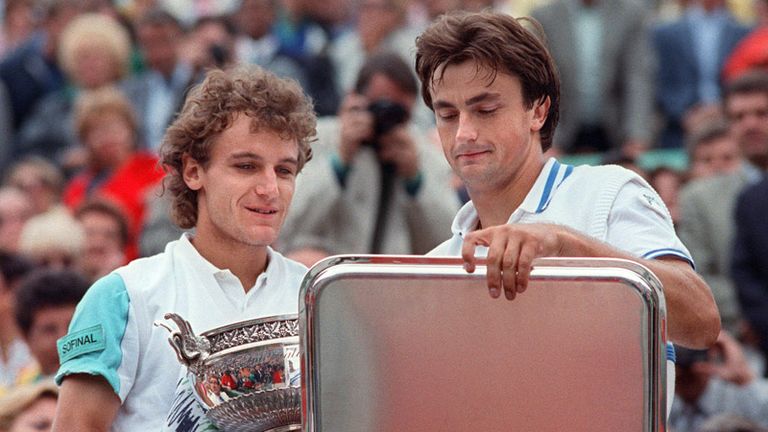
The stat reeled out most often about Wilander is that he won three of the four Grand Slams on offer in 1988, only missing out at Wimbledon. But perhaps the most remarkable aspect of Wilander's career was his win in Paris back in 1982. He arrived unseeded, but as the reigning junior champion some knew of his potential. What people didn't expect was him to become the youngest-ever Grand Slam winner (a record broken three years later by Boris Becker) with Ivan Lendl and Guillermo Vilas among his victims. Despite the final against Vilas featuring just four sets, with one of those being won 6-0, it remains the longest in the tournament's history at four hours and 42 minutes. Also won in the French in 1985.
Ivan Lendl
Lendl was never the most popular of players, but there is surely no doubting his claycourt pedigree. He dominated the French Open in the mid-80s, winning three titles in four years from 1984 to 1987. He may well have won more but famously opted to skip the event in 1990 to prepare for Wimbledon - the one Grand Slam which would elude him. His robotic nature mirrored Borg's professionalism but it was also an aspect which failed to endure him to the fans. Another was his constant tapping of his shoes. It was to clear the clay from his soles but he regularly carried on the routine on Wimbledon's grass too. Plenty of his critics were happy to see him beaten in Paris by a teenage Michael Chang in 1989, the American cracking Lendl's renowned focus with his famous underarm serve.
Sergi Bruguera
Some will argue his position among Spain's great dirtballers; others will argue he simply took advantage of a slip in standards. Jim Courier's best days were numbered, Pete Sampras was stifled by the clay, while Andre Agassi had yet to put his wild days behind him. But it's hard to argue with back-to-back French Open wins in 1993 and 1994, while Bruguera also made the final in 1997 after returning to the tour following a serious ankle injury. Hardly a spectacular player, what he did know was how to win on clay. Thirteen of his 14 ATP titles came on the surface.
Thomas Muster
With just one French Open title to his name, many of you will doubt Muster's credentials to appear on this list. Having won in Paris in 1995, the Austrian, one of the grittiest of players, looked set to rule the roost for years to come. He failed to do so, but his achievements on the rest of the ATP Tour merit at least some sort of mention. In 1995 Muster racked up a 65-2 win-loss record on clay - the sort of figures not even Rafael Nadal has managed in recent years. He backed that up with a 46-3 record the following season but suffered the most unlikely of defeats to Michael Stich at Roland Garros. He ended his career with 44 ATP titles, 40 of which were captured on clay. Despite his limited success on other surfaces, Muster did manage to reach the world number one spot - something that riled the tennis purists.
Gustavo Kuerten
Arguably the most popular of champions at Roland Garros. He was simply loved by the Parisien crowd. The feeling was mutual. A memorable image of Kuerten's Roland Garros reign was him drawing a heart in the clay to symbolise his love for the tournament and its fans. Like Wilander 15 years before, Kuerten's first win of three came when he was unseeded in 1997. Ranked just 66 in the world at the time, he took out three former champions (Muster, Yevgeny Kafelnikov and Bruguera) en route to the title. After winning again in 2000, the third of his triumphs came after he saved match point on a bad day at the office against little-known American Michael Russell in the last 16. It's widely regarded that he would have added more titles but for hip surgery which meant he was never the same player. Finally opted for retirement in 2008. It was no surprise he chose Roland Garros for his last-ever match.