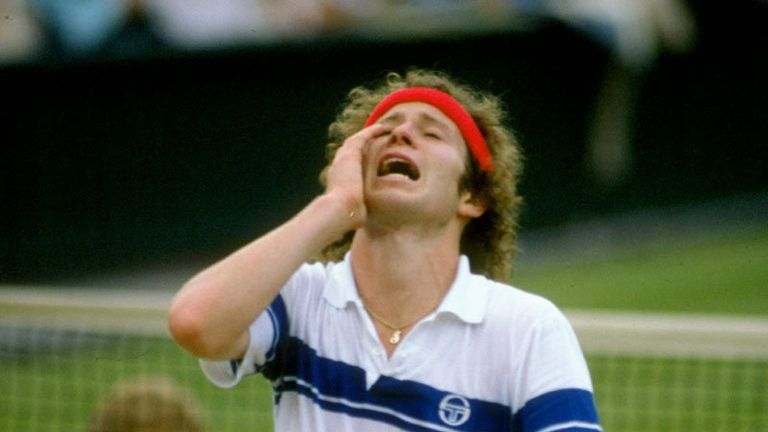
McEnroe, Tarango, Safin, Henman...all the tennis bad boys have boiled over when the going has got tough.
A look back at Wimbledon hot-heads down the years
McEnroe, Tarango, Safin, even Henman...all the tennis bad boys have boiled over when the going has got tough.
Andy Clarke takes a look at those whose tempers have frayed in the heat of competition.
Tim Henman
Where else to start but with the meanest, baddest, nastiest of them all? In 1995, the renowned hot-head Tim Henman set the angry tone for the rest for his career when he became the first player ever to be disqualified from the tournament. The young Henman thrashed a ball at a ball girl in a fit of pique during a doubles match, striking her on the head. It's been one tantrum after another ever since.
Jeff Tarango
Moving swiftly on to a genuine firebrand, a man who could make John McEnroe blush. Jeff Tarango didn't wait to be thrown out of the 1995 tournament, he packed his bags and left after he felt that one decision too many had gone against him. "That's it, I'm not playing," Tarango stormed after umpire Bruno Rebeuh called one of his serves out. "You're one of the most corrupt officials in the game and you cannot get away with this." Not to be outdone, Tarango's wife Benedicte later slapped the hapless umpire twice in the face. Tarango was banned for two Grand Slam events including the next year's Wimbledon, and fined $63,000.
John McEnroe
Tarango learned and fine-tuned everything he knew from the father of the on-court outburst. The 1981 tournament saw McEnroe labelled 'SuperBrat' by the British media for his run-ins with umpires, including the repeated use of the now famous "You cannot be serious." McEnroe also called umpire Ted James 'the pits of the world' during a second-round match with Tom Gullikson, an insult which almost led to him being thrown out of the tournament years before Henman set that particular trend. Instead he was fined $1,500 and went on to win the title, stopping Bjorn Borg's bid for six successive wins in perhaps the best ever final. Yet even now, he's perhaps better remembered for the ranting.
Greg Rusedski
The Brits may be a little too mild-mannered and lack the edge that turns good players into great ones, but they know how to book their place in a light-hearted, pre-tournament hall of fame. Greg Rusedski must have been one of the most harmless men on the circuit, but that didn't stop him lashing out during his second-round defeat to Andy Roddick in 2003. Many a spaghetti hoop was spilt as the children's tea-time telly audience watched in shock. Rusedski's 'audible obscenity' - after he mistook a shout from the crowd for a dodgy line-call - cost him £1,500 and a tiny fraction of his good-guy image.
Marat Safin
Safin is another who, on closer inspection, doesn't belong in such illustrious umpire-abusing, line-call disputing company as McEnroe and Tarango. Yet the gifted Russian is overly fond of smashing a racquet or two and is outspoken in his dislike of the grass of the All England Club. "I give up on Wimbledon," said Safin after his first-round defeat to Dmitry Tursunov in 2004. "It is definitely not the tournament for me. I give up on spending time on these courts. I give up on practising before the tournament."
Martina Navratilova
Just as McEnroe was the father of the tantrum, Monica Seles was the mother of the grunt. Oft-copied but rarely bettered (although Maria Sharapova is said to be louder, if you'd care to think about that for a moment) the teenaged Seles screeched and squealed her way to the final in 1992, upsetting many along the way. Nathalie Tauziat was the first to complain before Navratilova was dragged into the dispute after her semi-final defeat. "Well, it just gets louder and louder. You cannot hear the ball being hit," said the nine-time champion. "Her argument is she is not doing it on purpose. But she can stop it on purpose, you know." Asked why she had not complained after her previous 11 meetings with Seles, she stormed: "Am I on trial here or is her grunting on trial?"
Andre Agassi
How times change. "This isn't tennis," fumed 17-year-old Andre Agassi after his first-round defeat to Henri Leconte in 1987, in which he won just four games. Increasingly image conscious, and fearful of grass, Agassi skipped the next three years. He returned in 1991, mullet reined in somewhat, outrageous clothing whitened, and reached the quarter-finals and so began his love affair with SW19. He became a champion in 1992 and made his final appearance in 2006. "It's been a privilege to be out there again for one last time," he said.
Goran Ivanisevic
Arguably the greatest fit of pique to 'grace' a Wimbledon final came in 2001 when the genial Croat suddenly lost it. Two sets to one up on Pat Rafter, Ivanisevic was seeing the match slip away as his errors handed the Aussie the fourth set. Never a player to keep a cool head, Ivanisevic kicked the net (not that it could fight back), smashed his racquet into the famous turf and blurted out expletives at the umpire. Amazingly Goran managed to calm down and fought back to win a thrilling contest, but you feel it just wouldn't have been the same without this near meltdown.
The field
Perhaps the greatest Wimbledon strop belongs to the players who simply didn't turn up in 1973. A stand-off broke out between the International Lawn Tennis Federation and the newly-formed players' union, the Association of Tennis Professionals (ATP). A power struggle had been ongoing and the straw that broke the camel's back was the suspension of leading player Nikki Pilic, who - the ITLF claimed - had refused to play in a Davis Cup tie. His fellow players were prepared to back him up and after a High Court move to have Pilic's ban lifted was thrown out, a total of 79 players refused to play, including 13 of the original 16 seeds.