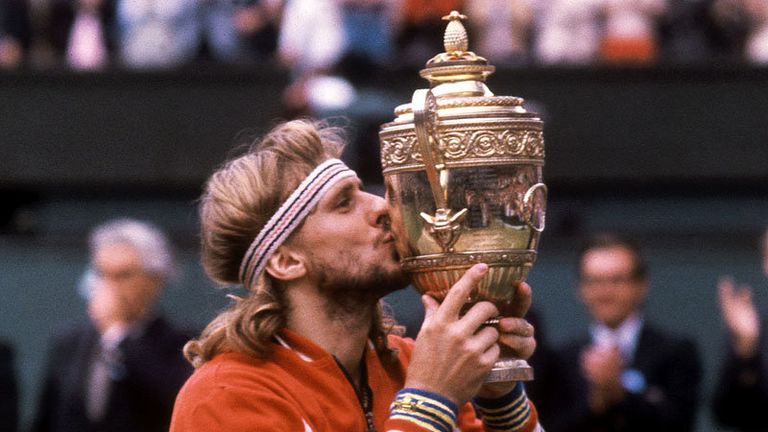
The Wimbledon Championships have come a long way from their humble beginnings in 1877.
From its humble beginnings in 1877, when 22 men competed for the inaugural gentleman's singles title, Wimbledon has grown into one of the most celebrated sporting events in the world, watched by a global audience of billions.
The first champion, Spencer Gore, received 12 guineas for his triumph in a final which spectators paid one shilling to watch.
It was seven years before the ladies' singles was introduced, with Maud Watson emerging successful from a field of only 13 competitors.
Also in 1884, the gentlemen's doubles began and as the popularity of Wimbledon increased, facilities for spectators improved.
Permanent stands were erected as crowds flocked to see the prowess of British twins, Ernest and William Renshaw, who separately and as doubles partners won 13 titles between 1881 and 1889.
British dominance ends
The home domination of the championships continued beyond the turn of the century, until American Mary Sutton became the first overseas winner in 1905.
She repeated her success in 1907, the year Norman Brookes of Australia became the first men's champion from overseas.
Play was suspended during World War One and moved to a new venue at Church Road in 1922 after efforts to extend the old grounds had failed.
The Centre Court was designed with seating for 9,989 people with standing room for 3,600, a move which helped popularise the game enormously.
By 1924 the old number one court had been opened and the following year a qualifying competition for the championships was necessary for the first time.
In 1927 over 22,000 spectators attended on the first Saturday of the championships with 2,000 more turned away.
Four Musketeers
French players were hugely successful in the 20s, with Suzanne Lenglen reigning supreme in the ladies' singles and the 'Four Musketeers' - Jean Borotra, Jacques Brugnon, Henri Cochet and Rene Lacoste - winning six singles and five doubles titles between them.
A landmark was achieved in the championships of 1930 when Brame Hillyard became the first man to play wearing shorts. That was on court 10, and Bunny Austin was the first to do so on Centre Court three years later.
The last golden era of British tennis followed in the mid-to-late 30s when 11 titles were claimed, including three successive gentlemen's singles titles for Fred Perry and two by Dorothy Round.
World War Two bomb damage, which resulted in the loss of 1,200 Centre Court seats, was repaired in time for the 1949 championships. In the post-war era, it was the Americans who emerged as the major force, with Althea Gibson the first black winner in 1957.
From 1956 until the early 1970s, the gentlemen's singles title was virtually the property of Australia and Lew Hoad, Neale Fraser, Rod Laver, Roy Emerson and John Newcombe became household names.
The sequence of American wins in the ladies' singles was not broken until 1959 when Maria Bueno of Brazil triumphed.
Australian takeover
In the 1960s, Margaret Smith became the first Australian to win the event, while Angela Mortimer and Ann Jones won for Great Britain.
At this stage players were still officially amateurs but were increasingly branded "shamateurs" for receiving financial assistance well in excess of the amounts allowed by the International Tennis Federation (ITF).
The All-England Club proposed in 1959 that the championships be made open to all players but the move was rejected by both the ITF and the Lawn Tennis Association.
In 1967 however an