
Smashing Sehwag
Wednesday 2 April 2008 09:51, UK
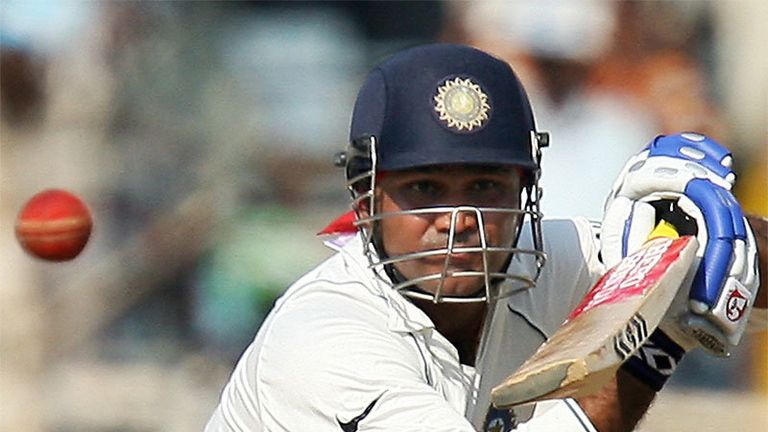
One man in particular dominates Benedict Bermange's cricket statistics column this week...
Sky Sports' cricket stats man Benedict Bermange has teamed up with skysports.com to bring you statistical highlights from our cricket coverage of the past week. The glorious game will be brought to you in numbers every week as Benedict unearths relevant historical facts that have arisen from the past seven days in the world of cricket. He will also be on hand to answer your statistical cricketing questions, be it about an existing record, player, team, ground, umpire, laws of the game or whatever your query may be. If something has been puzzling you, or you have come across a fact or stat during Sky Sports' cricket coverage that you must have verified to cure your insanity, then ask Benedict. Or maybe if you have been stumped by a quiz question down the local, just email Benedict here or fill out the comment form at the bottom of the page and he will answer your questions.Virender Sehwag
In the course of his Indian-record innings of 319, Virender Sehwag became only the third player to achieve the feat of two Test triple-hundreds, alongside Australian Don Bradman and West Indies' Brian Lara. He scored the third fastest double hundred in terms of balls faced (194) in Test history - the top two being New Zealand's Nathan Astle (153 balls) against England at Christchurch in 2001-02 and Sehwag himself (182-balls) against Pakistan at Lahore in 2005-06. Not content with that, he then reached the fastest Test triple-hundred in history, reaching the landmark from just 278 balls, surpassing Matthew Hayden's triple-ton from 362 balls against Zimbabwe at Perth in 2003/04. It took Sehwag 481 minutes to get to 300, but England's Wally Hammond reached 300 in only 288 minutes against New Zealand in Auckland in 1932-33, but there isn't an accurate account of how many balls Hammond faced. Sehwag scored 257 runs on the third day; only four batsmen in history have scored more runs in a day of Test cricket:| NAME | RUNS IN A DAY | MATCH | VENUE | DATE |
| Donald Bradman | 309 | Australia v England | Leeds | 11/07/1930 |
| Wally Hammond | 295 | England v New Zealand | Auckland | 31/03/1933 |
| Denis Compton | 273 | England v Pakistan | Nottingham | 01/07/1954 |
| Donald Bradman | 271 | Australia v England | Leeds | 20/07/1934 |
2nd Wicket Partnership: 266, PE Richardson (126)/TW Graveney (258)
3rd Wicket Partnership: 307, TW Graveney (258)/PBH May (104) Match: Zim v Pak, Harare, 1994-95
4th Wicket Partnership: 269, GW Flower (201*)/A Flower (156)
5th Wicket Partnership: 233*, GW Flower (201*)/GJ Whittall (113*) Match: Ind v SA, Chennai, 2007-08
1st Wicket Partnership: 213, W Jaffer (73)/V Sehwag (319)
2nd Wicket Partnership: 268, V Sehwag (319)/RS Dravid (111)
Runs on the board
Rahul Dravid become the sixth batsman (and third Indian) in Test history to break the 10,000-run barrier. He reached the landmark with a clip towards midwicket off Morne Morkel when he went from 79 to 80. India's total of 627 also set a little-noticed record: It is the highest total in Test history in which three batsmen have been dismissed for ducks (Sachin Tendulkar, Harbhajan Singh and RP Singh). The previous record had stood since February 1912 when England were all out for 589 against Australia at Melbourne, with Jack Hearne, Johnny Douglas and Sydney Barnes not troubling the scorers. Despite giving up the highest total they have ever conceded to India, South Africa themselves managed to score 871 runs in the match, the second-most by a visiting team in India, behind Zimbabwe's 885 (382 and 503/6) at Nagpur in November 2000.Benedict's bumpers
Paul Harris took 3 for 203 in India's first innings, he is only the second South African bowler to concede more than 200 in a Test innings; and the other one was a slow left-armer too: Nicky Boje, who had figures of 0 for 221 against Sri Lanka in Colombo in 2006Firsts
Providence Stadium in Guyana became the 97th ground to host a Test match, and it saw Sri Lanka's first win in the Caribbean at their fifth attempt. However, it saw an unhappy start to Sulieman Benn's Test career. He conceded 120 runs without taking a wicket in Sri Lanka's first innings, only three bowlers in Test history have had worse starts to their careers:| NAME | FIGURES | MATCH | VENUE | YEAR |
| JJ Warr | 0-142 | England v Australia | Sydney | 1951 |
| Tawanda Mupariwa | 0-136 | Zimbabwe v Sri Lanka | Bulawayo | 2004 |
| Bapu Nadkarni | 0-132 | India v New Zealand | Delhi | 1955 |
Benedict answers your questions...
Has any test cricketer captained his side on debut? Also... In English first class cricket who should be Vaughan's Test replacement if he was to be dropped based on batting average? Cheers Jack Backler BENEDICT REPLIES: If you exclude a country's inaugural Test match, this has happened 23 times now, most of them in the early days of Test cricket when it was not unusual for England (especially) to venture overseas with an untried amateur captain. But it has been a rarity since the Second World War. There are only four instances since then, three of them by England: George Mann against South Africa at Durban in 1948, Nigel Howard against India at Delhi in 1951, and Tony Lewis against India, also at Delhi, in 1972. The most recent instance was when Lee Germon captained New Zealand on his Test debut, against India at Bangalore in 1995. As for a replacement for Michael Vaughan, the leading English-qualified run-scorers in first-class cricket last season were as follows: Mark Ramprakash (2026), David Sales (1384), Marcus Trescothick (1343, but retired from international cricket), Mark Wagh (1310), and Stuart Law (1277). Robert Key scored 1250 runs in first-class cricket last year. Benedict. Has anyone ever made 100 in their first ever Test match and then been dropped? Similarly, has anyone ever taken 10 wickets in their first match and been dropped for the next one? Cheers Daryl Godbold. BENEDICT REPLIES: Seven players scored a century on their Test debut and then were not picked for the next. Spare a thought for Andy Ganteaume and Rodney Redmond, who never played another Test.| NAME | MATCH | VENUE | YEAR |
| Roger Hartigan | Aus v Eng | Adelaide | 1907-08 |
| Billy Griffith | Eng v WI | Port-of-Spain | 1947-48 |
| Andy Ganteaume | WI v Eng | Port-of-Spain | 1947-48 |
| Arthur Milton | Eng v NZ | Leeds | 1958 |
| Khalid Ibadullah | Pak v Aus | Karachi | 1964-65 |
| Rodney Redmond | NZ v Pak | Auckland | 1972-73 |
| Dirk Wellham | Aus v Eng | The Oval | 1981 |
| NAME | MATCH | VENUE | YEAR |
| Fred Martin | Eng v Aus | The Oval | 1890 |
| Clarrie Grimmett | Aus v Eng | Sydney | 1924-25 |
| Charles Marriott | Eng v WI | The Oval | 1933 |
| Sydney Burke | SA v NZ | Cape Town | 1961-62 |
| Hines Johnson | WI v Eng | Kingston | 1947-48 |
% times the captain winning the toss has batted first and won;
% times the captain winning the toss has batted first and lost;
% times the captain winning the toss has bowled first and won;
% times the captain winning the toss has bowled first and lost.
Many thanks, Peter Grey. BENEDICT REPLIES: Of course I have those stats - here you go Peter:
% times the captain winning the toss has batted first and won: 34%
% times the captain winning the toss has batted first and lost: 31%
% times the captain winning the toss has bowled first and won: 36%
% times the captain winning the toss has bowled first and lost: 30%
So, in conclusion, on winning the toss and bowling the captain has a slightly better record than batting regarding winning Tests. Benedict, How many one cap wonders has there been for England and who? Wayne Taylor. BENEDICT REPLIES: A total of 87 men have played a solitary Test Match for England. The entire list is too long for here, but the last five are: Jon Lewis, Ian Blackwell, Kabir Ali, Gavin Hamilton and Mike Smith. New England Selector James Whitaker is a member of this exclusive club as is Ryan Sidebottom's father Arnie. Hello Benedict, A question arose after NZ scored 430+ in the fourth innings of a test match: what is the highest scores for a team batting fourth to lose a Test match or gain a draw. And the Test matches they were in? Regards, Ray Edgington BENEDICT REPLIES: The highest score in the fourth innings of a Test to draw is England's 654-5 against South Africa at Durban in March 1939. They were chasing 696 to win but the match had to be abandoned on the 10th day as the England team had to catch their departing ship from Cape Town. The highest score in the fourth innings of a Test to lose is indeed held by New Zealand - they made 451 in the famous Christchurch Test of 2002 when Nathan Astle hit 222. The 431 they managed this year at Napier is the fourth-highest fourth innings total to lose. Email Benedict here or fill out the comment form at the bottom of the page and he will answer your questions.