Geraint Hughes
Sports News Correspondent
Dave Ryding: Britain's most successful alpine skier set for Olympic farewell
Five-time Olympian Dave Ryding is set to say his Olympic farewell; 'The Rocket' has won seven World Cup medals and famously won at Kitzbuhel in 2022; he is Britain's most successful alpine skier
Last Updated: 16/02/26 7:50am
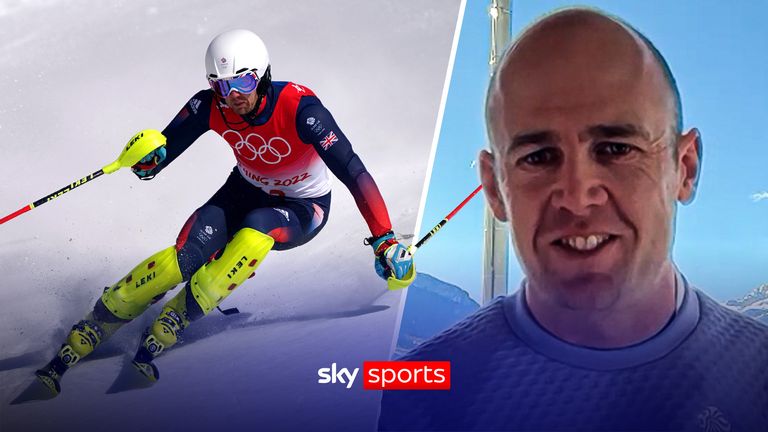
He's called 'The Rocket'. Dave Ryding has changed attitudes; the attitudes of the winter sport giants who thought any British alpine skier would be a bit of a joke.
Yes, there have been some excellent skiers in the past, but perhaps after fleetingly mixing it at the top, a consistent British challenge to the world's best was tending to fade away. Until the Rocket came along.
He is the most successful British skier of all time, winning seven medals on the World Cup circuit with perhaps his greatest moment coming at one of the most challenging and prestigious runs in his sport - he won at Kitzbühel in 2022, the first victory for any British skier at that level.
- Winter Olympics 2026: Key info, GB medal hopes, world stars and more
- Not got Sky? Get Sky Sports or stream contract-free on NOW
- Choose the Sky Sports push notifications you want
His longevity is unrivalled, he's 39 and will at some point this season, maybe after he's completed his Olympics, call time on his 17-year career. He has the respect and friendship of the top European skiing nations as well those from North America. He's in their club because he's earned it.
His beginnings - as you would expect for most British skiers - are a bit different from those who grew up in the Alps and were on skis from the age of 18 months.
Ryding first skied when eight years old at Pendle Ski Club in the Ribble Valley - it was a dry ski slope. Dry ski slopes are interesting, especially those from 30 years ago. It is a starting point for skiing in the UK as, bar Scotland, snow to ski on is at a premium.
However, it is quite a different feel compared with snow… and if you fall you can get some seriously painful friction burns!
Ryding first skied on snow when he was 12 and now here at the Olympics 27 years later he'll make his fifth and final appearance at an Olympic Games, but despite that he's targeting a best Olympic finish.
"I didn't really feel like I'd given a true reflection of myself at some of the major events, whether that was World Championships or Olympics so the one thing I said to myself two years ago was, 'right, the next two years is about doing the best performance you've ever done' at the World Championships and I did that last year. And then Olympics this year. So that's exactly where my mindset is.
"My best in the Olympics is ninth which isn't bad , it is like getting to a 100m final so it's a very respectable result.
"But over my career obviously with 30-odd top 10's and seven podiums and a win, I did feel like I could do a better reflection of myself than the ninth.
"That is why I am here to finish my career, even at my age, with my best performance in an Olympic Games."
Slalom is Ryding's specialty, it's not a 95mph dash straight down a mountain, but instead a very technical event with lots of twists and turns - a nightmare on the knees - where one of the key metrics is NOT to lose speed twisting and turning.
Keep that pace up and you always stand a chance. The 2026 Olympic course is run at Bormio. "The best thing you can describe Bormio is, with all respect to the course, it's a much more mellow piece than what you're used to on the World Cup.
"More than anything it's going to throw the door wide open to some unexpected names being right up there.
"I've worked a lot over the last few days about the high-speed skiing and how I ski on the flats because on the World Cup it's a bit different. It's very much about getting myself used to high-speed ski racing again in Slalom.

"It's always been a bit of a strength of mine in generating speed on flats and really moving my body in a way like I learnt on the dry slopes so I think if I'm in the right mindset that's going to be the most important to go all in.
"I'm going to have to accept consequences, because if I don't go all in, then that's where you lose time on the flats. You have to commit 100 per cent to the speed. Get in the right mindset and just go for it!"
Like we have found out about skiers at these Olympics, they're fearless and prepared to take risks. Lindsey Vonn is proof of that. First she ruptures her ACL, then she decides to race anyway and suffers an horrific crash and badly breaks her leg where four operations later she may be able to leave Italy to only return to the USA for further surgery.
While Ryding doesn't get up to speeds of over 90mph, he's pushing 35-40mph while constantly twisting and turning: "If you do crash then the consequences are definitely less than downhill.
"Obviously, people do get injured and the twisting of the knees, etc. It happens in all disciplines but yeah it's sport in general, you know, whether you're a MotoGP rider clinging on to an engine doing 300km an hour or an alpine skier. It's just what you have grown up with.
"Obviously when you're younger it's on your mind less, as you get older and like with anyone your fear factor is through the roof.
"When you get more experienced and older then that definitely naturally [rises] and that's one of the gremlins that you've got to fight and knowing how to do that is a big part of being a top ski racer."