Most iconic NBA numbers: #34 – Bill Russell and Julius Erving
Saturday 30 May 2020 08:23, UK
Thanks to the achievements of the players who wore them, certain NBA jersey numbers have become synonymous with championship wins, MVP victories and spectacular scoring feats.
With the 2019-20 NBA season on hold for the foreseeable future, it is an opportune moment to explore a selection of the NBA's most iconic numbers.
In the latest feature in our series, we take a look at two of the NBA's most iconic players who wore No 6.
Bill Russell
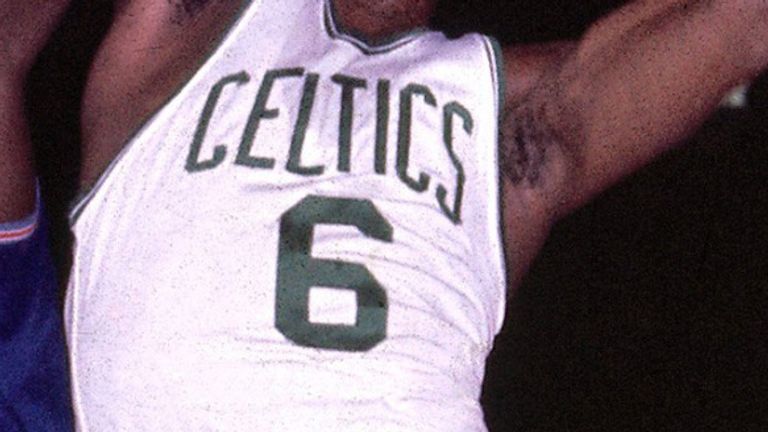
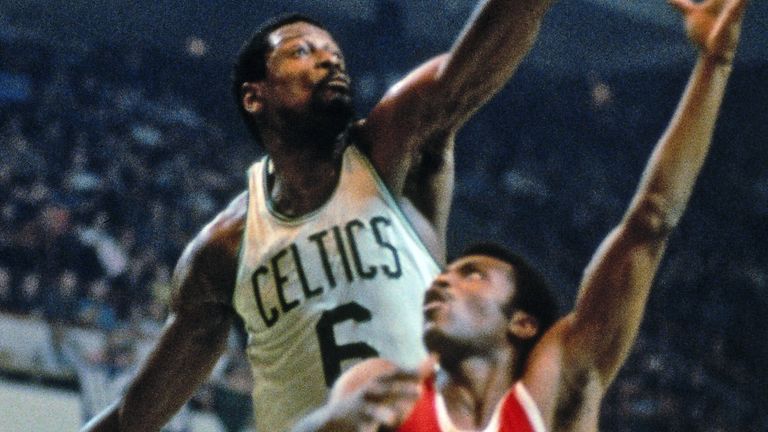
LeBron James won two NBA championships wearing No 6 during his 2010-14 stint with the Miami Heat but that notable achievement is dwarfed by the 11 titles won by Russell as the cornerstone of the Boston Celtics' dynasty of the 1960s.
A five-time NBA Most Valuable Player and a 12-time All-Star, Russell amassed 21,620 career rebounds (an average of 22.5 per game). His uncanny shot-blocking ability revolutionized NBA defensive concepts. Stats don't illustrate Russell's impact on the game. Blocked shots were not an official statistic until 1973-74, and the league only recorded total rebounds, without distinguishing between offensive and defensive boards until that same season.
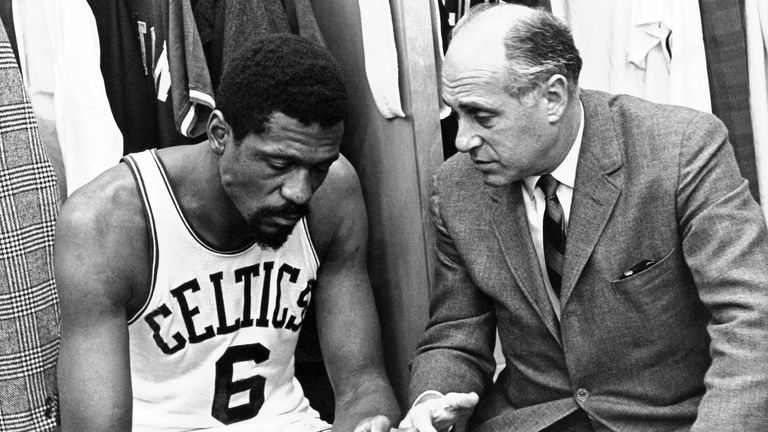
Russell's many individual accolades were well deserved, but they were only products of Russell's philosophy of team play. His greatest accomplishment was bringing the Celtics 11 championships in his 13 seasons. His last two titles in that span came as a player-coach after Red Auerbach retired before the start of the 1966-67 season.
Russell captured his first NBA title in 1956-57, his first season in the league. The Celtics outlasted the St Louis Hawks in a seven-game Finals series. He won his first Most Valuable Player award the following season. He was also known for extending his effort at critical moments, both within a game and within a season. Consequently, he typically improved his rebounding numbers during the playoffs, and in the 1959 postseason, he pulled down 27.7 boards per game as the Celtics regained the NBA title.
Wilt Chamberlain, Russell's greatest adversary, entered the NBA and joined the Philadelphia Warriors for the 1959-60 season, setting up a decade-long rivalry. Chamberlain put up incredible numbers during the period in which the two went head to head, but Russell helped the Celtics hang nine NBA championship flags in the Garden in his first 10 seasons, often at the expense of Wilt's teams.
After the Celtics' eighth straight NBA championship win in 1966, Auerbach retired. Russell took over as player-coach, becoming the NBA's first African-American coach. He led Boston to a 60-21 regular-season record, but the Celtics finally had their string of championships snapped when they lost to a powerful Philadelphia 76ers team in the playoffs.

Boston returned to form in 1967-68, recapturing the championship under Russell's direction. In the Eastern Division finals, the club came back from a two-game deficit to force a seventh game with Chamberlain and the 76ers. The Celtics were leading 97-95 with 34 seconds left when Russell took over. He sank a foul shot, blocked a shot by Walker, grabbed a rebound off a Greer miss, and fed the ball to Jones, who made the final basket in a 100-96 triumph. Boston then beat Los Angeles in six games in the NBA Finals.
The 1968-69 season was even more gratifying. The aging Celtics barely made it into the playoffs with a 48-34 record, then caught fire in the postseason. In Russell's third year as player-coach, Boston repeated as NBA champions by defeating the Lakers, who had acquired Chamberlain, in a seven-game battle for the title. The great Celtics leader promptly retired.
Russell remains the greatest winner in NBA history. Until the ascent of Michael Jordan in the 1980s, he was acclaimed by many as the league's greatest ever player. That status is underscored by his strict adherence to team basketball and devotion to the success of his team-mates.
As Russell once wrote: "To me, one of the most beautiful things to see is a group of men coordinating their efforts toward a common goal, alternately subordinating and asserting themselves to achieve real teamwork in action. I tried to do that, we all tried to do that, on the Celtics. I think we succeeded."
Julius Erving
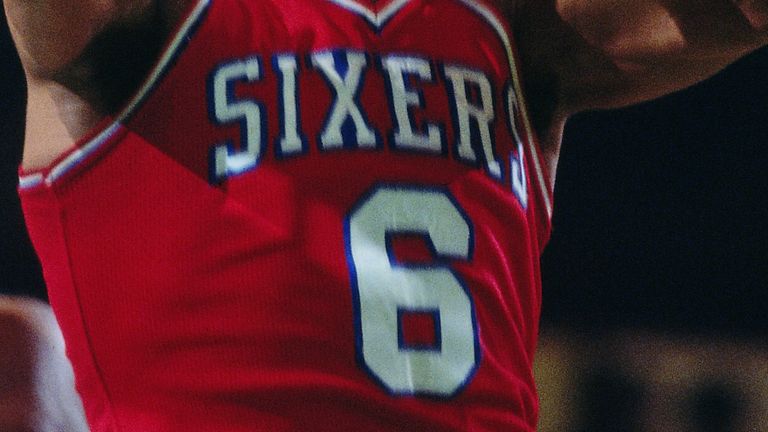
Julius Erving, universally known as 'Dr J', was an innovator who changed the way the game was played. He was a wizard with the ball, performing feats never before seen: mid-air spins and whirls punctuated by powerful slam dunks. He was one of the first players to make individual expression an integral part of the game, setting the style of play that would prevail in the decades to follow.
Erving began his professional career in the American Basketball Association (ABA) with the Virginia Squires and the New York Nets. The 6ft 7in, 210lb small forward also played for 11 years with the Philadelphia 76ers, leading them to the NBA title in 1983.
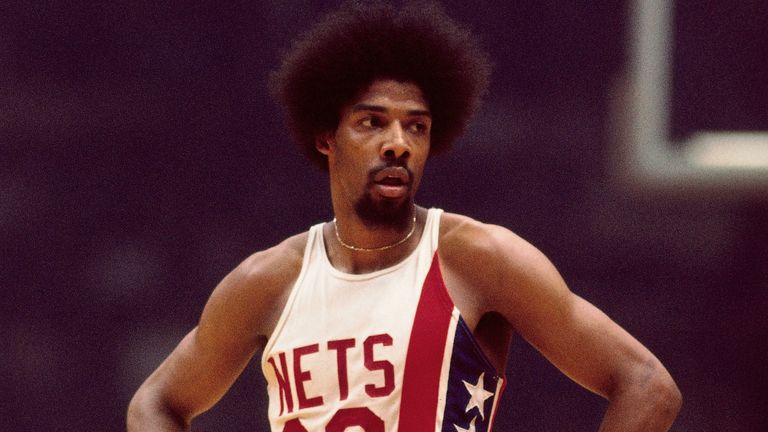
In his five ABA seasons, Erving won three scoring titles, three Most Valuable Player awards and two championships. During his 11-year NBA career, Erving was an All-Star each season, the MVP in 1981 and a five-time member of the All-NBA first team. He scored 30,026 points in his combined ABA and NBA career; only Kareem Abdul-Jabbar, Wilt Chamberlain, Karl Malone, Michael Jordan, Kobe Bryant, LeBron James and Dirk Nowitzki have scored more points in the history of professional basketball.
Widely regarded as the greatest player of his time, Erving is often considered to have been the main catalyst for the ABA-NBA merger.
By 1975-76, a handful of ABA teams had folded but Erving ensured the league went out with flair. At midseason, they unveiled the first All-Star Game Slam Dunk Championship. Erving out-jammed Artis Gilmore, George Gervin and David Thompson for the title with an iconic slam from the free-throw line.
The ABA era was over, with the Nets one of four teams absorbed into the NBA. On the eve of the 1976-77 NBA campaign, Erving was locked in a salary dispute with his team. When it couldn't be resolved, New York sold him for $3m to the Philadelphia 76ers only 24 hours before the start of the season.
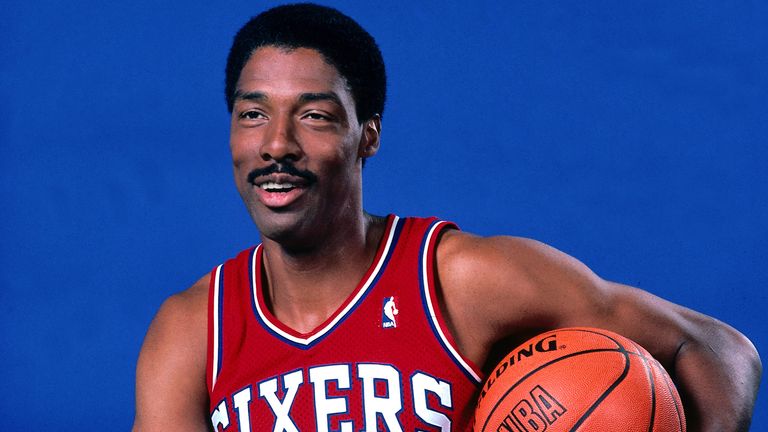
Erving made his mark at the 1977 NBA All-Star Game, displaying the artistry that had made him the most exciting player in the ABA. He scored 30 points, grabbed 12 boards, recorded four steals and walked off with the MVP trophy.
As the Sixers began to build a team around him, Erving established himself as a permanent fixture on the All-NBA first team. He led his team to the 1980 NBA Finals and was spectacular as the teams split the first four games. In Game 4, Erving made the legendary 'Baseline Move' that would go down as one of the most spectacular shots in NBA history.
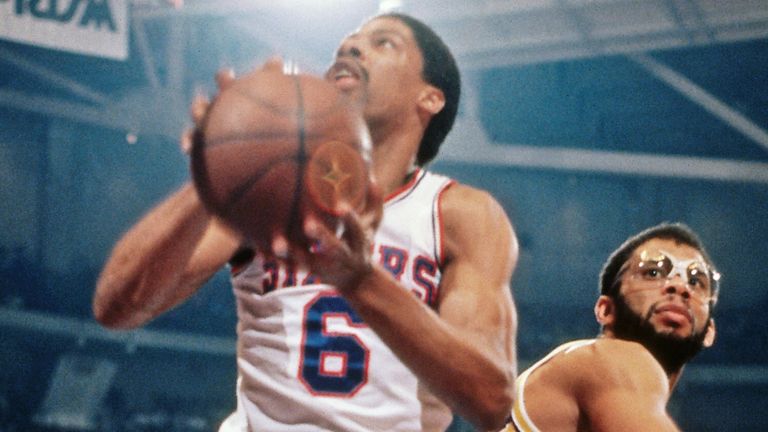
The Lakers had the final say. They won Game 5 at home and then, with the rookie Magic Johnson filling in at center for the injured Abdul-Jabbar and scoring 42 points, won Game 6 in Philly seal the title.
The 1980-81 season was Erving's greatest individual year. He was named MVP after scoring 24.6 points per game while chalking up career highs with 364 assists and 173 steals. Philadelphia fell to the Celtics after giving up a 3-1 lead in the Eastern Conference Finals. They avenged that loss 12 months later but could not overcome the Lakers in the 1982 Finals.
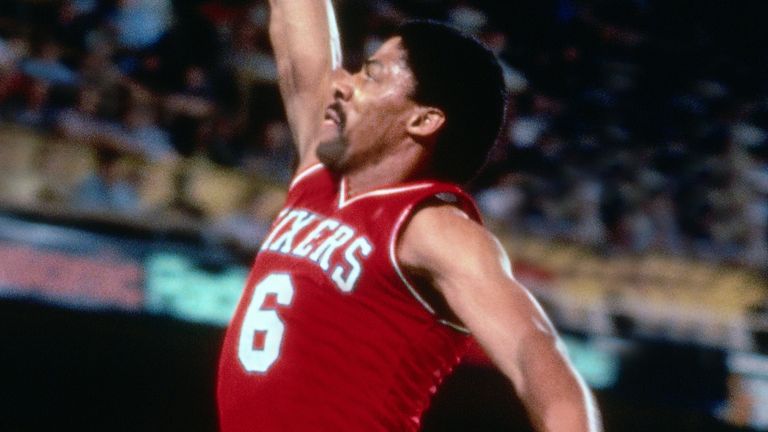
Philadelphia lacked one important piece to complete the championship puzzle, a dominant center to combat Abdul-Jabbar. They got what they needed in the form of Moses Malone in a trade with the Houston Rockets.
The Sixers went 65-17 in the 1982-83 regular season, behind 24.5 PPG from Malone and 21.4 PPG from Erving. Both players were named to the All-NBA first team and Malone won his second MVP. But Philadelphia won with its depth, surrounding the two superstars with Maurice Cheeks, Andrew Toney and Bobby Jones.
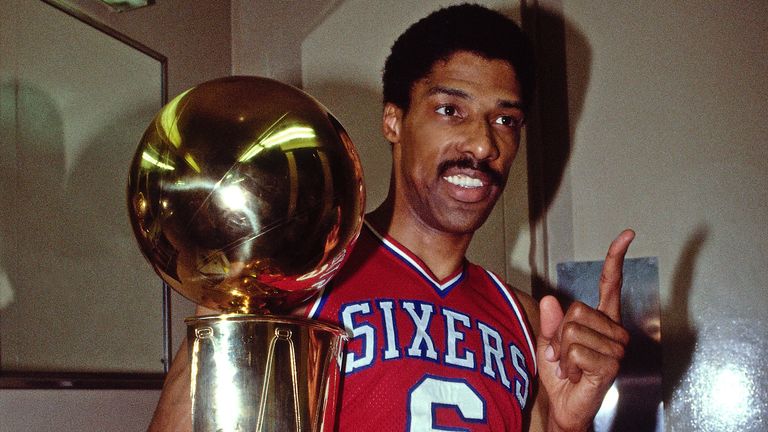
The Sixers ripped through the 1983 playoffs, winning eight of their first nine playoff games as they returned to the Finals. Their third meeting with the Lakers lacked the drama of the previous two as the Sixers won in four straight games, giving Erving his first (and only) NBA championship ring.
After the championship season, Erving was in the golden years of his career. He still played well but relied more on intelligence than on the raw physical skills that had been his trademark. In the 1984 All-Star Game, the kind of exhibition in which he could still showcase his skills, he erupted for 34 points.
After Erving announced that he would retire following the 1986-87 season, the campaign turned into the Dr J farewell tour. He was honoured in every NBA arena, as fans across the country showed their love and admiration for one of the greatest players the game had ever seen.