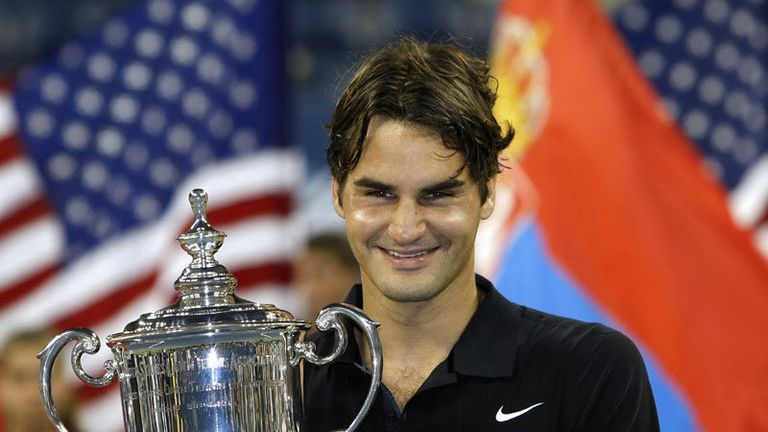
Roger Federer picked up three more Grand Slam titles, while Tim Henman and Martina Hingis called it a day.
A look back at another year of Federer domination
The year in pictures
Another year has passed by, but Roger Federer remains the dominant force in men's tennis, despite a strong challenge from Rafael Nadal and the emergence of Novak Djokovic.
The Swiss star reached 200 weeks as the world number one, collecting eight titles including three Grand Slam successes which take his haul to 12 for his career.
Federer's victory over Nadal in a gripping five-set final at Wimbledon was easily the highlight of the year, earning the 26-year-old from Basle a fifth successive title at the All England Club and a place in history.
He had already collected his third Australian Open title in four years, beating Fernando Gonzalez in the final in Melbourne, and he went on to add a fourth straight US open crown together with a fourth Masters Cup.
Nadal the king of clay
Nadal was not entirely eclipsed by Federer, as he beat his great rival to win his third consecutive French Open title, underlining his status as the world's greatest exponent of the clay-court game.
However, the gap between the two men on clay appears to be closing, with Federer earning his first career win over Nadal on the Spaniard's favoured surface in the final of the Hamburg Open.
It was in Hamburg that Andy Murray sustained the injury which wrecked what promised to be a productive summer.
The young Scot had already won his second career title in San Jose (the same venue where he picked up his first winner's cheque 12 months earlier) when he damaged his right wrist in Germany, forcing him to miss almost three months of competitive tennis including Roland Garros and Wimbledon.
After returning to the court in August, Murray almost forced his way into the top eight in the ATP Champions Race with some scintillating tennis.
He won the St Petersburg Open in October - his third career victory - but fell just short of gaining a place in Shanghai.
Murray ended his frustrating year by parting company with coach Brad Gilbert, after the pair's working relationship had become increasingly strained.
Djokovic breakthrough
While Murray's progress was kept in check by injury, Djokovic made the breakthrough by winning five titles and reaching his first Grand Slam final.
Although he was beaten by Federer at Flushing Meadows, the young Serb reached number three in the world - a position he does not look likely to relinquish in a hurry.
Djokovic's victory at the Montreal Masters was particularly impressive, as he beat the top three seeds - Andy Roddick, Nadal and Federer - to win the title.
Tim Henman began the year determined to improve his ranking, but after an increasingly frustrating battle against a troublesome back injury, he called time on his career in the autumn.
Fittingly, Henman's swansong was at Wimbledon, where he helped Great Britain to beat Israel in a Davis Cup tie to regain their place in the World Group.
Two months earlier he had left his mark on the Wimbledon Championships for the final time, winning one last epic duel against Carlos Moya before bowing out in the second round.
Williams sisters back on top
In the women's game, the Williams sisters gave a stark reminder of their fighting qualities with unlikely victories at the Australian Open and Wimbledon.
Serena was the winner in Melbourne, landing the title despite playing on three matches in the previous three months because of injury.
After Justine Henin had won a third straight French Open title, Venus Williams won the third Grand Slam of the year at Wimbledon.
In doing so, the American 23rd seed became the lowest-ranked winner of the women's singles at SW19, surpassing her own record at the event.
She beat Marion Bartoli in a one-sided final after the unfancied Frenchwoman had caused the shock of the tournament to knock out Henin.
Incredibly, that would prove to be Henin's last defeat of the year.
The Belgian world number one won her next 25 matches, landing the US Open and Sony-Ericsson Championship as well as titles in Toronto, Stuttgart and Zurich.
It was a remarkable end to a difficult year for 24-year-old Henin, who had withdrawn from the Australian Open in January following her divorce.
Stars call it quits
While 2007 was kind to Henin, it saw the retirement of two of the leading stars of the women's game in very different circumstances.
Troubled throughout her career by injury, Kim Clijsters her retirement at the age of just 23 in May, only three months after reaching the semi-finals of the Australian Open.
In November, Martina Hingis quit the sport with immediate effect after calling a news conference to reveal that she had tested positive for cocaine at Wimbledon.
Hingis, who won the 43rd and final title of her career in Tokyo in February, insisted that she had never taken drugs and intends to fight the accusations.
A year of scandal
The Swiss star's failed drugs test was not the only scandal to hit tennis in 2007, with accusations of match-fixing, while several players revealed they had been offered money for information about their fellow professionals.
Nikolay Davydenko, the Russian world number four, found himself at the centre of the controversy after irregular betting patterns were detected during his match against Martin Vassallo-Arguello in Poland.
Davydenko won the first set comfortably, yet his price lengthened on the betting exchanges before he retired hurt in the third set.
The Muscovite later came under the spotlight again when he was fined for not trying hard enough in a match against Marin Cilic in St Petersburg, although he denies any wrongdoing in each instance.
Investigations into betting in the sport continue, although two players were fined and banned for breaching rules on gambling.
Italy's Potito Starace and Daniele Bracciali were punished for betting on the outcome of matches, even though neither player was suspected of attempting to influence the results.