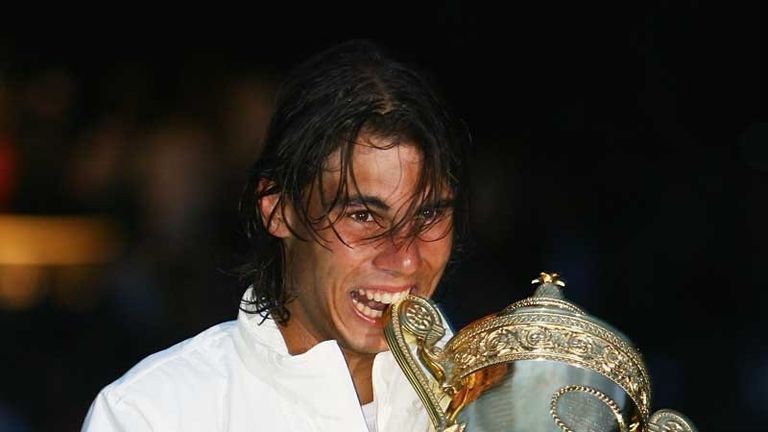
A vintage year was headlined by the exploits of Rafael Nadal, as well as Britain's Andy Murray.
Graeme Mair takes a look back at the last 12 months on the ATP Tour
A vintage year of men's tennis was headlined by the exploits of Rafael Nadal.
Nadal was almost unbeatable in the middle part of the season, bagging eight titles and deposing Roger Federer as world number one.
He became the first man for 28 years to win the French Open and Wimbledon in the same year, dispatching his great rival Federer in both finals.
Federer started the year as king of all he surveyed and finished it with a fifth straight US Open crown, but in between things did not follow the expected script.
Glandular fever proved the catalyst for his downfall and by mid-August the Swiss player had surrendered two of the things that had come to define him.
The loss of his Wimbledon title to Nadal was quickly followed by top spot in the rankings heading the same way.
A fit-again Federer re-stated his credentials with a 13th Grand Slam title at the US Open to move within one of Pete Sampras at the top of the all-time list.
But the presence of Nadal and a growing band of youthful challengers saw his days of dominance brought to an end.
From a British perspective it was all about the rise of Andy Murray in the second half of the season, the high point coming with a run to the US Open final.
He finished the year at number four in the world rankings - a position that represented the high water mark in the careers of both Tim Henman and Greg Rusedski - and heads into 2009 with high hopes of becoming the first British man to win a Grand Slam since Fred Perry.
Player of the year - Rafael Nadal
Hardly a difficult choice, Nadal was the dominant figure in men's tennis during 2008.
In addition to his usual clay court brilliance, he dethroned Roger Federer at Wimbledon and shortly afterwards claimed the number one ranking from his Swiss rival, something that had been unthinkable in previous years.
Fatigue and injury eventually caught up with him at the tail-end of a gruelling 11-month season, but the 22-year-old finished the year as the ATP Tour's undoubted number one.
Rising star - Jo-Wilfried Tsonga
The Frenchman announced his arrival at the top of the game by cutting a swathe through the draw to the final of the Australian Open in January.
He was beaten by Novak Djokovic in the final in Melbourne and further progress was initially stalled by a knee injury that required surgery and forced him to miss both the French Open and Wimbledon.
But he came on strong in the final months of the season with titles in Bangkok and Paris to finish the year at number six in the world rankings.
And the extravagantly gifted Tsonga should be able to use his strong finish to the season as a staging post for bigger things in 2009, providing his body holds up.
His serve, forehand, volleying and athleticism are all among the best in the game and, providing he stays injury free, looks to be a contender to gatecrash the cosy Nadal-Federer-Djokovic club at the top of the rankings.
It was a good year in general for the ATP Tour's rising stars. Tsonga was one of four young newcomers to the top 10 in the year-end rankings along with Andy Murray, Juan Martin del Potro and Gilles Simon.
Most improved - Andy Murray
Murray's year began with an early exit at the Australian Open, leading many to lose patience and write him off as soft and over-hyped.
But the Scot had worked hard to improve his physical conditioning and service since returning from a serious wrist injury and eventually reaped the rewards in the second half of the season.
The turning point came in his last 16 match at Wimbledon against Richard Gasquet when Murray overturned a two-set deficit to defeat the Frenchman 6-4 in the fifth.
He subsequently lost in the quarter-finals to Nadal but, once back on his favoured hard courts, Murray enjoyed a golden run that saw him shoot up to fourth in the world rankings.
Back-to-back Masters Series titles in Cincinnati and Madrid sandwiched a maiden Grand Slam final appearance at the US Open, where he demolished Nadal in the last four before losing to a resurgent Federer in the final.
Comeback - Roger Federer
Such was Federer's fall from grace that many had written off the Swiss player's chances when the US Open rolled around at the end of August, despite him arriving at the event as the four-time defending champion.
A bout of glandular fever had derailed Federer's early season and, as the surprise defeats started to mount, his cloak of invincibility was removed.
Younger rivals, chiefly Nadal and Djokovic, noted the vulnerability and ruthlessly exploited it, no doubt motivated by past defeats.
His slump reached a climax at the point of the season he usually enjoys most. Federer headed to Wimbledon off the back of a demoralising straight-sets thrashing at the hands of Nadal in the French Open final.
Worse followed in SW19, Federer lost an epic five-set final to Nadal to surrender his five-year unbeaten record at the tournament and, less than a month afterwards, had also lost top spot in the rankings.
Those who rushed to pen his career obituary probably should have known better as Federer - now restored to something approaching full health -produced an emphatic return to form to capture his fifth straight US Open crown.
The one wobble came in the last 16 where he needed five sets to see off Igor Andreev, but a comprehensive win over Djokovic in the last four was followed by a tennis lesson for Murray in the final.
Best performance - Nadal's deadly double
The Spaniard became the first man to win the French Open and Wimbledon titles in the same season since Bjorn Borg in 1980.
Nadal has been the outstanding clay court practitioner of his generation - arguably ever - since emerging on the scene as a muscle-bound 18-year-old in 2005.
He collected titles in Monte Carlo, Barcelona and Hamburg prior to a fourth consecutive triumph in Paris to maintain his unbeaten career record at Roland Garros. His solitary loss on the surface in 2008 came in the second round in Rome against compatriot Juan Carlos Ferrero.
In previous years Nadal's dominance had largely been confined to clay and, when the action returned to grass and hard courts, he had once again deferred to Roger Federer.
Not this year, however, as the 22-year-old proved he could transfer his success onto other surfaces.
The most spectacular example was on the Wimbledon grass but there were also hard court titles in Montreal and Beijing to prove his versatility now extends to all conditions.
From late April to early August Nadal compiled a 48-2 win-loss record on the ATP Tour and won eight titles, including two Grand Slams and an Olympic gold medal. His efforts also earned him the number one ranking for the first time.
Match of the year - Wimbledon final
The match of this or any other year came on one of the game's biggest stages - the men's singles final, Wimbledon centre court.
Federer was defending an unbeaten record at the venue stretching back through five years of utter dominance. His supremacy on grass went unchallenged and, until Nadal warmed to the task, looked unchallengeable.
Both men had negotiated their way to the final with great ease, Nadal dropping one set compared to Federer's unblemished progress.
Nadal powered into a two-set lead, 6-4 6-4, and at that stage looked set to inflict another straight-sets blowout on his great rival, a month after an embarrassingly one-sided win in the French Open final.
But Federer inched his way back from the brink, ekeing out the third set in a tie-break and then - after falling 5-2 behind and saving two championship points - levelling matters at two sets apiece in another breaker.
With the match locked at 2-2 in the decider, a half-hour rain delay - the second of the contest - added to the tension and, with the light starting to fade, raised the unpalatable prospect of a Monday finish.
Nadal, however, finally seized the moment and broke his opponent for an 8-7 lead before serving out for the title in near darkness.
Federer sat alone in his chair reflecting on the defeat while Nadal went on an excursion into the royal box to the take the congratulations of members of the Spanish royal family. Watching that scene made it easy to conclude that the world had just witnessed a changing of the guard at the top of men's tennis.
Low point - Olympic mis-fit
No sport appears more out of place than tennis at the Olympics.
The Olympics are supposed to represent the pinnacle but that is clearly not the case with tennis, it bears no comparison to the importance of Grand Slam events.
World number eight Andy Roddick even preferred to play at the Legg Mason Classic rather than make the trip to Beijing, while world number four Murray admitted afterwards he had taken an "unprofessional" attitude towards the event after crashing out in the first round.
Nadal, one of the players who seemed genuinely thrilled to be in China, claimed a straight-sets victory over Fernando Gonzalez in the final.
But even though the best player took home the gold medal, it did little to erase the nagging thought that tennis has little place at the quadrennial showpiece.
What do you think of the selections? Let us know using the form below.