
Bradman years
Tuesday 14 September 2010 11:39, UK
In part three of skysports.com's history of the Ashes, we look at the Don Bradman era.
Some players dominate a match, some dominate a series. But as Dave Tickner explains in the third part of his Ashes history series, Donald Bradman dominated an entire era.
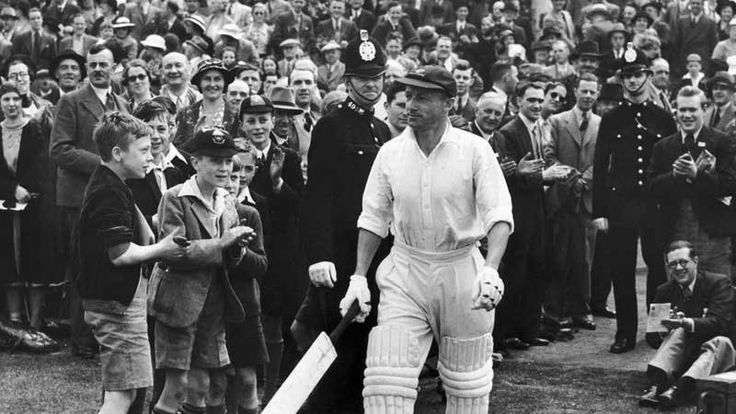
Many players have stamped their authority on Ashes series. Some have dominated individual series. A select few have even had series named after them. But no player has dominated the Ashes for so long and so utterly (or forced the opposition to concoct such devious plans to stop him that full-scale diplomatic incidents are only barely avoided) as Sir Donald George Bradman, the greatest cricketer - and perhaps the greatest sportsman - of all time. He was irrefutably a genius. Having served notice of his outrageous talent in the 1928/9 series with his first two Test hundreds, it was on the 1930 tour of England that he confirmed his genius beyond all doubt. The figures are eye-watering. Bradman scored six double centuries during the tour, passing 1000 first-class runs before the end of May (the first Australian to achieve the feat). In the five Test matches, he scored 974 runs at 139.14. Neither mark has been bettered. And Australia regained the Ashes. England actually won the first Test, at Nottingham, by 93 runs. But that was as good as things got for the hosts. Australia continud their love affair with Lord's as Bradman smashed 254 in an eye-watering total of 729 for six declared. England battled hard, and Duleep emulated his uncle Ranji by scoring a century in his first Test against Australia, but the tourists eased to victory by seven wickets. Although Maurice Tate (son of the unfortunate Fred) did have the satisfaction of dismissing Bradman for just a single. The next two Tests were drawn, partly thanks to the northern weather. Australia had already further highlighted their fondness for Lord's; now Bradman would commence his love affair with Headingley. He was 309 not out after day one, and legend has it that he said afterwards it was good practice for the second day. It wasn't: he was dismissed for a mere 334 on day two England were forced to follow on despite a rearguard century from Wally Hammond, but rain on the third day helped them escape with a draw. More rain produced a draw at Old Trafford, however unlikely a notion that may be. The final Test at The Oval, with the Ashes on the line, was a winner-takes-all timeless clash. Australia cruised it by an innings and 39 runs. Herbert Sutcliffe's century helped England post 405 in the first innings. It was horribly insufficient. Bill Ponsford (110) and Bradman again (232) took Australia to 695, and Percy Hornibrook (7/92) spun Australia to innings victory on a pitch by now offering great assistance to slow bowlers. The Ashes were back in Australian hands. And it was clear, if England hoped to regain them any time soon, Bradman had to be contained. But how? What followed is still the most infamous and controversial series in cricket history. One can still bring almost 80 years of Australian bile to the surface by simply saying the word 'Jardine' in their presence. Douglas Jardine - already hated in Australia for wearing a Harlequin cap and generally personifying all that was wrong with England - was appointed captain and set about devising a plan to combat Bradman.Bodyline
Having perceived a slight weakness in the great man's game against short-pitched bowling aimed at the body, Jardine developed Bodyline: a persistent targeting of the batsman's body with fast, short-pitched bowling and a ring of close catchers on the legside. And in the two Notts professionals Harold Larwood and Bill Voce he had the perfect weapons to deploy his plan. It was not a particularly novel idea. Leg-theory, as it had been known, had been around for decades. It was an effective method of making run-scoring almost impossible. But no captain had previously used it with such apparent relish and for such a sustained attack on all opposition batsmen. The true effectiveness of Jardine's scheme would not be known in the first Test at Sydney. Bradman didn't feature as England secured a 10-wicket victory. Larwood took 10 wickets. Leg-spinner Bill O'Reilly spun Australia to victory in the second Test to square the series. The returning Bradman followed a duck in the first innings with a century in the second. And so the teams, tied at 1-1, headed for Adelaide. And simmering ill-feeling boiled over into a full-blown diplomatic crisis. England collapsed to 31/4 but recovered to post 341. In reply, Aussie captain Bill Woodfull was hit on the heart. After treatment, he carried on. When Jardine set a bodyline field for the next ball, a riot was only narrowly averted. Mounted police gathered outside the ground. After the day's play, England manager Warner attempted to placate the Australians. Woodfull dismissed him from the Aussie dressing room with one of the game's great quotes: "I don't want to see you, Mr Warner. There are two teams out there. One is trying to play cricket, the other is not." England won the match by 338 runs as Larwood and co continued to target the batsmen's bodies even as they backed away to leg exposing their stumps. A short ball from Larwood fractured the wicketkeeper Bert Oldfield's skull. Wisden descirbed it as "probably the most unpleasant Test ever played ... altogether the whole atmosphere was a disgrace to cricket" On the fourth day of the Test, the MCC received the following cable from the Australian Board of Control: "Bodyline bowling has assumed such proportions as to menace the best interests of the game, making protection of the body by the batsman the main consideration. This is causing intensely bitter feeling between the players as well as injury. In our opinion it is unsportsmanlike." It is impossible to overstate the seriousness of that accusation to the gentlemen of the MCC in the 1930s. Short of suggesting Jardine had taken a dump in the King's shoes, it was about the most serious accusation the Australians could make. The MCC, blissfully unaware on the other side of the world of just how unpleasant things had become, haughtily replied that they had full confidence in their team and captain to uphold the highest virtues of sportsmanship and fair play. The MCC did, however, concede that if the Australian board wanted to abandon the tour, they would agree "with great reluctance". Diplomatic relations between the two countries were at an all-time low, but the Australians - perhaps mindful of the financial implications of cancelling the remainder of the tour - became slightly more conciliatory. The tour continued, but under a cloud of ill-feeling and unrest that lingers to this day. England reclaimed the Ashes at Brisbane as Eddie Paynter, suffering from severe tonsilitis, clambered from his hospital bed to make a crucial 83. On the same day, Archie Jackson - who had made such an impression as a teenager in 1928/9 - died of tuberculosis. He was 23. There are those who say he could have rivalled Bradman as the great batsman of the age. What is without question is that Jackson remains cricket's great lost talent.Cheered
With the Ashes regained, Larwood reportedly asked to be left out of the final Test of the series. Jardine, so the story goes, denied the request thus: "Harold, we've got them down: now we're going to tread on them." In the end it was the subtler wiles of Hedley Verity's spin bowling that secured England's 4-1 series victory, while Larwood's 98 (then the highest score by a nightwatchman) was sportingly cheered by an Australian crowd who had long decided the identity of the real villain of the piece. But Jardine's tactics, whatever their relationship with fair play and sportsmanship, had worked. Larwood's 33 wickets at less than 20 apiece proved the decisive contribution to the series, while the genius of Bradman was tamed: he averaged 'only' 56.57 in the series.And Jardine would later show that bodyline could be countered, making his only Test century against leg-theory bowling from the West Indies later that year. However, in 1934, MCC issued a ruling that the "persistent and systematic bowling of fast and short-pitched balls at the batsman standing clear of his wicket" was "unfair" and a "direct attack on the batsman". Bodyline was finished, and neither Jardine nor Larwood would play for England again. However, the last word on this most infamous of series must go to its architect. Jardine's view on the series was summed up in verse: "Australia's writers showed their claws,Her backers raged, her batsmen shook,
Statesmen consulted - and the cause?
Our bowling was too good to hook." In 1934, Bodyline now effectively outlawed, Australia regained the Ashes. They would not relinquish the urn for almost 20 years. The first Test, at Nottingham, was won by 238 runs. A comprehensive victory, but England were only 10 minutes away from scraping a draw (though at the time Wisden conceded they never really looked likely to). It was Australia's only victory over England between 1928 and 1938 achieved without a Bradman century. In the second Test, something remarkable happened. England beat Australia in a Test match at Lord's. And they didn't just beat them - they thrashed them. England won by an innings and 38 runs. After two days, the game was evenly poised. England had amassed 440; Australia, in reply, were 192/2. But, after a rest day, Hedley Verity took 14/80 on the third day's play - six wickets in the last hour - as Australia were forced to follow-on before crumbling to just 118 all out in their second innings. It was England's only Ashes victory at Lord's in the 20th century. The 21st century is faring no better. The next two Tests, at Old Trafford and Headingley, were (as in 1930) drawn despite Bradman's now-customary triple century in Leeds (304). And so, as four years previously, a timeless fifth and decisive Test at The Oval beckoned. Again it was proved a one-sided affair. In a scintillating performance, Australia wrapped up an astonishing 562-run victory inside four days. Bill Ponsford and Bradman both made double centuries on the opening day. Australia were 475/2 by stumps. Their first innings was extended to 701 before the final wicket fell. England managed just 321 in reply. Australia added another 327 (Frank Woolley, recalled to the side at 47, replaced injured keeper Les Ames and shipped 37 byes) to leave England chasing the small matter of 708 to retain the Ashes.