The Rematch #3
Lennox Lewis may have lost his first fight with Oliver McCall, but he gained a key ally and took revenge in a bizarre rematch...
Sunday 15 January 2017 11:38, UK
Lennox Lewis may have lost his first fight with Oliver McCall, but he gained a key ally and took revenge in a bizarre rematch...
"A loss can make you look at yourself in a way that victory cannot. It gives you a feeling that inspires you to be better. Gladiators need to experience setbacks, because if you can come back from them it shows just how great you are." Lennox Lewis
It is almost a decade since Lennox Lewis, in the words of the late and great Emanuel Steward, "took it to the streets" to stop upstart Ukrainian Vitali Klitschko on cuts in the last of his 44 professional fights. Lewis remains the heavyweight division's last recognised undisputed champion, but all those years on from retirement he can still divide opinion.
To his detractors, the Klitschko fight was an unconvincing send-off which reinforced an impression of Lewis as vulnerable and a grind to watch. Where on his record is the mark of genuine greatness, goes the argument, beyond a thorough demolition job on an over-the-hill Mike Tyson and a decision over an Evander Holyfield no longer in his prime?
To Steward, the legendary trainer and long-time mentor whose death last year left Lewis devastated, his man had simply done what he did best: found a way to win. "The thing about Lennox," Steward later said in an interview with East Side Boxing, "was he did whatever you asked him to do to win a fight. He could make the adjustments."
Twice, of course, Lewis' famously strategic thinking deserted him: once, in 2001, when he complacently walked straight from a Las Vegas movie set, into the altitude of South Africa and onto a monster right cross from the little-known Hasim Rahman.
Lewis would avenge that defeat the same year, heading up to the Pocono mountains to get in shape and leaving nothing to chance ahead of a one-sided rematch.
But it was the first defeat of his career, seven years earlier at Wembley Arena, which would send the London-born, Canada-raised Lewis on a tortuous road to redemption and a claim to a place among the best heavyweights in history.
Weakness
Oliver McCall was the fourth man to challenge for the WBC title Lewis had inherited from his detested rival Riddick Bowe - the American he had beaten while boxing for Canada at the 1998 Olympic Games and who threw his belt in the dustbin rather than face his old foe.
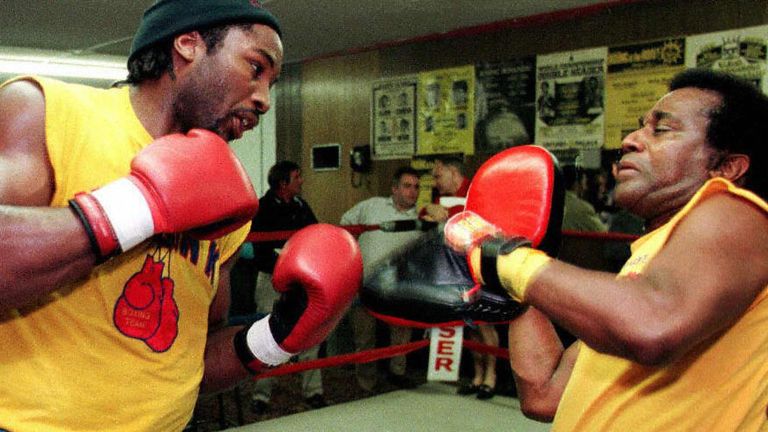
Few gave McCall a prayer - the 'Atomic Bull' had suffered five points defeats in 24 fights and was more noted for his sparring sessions with Mike Tyson than anything on his record. His problems outside the ring were well-known, too, but McCall had one decisive advantage over the champion: Emanuel Steward was in his corner.
McCall - and his personal demons - had been kept under lock and key for months before the fight by the canny Steward, who had long admired Lewis but identified as a weakness his overconfidence in throwing the heavy right hand which had become his greatest weapon.
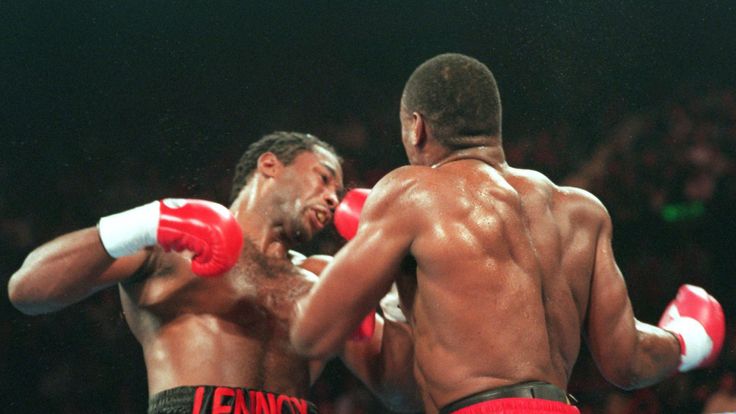
With 31 seconds gone in round two, Lewis reached for the heavy artillery as predicted and, beaten to the punch, was sent to the canvas by a huge right from McCall which landed flush on the chin. The champ got to his feet but, in the words of the watching Hugh McIlvanney, "his legs fluttered like saplings in the breeze" as referee Jose Guadalupe Garcia called a halt.
Battling the immediate affront of a stung ego and the reality he was suddenly out in the cold in a heavyweight division now back in the hands of Don King, the ruthless promoter he