Sky Academy Sports Scholarships: Johnny Nelson interview
Tuesday 26 November 2013 17:09, UK
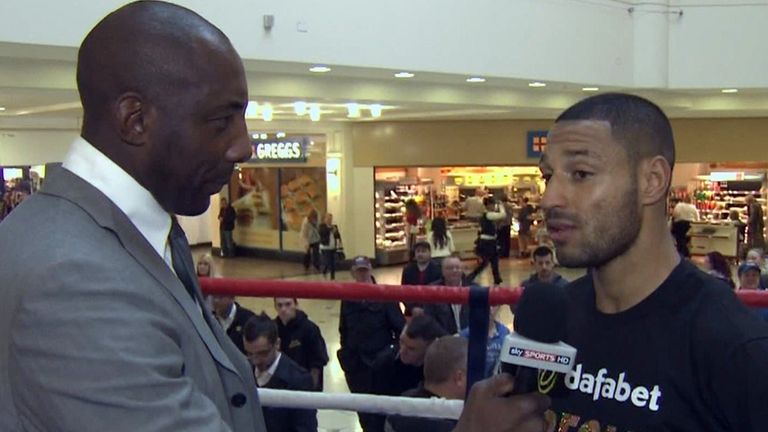
Having been announced as the new Sky Academy Sports Scholarships spokesperson, Johnny Nelson spoke to us about his own boxing career and the culture shock of moving into the working world.
I can remember driving down the street with Brendan and in the papers I wasn't expected to win, I said to Brendan 'I don't understand how they think he's going to win.' All of a sudden I couldn't see the negative I could only see the positive, whereas before I could only see the negative. I could see Brendan have a wry smile on his face as if to say the penny's just dropped. I was blind to the negative; I could only see the positive. He knows it's not front because I'm very honest with him and I said, 'I don't see what they see.' He said 'that's all you need to see, Johnny. You don't need to see what they're seeing. They just can't see what you're seeing; now you're on the other side.' And that was that thin line. I remember we were just coming back from the sauna, we'd had a chat and people at the sauna were saying, 'you know it's a hard fight, Johnny' so I can remember driving back. Mental is everything. If I'm 80% fit and only 20% mentally strong, somebody that's only 20% fit but 80% mentally strong will beat me. So if you're mentally strong, you can pull it round. That's why Brendan persisted with talking to me, reciting the history of other fighters. His main saying was 'same story, different actors.' That was Brendan's saying. He kept referring it to parts of history. People in history, sportsmen in history - it didn't just have to be boxing. So for these guys, I'm trying to say to them look, same story, different actors. So it's exactly the same situation, it's just different individuals. With that in mind, was that the high point of your career, the fight with Carl Thompson? And conversely what was the lowest moment for you? That was the high point. It wasn't even the actual fight, it was the realisation. So when I got into the ring I expected to win. I didn't expect anything else. I even predicted the round. All of a sudden I was that confident that people mistook it for arrogance. From being this shy no confidence kid, I'm an arrogant kid because all of a sudden the penny had dropped. The lowest point was when I first boxed for the world title, I was only 22, I was a boy in a man's body, so physically I looked the part but mentally I was a child. It would be like put a school leaver behind the wheel of a car, a flash Porsche, and saying 'if you can drive this down the road without crashing it, you can have it.' Then all of a sudden I can't drive. So the lowest point was that. But actually, I wouldn't change it for the world because it made me the person I am today, it made me see different sides of life. I boxed for the world title against Carlos De Leon, 1990, and I had a load of good-time friends and I was very popular and then when I lost then I saw two sides of the game. People were being very negative, cool, nasty and that's why with the scholars I've got to prepare them for all of that. It doesn't mean you have to go someone's face and say 'ha ha, I told you so.' It just means I want them to be humble enough and to be strong to accept compliments but not take them to heart. Accept criticism but don't take it to heart. I used to read magazines that said Johnny Nelson put in an outstanding performance blah, blah, blah. They'd tell me how the fight went and I'd think 'no, that's not how it went' but that's what they wrote. So if you start to buy into the publicity all of a sudden when the publicity changes on you and it becomes negative, you are starting to