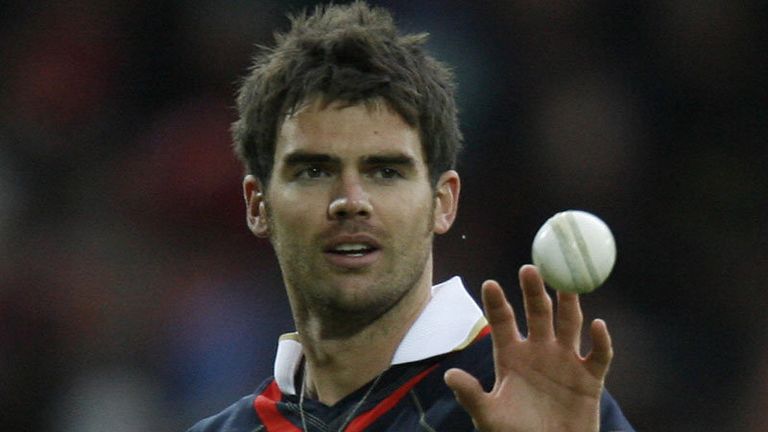
Twenty20 cricket is a costly affair for bowlers. Benedict Bermange assesses who is the most expensive.
Benedict's back with more stats and facts
Sky Sports' cricket stats man Benedict Bermange has teamed up with skysports.com to bring you all the statistical highlights from our cricket coverage.
He will also be on hand to answer your statistical cricketing questions, be it about an existing record, player, team, ground, umpire or the laws of the game.
Whatever has been puzzling you, just email Benedict
here or fill out the comment form at the bottom of the page and he'll answer your questions.
Here are Benedict's favourite Twenty20 stats!
Phenomenal rate
The tournament started with an incredible upset victory for the Netherlands against England at Lord's, which brought back memories of England's 13-run defeat to Zimbabwe in the 1992 World Cup at Albury.
The Netherlands became just the second team to reach their target in a T20 International from the last ball of the match, following New Zealand who reached their target of 150 from the last ball to beat India at Wellington this 27 February.
The New Zealand v Scotland match at The Oval saw runs scored at the phenomenal rate of 13.76 per over.
This is the highest rate ever in any Twenty20 match world-wide in which more than ten overs have been bowled. The previous record was the 12.00 per over at which the Titans and Cobras scored at Centurion in 2006.
Brett Lee's four overs cost 56 runs against West Indies at The Oval as Chris Gayle careered to 88 from just 50 to help send Australia out of the competition. However, the most expensive bowling figures in international Twenty20 cricket still belong to England's James Anderson:
| Figures |
Name |
Team |
Against |
Venue |
Season |
| 4-0-64-1 |
JM Anderson |
England |
Australia |
Sydney |
2007 |
| 4-0-64-0 |
ST Jayasuriya |
Sri Lanka |
Pakistan |
Johannesburg |
2007 |
| 4-0-61-0 |
LN Onyango |
Kenya |
Sri Lanka |
Johannesburg |
2007 |
| 4-0-60-0 |
SCG Broad |
England |
India |
Durban |
2007 |
| 4-0-57-1 |
N Odihiambo |
Kenya |
Sri Lanka |
Johannesburg |
2007 |
| 4-0-57-0 |
Joginder Sharma |
India |
England |
Durban |
2007 |
Chris Gayle smashed 27 from one of Lee's overs - the fourth-most expensive over in T20 International history:
| Runs |
Batsman |
Bowler |
Match |
Venue |
Year |
| 36 |
Yuvraj Singh |
SCJ Broad |
India v England |
Durban |
2007 |
| 30 |
RT Ponting |
DR Tuffey |
Australia v New Zealand |
Auckland |
2005 |
| 29 |
J Mubarak |
LN Onyango |
Sri Lanka v Kenya |
Johannesburg |
2007 |
| 27 |
CH Gayle |
B Lee |
West Indies v Australia |
The Oval |
2009 |
No margin for error
South Africa's victory over Scotland by 130 runs in the second-largest margin of victory in any Twenty20 International. In the 2007 World Cup, Sri Lanka beat Kenya by 172 runs at the Wanderers, Johannesburg.
Their victory by just one run over New Zealand at Lord's equalled the narrowest victory margin - set by Australia also against the Kiwis at Sydney this February.
By beating the West Indies at The Oval, South Africa became the first team to ever win six consecutive T20 Internationals. They had previously won five from 2 February to 19 September 2007, as had India from 19 September to 20 October 2007.
By contrast, Bangladesh has now lost their last either Twenty20 International matches, beating New Zealand's record of seven consecutive defeats set between 19 September 2007 and 13 June 2008.
Aaron Redmond hit thirteen fours in his innings of 63 from just thirty balls against Ireland at Trent Bridge, a total surpassed by just one batsman in T20 International cricket. Lendl Simmons came close a couple of days later!
| Fours |
Name |
Score |
Team |
Against |
Venue |
Season |
| 14 |
HH Gibbs |
90* |
South Africa |
West Indies |
Johannesburg |
2007/08 |
| 13 |
RT Ponting |
76 |
Australia |
India |
Mumbai-B |
2007/08 |
| 13 |
AJ Redmond |
63 |
New Zealand |
Ireland |
Nottingham |
2009 |
| 12 |
LMP Simmons |
77 |
West Indies |
South Africa |
The Oval |
2009 |
Umar Gul's astonishing figures of five for six for Pakistan against Sri Lanka are the best-ever by any bowler in T20 International cricket. Amazingly, he also currently boasts the third-best figures:
| Figures |
Name |
Team |
Against |
Venue |
Year |
| 5-6 |
Umar Gul |
Pakistan |
New Zealand |
The Oval |
2009 |
| 4-7 |
MR Gillespie |
New Zealand |
Kenya |
Durban |
2007 |
| 4-8 |
Umar Gul |
Pakistan |
Australia |
Dubai |
2009 |
| 4-9 |
DW Steyn |
South Africa |
West Indies |
Port Elizabeth |
2007 |
| 4-11 |
Shahid Afridi |
Pakistan |
Netherlands |
Lord's |
2009 |
Kamran Akmal stumped four helpless Dutch batsmen in the comfortable Pakistani victory at Lord's which set a new record for this form of cricket, beating the record he himself shared with Tatenda Taibu of Zimbabwe:
| Name |
St |
Team |
Against |
Venue |
Year |
| Kamran Akmal |
4 |
Pakistan |
Netherlands |
Lord's |
2009 |
| Kamran Akmal |
3 |
Pakistan |
Kenya |
Nairobi |
2007 |
| T Taibu |
3 |
Zimbabwe |
Canada |
Toronto |
2007 |
Group therapy
Hi Benedict. Why are England only able to qualify into group E with the 3 other strongest teams of the tournament..., even if they finish 1st or 2nd in their group? Godmanchester, Cambs
Benedict replies: The groups were decided as a result of how the teams fared in the inaugural competition in South Africa in 2007. The top four teams from that competition (India, Pakistan, Australia, New Zealand) were all seeded into different groups and the next four (South Africa, Sri Lanka, England, Bangladesh) were then placed in separate groups so that seed 1 (India was with seed 8 (Bangladesh) etc. Therefore England (7th) were placed with Pakistan (2nd) in the initial stage. The two Super 8 groups consist of two top-placed teams and two second placed teams from the initial group stage. However, if a non-seeded team qualified in place of a seeded team in the initial stage (as Ireland did in place of Bangladesh), they take their place in the Super 8 group. The ICC state this is to ease logistics and to provide spectators and television companies with some degree of certainty as to the location of team matches.
Sum it up, please
Hi Benedict. Could you please explain how to calculate run rate and hence net run rate. Thank you. Sally
Benedict replies: It is a simple matter of taking the number of runs a team has scored divided by the total overs they have faced and comparing this with the total runs they have conceded and the total overs they have bowled. So - in the group stages, England scored 347 runs in 40 overs at a run rate of 8.675. They bowled 40 overs at their opponents who scored 300 runs - a run rate of 7.500. 8.675 - 7.500 = 1.175 (their net run rate). Obviously if your opponents have scored at a faster rate than you have, your net run rate can end up negative.
Curve ball
Hi. Please clarify the measurement of balls hit for 6. I thought that the measurement was a computer projection of how far the ball would have gone by continuing the trajectory to the same level from which the ball was struck but today's Aus V WI commentator has said that the ball that Chris Gayle hit on to the roof was 105m to that point on the roof. John & Julie Wyatt-Barton
Benedict replies: I have emailed the powers that be for clarification on this fact. In the meantime, check out
www.hittrackeronline.com which attempts to measure the distance of each home run hit in Major League Baseball.
Don't duck it!
A friend who plays cricket for our team Langley Manor in the New Forest, Hampshire, has managed, unfortunately to get five ducks in five consecutive Saturday afternoon matches for the 1st team who play in Hants County 2 league. Would you know if this is a record? Roy
Benedict replies: That certainly is an unfortunate record. I am not sure if it is a record for all club matches, but the senior cricket records are as follows regarding most consecutive ducks:
| Name |
Team |
Ducks |
Test/ODI |
| Bob Holland |
5 |
Australia |
Test |
| Ajit Agarkar |
5 |
India |
Test |
| Mohammad Asif |
5 |
Pakistan |
Test |
| Gus Logie |
4 |
West Indies |
ODI |
| Pramodya Wickramasinghe |
4 |
Sri Lanka |
ODI |
| Henry Olonga |
4 |
Zimbabwe |
ODI |
| Craig White |
4 |
England |
ODI |
However, current Sussex coach Mark Robinson went twelve consecutive innings in first-class cricket in 1990 without scoring a run. Admittedly, some were not out, but this is one record that is unlikely to be broken anytime soon! His highest score in any of his sixteen innings that season was one not out.
Three Hat-tricks
Just wanted to share with you a family achievement that occured back in 1999. Both of my sons and myself all took Hat-tricks within just over a month of each other. My oldest son Craig took one for Skelmanthorpe 2nds against Meltham, (2.5.1999) Daniel took one for Skelmanthorpe Under 15s against Emley,(13.6.1999). I took one for Shepley First team against East Ardsley,(16.5.1999). Three Hat-tricks in one family ! I was wondering if this was of any interest to you and whether any of the Sky Sports viewers had similar feats to share with us. Kind Regards, Ian Glover
Benedict replies: The only recent comparable feat I could find was the Australian twins Lachie and Mick Mickan both taking hat-tricks for Kapunda in Australia in 2008 within a week of each other. Both are left-arm fast bowlers. Do any readers have any other stories?