
Cricket Review 2015: World Cup, England's Ashes, Day-Night cricket
Monday 11 January 2016 17:04, UK
A look back at some of the biggest stories from our cricket coverage over the last 12 months...
Associate Nations furore
Over a million fans attended 49 matches in the most popular 50-over World Cup in history, watched by an estimated global TV audience of more than a billion, but for all the record-breaking hoopla - an honourable mention simply must go to AB de Villiers for his 162 off just 66 balls against West Indies at this point - the ICC's proposal to cut the 2019 instalment from 14 to 10 teams largely at the expense of the Associate Nations left something of an unsavoury after-taste.

Ireland's players sent out the strongest possible complaint on the pitch by chasing down 305 to beat West Indies, sparking fresh debate as to whether international cricket should expand or contract. Shrink it shall for now, in tournament terms, with only the top eight teams in the ICC rankings plus two qualifiers competing in England in 2019. However, that could conceivably become the top six plus four qualifiers - the hosts qualifying by right (perhaps just as well after their group stage exit at the hands of Bangladesh). Any further change would surely worry West Indies, who have already fallen the wrong side of the rankings cut-off for the 2017 Champions Trophy.
England's evolution
After Alastair Cook's resurgence in 2014, surely 2015 would prove a less rocky road for England's team and management alike? Not so - that early World Cup exit hastened the departure of Paul Downton as managing director of the England and Wales Cricket Board before May's 1-1 Test series draw with West Indies heralded the end of Peter Moores' second tenure as coach. His exit, after barely 14 months in charge, ensured new cricket supremo Andrew Strauss started with a clean slate and, while many a camera was pointed in Jason Gillespie's direction in search of Moores' successor, the ECB opted for another Australian in Trevor Bayliss, a man widely reported to be a calming influence as a head coach and an excellent man-manager - Strauss already having negated perhaps Bayliss' biggest challenge by telling Kevin Pietersen that a "massive trust issue" would prevent him from playing for England "in the short term".
With England successfully adopting a new attacking brand of cricket under Paul Farbrace in the early season exchanges against New Zealand (could the 3-2 ODI win been the best series ever?), Bayliss had the perfect platform to forge aggressively into his first Test series as head coach against - you couldn't make it up - Australia…
Cook's Ashes redemption
"We've done something I didn't think was quite possible at the beginning of the summer," said Alastair Cook in the immediate aftermath of England's Ashes-regaining victory at Trent Bridge, hinting at the Test inexperience in his ranks. But he need not have feared - his team completed the job done on only the 14th day of the series despite a 405-run capitulation at Lord's, England seizing an unassailable 3-1 lead with the fifth Test at the Oval still to go. If Joe Root's 118-ball hundred on day one in Cardiff set the tone, it only did so after a seismic drop by Brad Haddin; had that been pouched, England would have been 43-4 and in a whole heap of trouble.
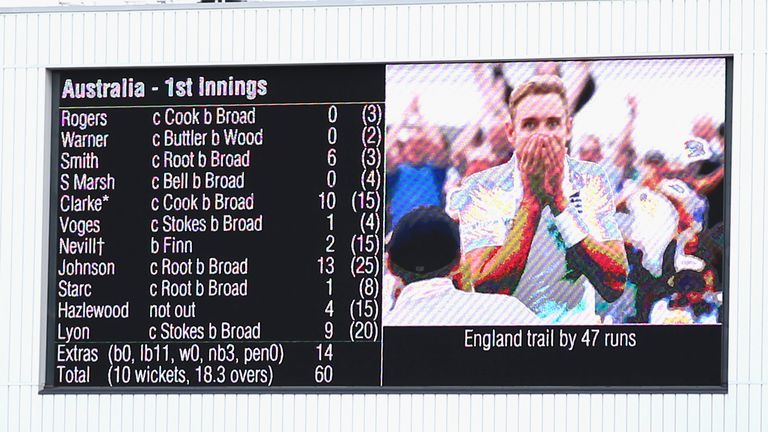
Blown aside at HQ, James Anderson led England's fightback at Edgbaston with his Ashes-best figures of 6-47 ably supported by Steven Finn, playing in his first Test for two years, with Ian Bell and Joe Root ensuring the advantage wasn't wasted. A fluctuating series tipped decisively and dramatically in England's direction as Stuart Broad delivered one of the Ashes spells of all time on his home turf, running amok to claim 8-15 in 9.3 overs as Australia crumbled to 60 all out - Ben Stokes snaffling an outstanding catch in the gully to epitomise the quality of England's catching throughout the series.
There was no way back for Australia - supreme in their 2013/14 whitewash of England - and "599 days after handing the urn over to Australia, Cook has his redemption" when Nathan Lyon dragged Mark Wood on. Australia's emphatic fifth Test win could not prevent Cook becoming only the third English captain after WG Grace and Mike Brearley to win two Ashes series at home and with England winning five out of the last seven Ashes series, it's no wonder Test cricket remains ever-popular…
Cometh the Day-Nighter
Concerns that a pink ball might misbehave under floodlights - or that the absence of lunch and introduction of dinner would cause further palpitations among tea traditionalists - drifted into the ether as 123,736 people flocked to the first day-night Test in 138 years of cricketing history, the game ending in a nervy three-wicket win for Australia over New Zealand inside three days in Adelaide.
As an indication that the concept will help swell crowds in countries struggling to sell Test cricket, the experiment could not have been more successful - a great buzz within the ground supporting Cricket Australia's report that 85 per cent of those surveyed supported the change as "a good idea". But would day-night Test cricket catch on in England? Quite possibly - but with fans still trooping through the gates to support England in the day, the prospect of watching a slow-burn session under lights in May or September is a little chilling.
Chris Cairns cleared
"It has been a living hell for two years," said Chris Cairns after he was acquitted of perjury and perverting the course of justice in November. The former New Zealand all-rounder was found not guilty of lying under oath during his successful libel case in 2012 against former Indian Premier League chairman Lalit Modi, who accused him of match fixing on Twitter in 2010.
The verdict followed evidence from the current Black Caps captain Brendon McCullum, who testified that Cairns had approached him about fixing matches in 2008. New Zealand Cricket subsequently said it "accepts and respects" the decision, reached after a nine-week trial, while Sky Sports pundit Bob Willis and Professional Cricketers' Association chief executive Angus Porter were among those who raised concerns that the outcome might deter cricketers from reporting information about match-fixing in the future.