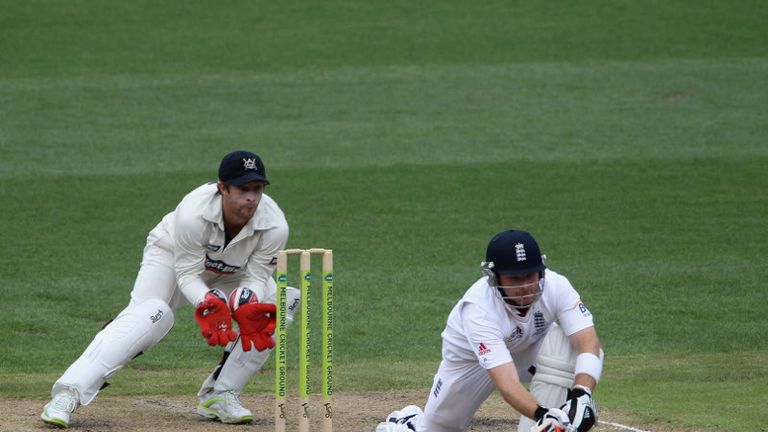
Sam Lavery tells us when and where, and more importantly how, to implement the sweep shot.
Pro coach Sam Lavery tells us when and where, and more importantly how, to implement the sweep shot
This week's blog is a continuation of last week's look at playing spin, and while last week identified different ideas that could be used when advancing down the pitch, this week looks into sweeping.
For many the sweep is a shot that is frowned upon, an un-classical stroke, playing across the line, and one deemed "dangerous" and "fraught with risk", but let's quickly break down that concept of risk. I remember a time when hitting a ball up and over the in-field was deemed risky, but the game has moved forward and that's now an excepted method of play, and why? Because players have practiced and practiced and practiced.
Is the sweep a dangerous shot for most cricketers to play, probably yes... and why? Because it doesn't receive the attention it deserves when it comes to practice. We see a straight drive as a safe shot to play, and it is, but it also helps that most players have a history of tens of thousands of successfully executed straight drives in their locker. Sweeps on the other hand, well I'd suggest a lot of 18-year-old cricketers could count their successfully played sweep shots on one hand, or close to it (you get the idea). So my first simple message is an obvious one: if you want to perform the sweep well, practice it.
Now all we need is to know how to play the shot, so let's briefly touch on the technical side of things, before we discuss when and how to use it. As with all aspects of cricket, balance is a key component of the sweep, so establishing a solid base is vital. Your stride out towards the ball should be comfortable, yet still large enough to control the movement of your body weight towards the ball. If you can imagine a side on view of a batsman, they would be looking to create a box shape, outlined by the upper and lower front leg, the thigh of the back leg, and the floor; once you actually get down to trying it this will become more apparent.
Now we have anterior/posterior stability, or, stability when moving backwards and forwards, we also have to create some stability from side to side, and again this comes from distributing our weight effectively through our base. This means lining up our feet so that they are in a straight enough line towards the ball that we can move towards it, but not so straight that they're lined up as if balancing on a tight rope. In fact if you can imagine a line like a tight rope pointing towards the ball then your ideal position would see both feet just either side of it, with your front foot on the leg side and your back foot slightly to the off side.
Now the base is established everything else should fall into place quite quickly. The next thing is positioning your head in the right place, and that means getting it forwards, and low down close to your front knee. We do this for a couple of reasons, obviously moving your head towards the ball will transfer your body weight forward which will help in generating power, but more importantly in my opinion, it allows you to get your eyes closer to the ball and its height. When we play a straight bat shot we always speak about the importance in getting inline with the ball, well with the sweep, a cross batted shot, it works in a similar way, however we're now trying to get our eyes "in height" with the ball as well as in line.
Plan of attack
Further to this basic position there is the constantly evolving position of the hands and the back swing, which can come from a wide variety of angles depending on where you want the ball to end up. For instance:
• A wide low back swing to hit up into a slog sweep.
• A high wide back swing to hit down onto a more conventional sweep.
• A high and straight back swing (actually in front of you so more of a forward swing) to hit down on the ball and hit a fine sweep.
• A wide (leg side) and high back swing to hit a reverse sweep.
• Finally, no back swing and instead just point the bat out towards the ball so set up one of the simplest shots in cricket, the paddle sweep.
When practicing the sweep always think about those two important things we started with, our balance and our eyes. Don't over hit the ball as that is so often the tendency, as swinging a bat powerfully across the line will quickly disrupt your balance, which in turn will disrupt your head position and your view of the ball.
To close, can we quickly consider why and when we play the sweep and when we should use it. Well, first of all I think we would generally look to sweep when we can't score the runs we need to win the game with a safer shot. So if we like hitting down the ground but the conditions, or the field means we can't score sufficiently there, we now may turn to the sweep. Here the sweep works in two ways, it can either produce runs for us in a new area, which will hopefully be enough to win us the game, or, it can create a change in the field that would hopefully open up another scoring area for us. In fact it's often the case now that people fear the sweep being played effectively, that if you can play one, or maybe two, really solid looking sweep shots, that will be enough for the bowler to make the change to the field, open up another avenue for you to score, and the sweep can go back in the locker for another day.
Finally, when shall we play it? Well the sweep is generally hitting the spinner's best ball, it's the one we can't quite drive down the ground, while not giving us room to get on the back foot. So my suggestion would be this, the better the bowler the more likely your need to use the sweep. If you can get by on the full balls and short balls being bowled, and you feel those shots are safer for you then do that. It's the consistent and controlled bowlers who don't offer those regular scoring opportunities that need to be manipulated, and the sweep may just be the way.
As with last week, when playing spin, it's vital you know your options, you know the requirements placed on you in the game situation, and then from there you can devise a plan of attack that will hopefully get you the runs you require, and remember, you need to practice before you perform!
As always all questions are welcome, for coaching courses around the UK please visit the
Pro Coach website for details.
Sam Lavery
More tips and tweets
@SamLaveryPCCA