Skysports.com takes a look back at events in the world of cricket during the last 12 months.
Australia rule the world...again
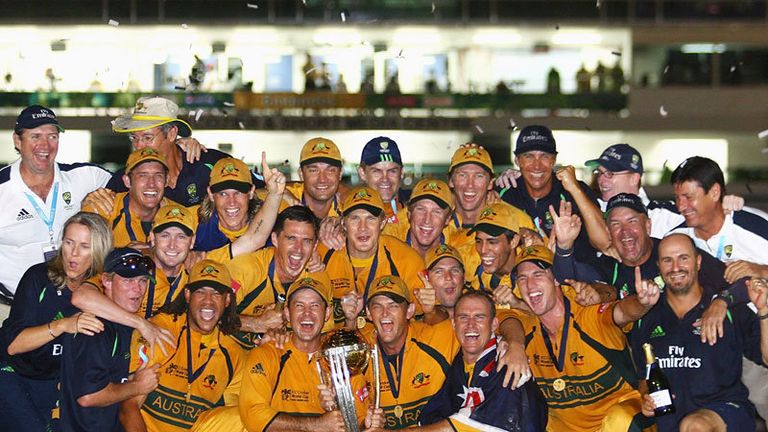
Another year of Australian dominance saw Ricky Ponting's side win a third straight World Cup in emphatic fashion.
Overall, it was a tale of two World Cups - the 50-over version in the Caribbean was an over-hyped, poorly attended flop, while the hastily arranged Twenty20 version in South Africa later in the year provided an unexpected highlight.
India prevailed in a final-over thriller against arch-rivals Pakistan to win the inaugural Twenty20 global showpiece, having beaten Australia in the semi-finals.
Needless to say, England failed to reach the last four in either tournament during a difficult 12 months that began with the last rites of an Ashes whitewash and the end of Duncan Fletcher's reign as coach.
Woolmer mystery
The World Cup was overshadowed by the death of Pakistan coach Bob Woolmer and subsequent murder investigation by the Jamaican police.
Woolmer was found dead in his Kingston hotel room the morning after Pakistan had been beaten by Ireland and eliminated from the tournament at the initial group stage.
Following a pathology report that concluded Woolmer was killed by 'asphyxia via manual strangulation', the Jamaican police launched a murder probe.
A media feeding frenzy ensued with no shortage of amateur sleuths willing to put forward their theories via the 24-hour news networks, although the police appeared to be making little progress.
In June, following three more pathology reports, the Jamaican police concluded that Woolmer had died of natural causes, although the inquest into his death recorded an open verdict.
Awesome Aussies
On the field, Australia marched to their third straight World Cup with a perfect record of 11 wins in a competition that failed to hit the expected heights.
None of those 11 matches were close and the final against Sri Lanka summed up the tournament.
It finished in farcical circumstances when the match officials - incorrectly according to the rules - insisted on play resuming in near total darkness as Sri Lanka made a forlorn attempt to chase a revised target of 282 from 38 overs.
Memorable individual moments included Adam Gilchrist's whirlwind 149 in the final, Sri Lankan paceman Lasith Malinga taking four wickets in four balls against South Africa, and Herschelle Gibbs hammering the unfortunate Dutch leg-spinner Dan van Bunge for six sixes in an over.
Gilchrist's opening partner Matthew Hayden was the outstanding batsman in the competition with 659 runs, including three centuries, while Glenn McGrath was the competition's leading wicket taker with 26 on his swansong.
India and Pakistan both exited at the group stage, while the so-called Super Eight included both Bangladesh and Ireland.
Ireland's three-wicket win over Pakistan was one of the great upsets in one-day history, although the death of Woolmer quickly put things in perspective.
For England it was another World Cup to forget as they failed to reach the semi-finals for the fourth time in a row. A partially fit Michael Vaughan was parachuted in to lead a side still reeling from their Ashes pummelling.
Morale in the camp began to sink when Andrew Flintoff, who had made way for Vaughan, was stripped of the vice-captaincy following a drunken late-night trip to sea in a pedalo two days before the group match against Canada.
England did beat Canada and Kenya to progress to the Super Eight but their uninspiring brand of cricket failed them against superior opponents and they eventually finished fifth, having been beaten by all four of the semi-finalists.
Coaching merry-go-round
The World Cup brought the end of an era for both England and Australia as respective coaches Duncan Fletcher and John Buchanan both stood down following eight-years at the helm.
Fletcher's legacy was tarnished by the Ashes capitulation and disappointing World Cup, but despite the gloomy end his reign was not without success.
The 2005 Ashes win on home soil was his side's sixth straight Test series win, while the introduction of central contracts and a more consistent approach to selection resulted in steady improvement - in the Test arena at least - for the majority of his time in charge.
Buchanan left Australia as he had found them - on top of the world in both one-day and Test cricket.
Greg Chappell (India), Bennett King (West Indies), and Dav Whatmore (Bangladesh) also vacated their jobs following the World Cup.
Split captaincy
England began the year by losing the New Year Test in Sydney, the final instalment of a 5-0 Ashes whitewash that was as one-sided as the scoreline suggests.
The World Cup debacle followed, the inquest into which led to the introduction of split captaincy for the first time since the ill-starred Michael Atherton-Adam Hollioake experiment in the late nineties.
Vaughan stepped down and was replaced by Paul Collingwood as limited-overs captain, but was retained in charge of the Test team despite lingering doubts about his recovery from the knee injury that kept him out of the Ashes tour.
That looked a shrewd decision from new coach Peter Moores - promoted from his position as head of the ECB academy to succeed Fletcher - when the Yorkshireman marked his first Test appearance for 17 months with a fine century on his home patch of Headingley against West Indies.
Kevin Pietersen also scored a double century in that match and was the most consistent English batsman with 1,007 Test runs during the calendar year, including four hundreds.
But it was the impact of Ryan Sidebottom that provided the story of the summer. The Nottinghamshire left-armer was called-up to make his second Test appearance at Headingley, six years after going wicketless on his debut.
Sidebottom responded with eight wickets in the match and went on to be an ever-present for the remainder of 2007, finishing the year as an established first-choice in all formats.
England went on to comfortably defeat West Indies 3-0 over four Tests, but Collingwood's initiation as one-day captain was not so smooth as West Indies fought back from losing the first game to triumph 2-1.
Indian summer
India were the visitors for the second part of the summer and provided a stern examination of England's progress under Moores.
Rahul Dravid's men triumphed by seven wickets in the second Test at Trent Bridge, a result that was sandwiched by draws at Lord's and the Oval to give the tourists a 1-0 success.
The home summer concluded with a seven-match one-day NatWest Series, it went all the way to the final game which England won by seven wickets at Lord's.
Unbelievable as it may sound, England's best results during 2007 came in one-day cricket, though not when it mattered at the World Cup.
The CB Series victory in February, during which England triumphed 2-0 in the finals series 2-0, briefly halted the Australian juggernaut.
And the 3-2 series win in Sri Lanka in October provided a welcome boost for Collingwood's leadership following the disappointment of an early plane home from the World Twenty20.
But England's year finished on a low, Sri Lanka turning the tables when they returned - this time with Vaughan in charge and Collingwood back in the ranks - for a three-match Test series in December.
Mahela Jayaardene's men won the series 1-0, although the scoreline flattered England, who were outplayed in all three Tests despite clinging on for draws in Colombo and Galle.
Twenty20 - a vision of the future
Cricket entered a brave new world in September with the inaugural World Twenty20 competition.
The two-week event in South Africa was a huge success, a succession of thrilling last-over finishes offering a glimpse of the future of the limited-overs format.
Australia, the kings in both Test and 50-over cricket, narrowly failed in their hat-trick bid when India beat them by 15 runs in the semi-finals.
India had left established names Rahul Dravid, Sachin Tendulkar, Sourav Ganguly and Anil Kumble at home and selected a young side led by wicketkeeper Mahendra Singh Dhoni.
It proved a shrewd policy, Dhoni's team gained momentum as the tournament progressed, culminating in the last-four victory over Australia and a five-run success over Pakistan in the final.
England selected players who had excelled in domestic Twenty20, but the likes of Stuart Broad, Darren Maddy, Chris Schofield and Jeremy Snape fell short of the required standard when elevated to the international stage.
The abiding memory of their campaign was India's Yuvraj Singh hammering Broad for six sixes in an over as England crashed out at the second group stage.
Rebels without a cause
In the aftermath of the World Twenty20, it looked as if the commercial possibilites of the format may lead to the biggest shake-up in the organisation of international cricket since the Packer revolution in the 1970s.
The lucrative Indian television market provided the money and, for a while, it looked as if the Kapil Dev-led 'rebel' Indian Cricket League competition would succeed in putting together a formidable line-up of big names for a proposed all-star tournament.
But the Indian Board decided to set-up their own remarkably similar competition, named the Indian Premier League, and trumped the rebels by securing the signatures of many of the players who were being courted by the ICL.
When the ICL finally did get underway in November it was with little fanfare and a notable absence of big name players in their prime - the revolution had been averted, for now.
Howard's way
The International Cricket Council continued to avert their eyes from the situation in Zimbabwe, but could not prevent Australia becoming the first country to refuse to tour the country on moral grounds.
Zimbabwe maintained their voluntary absence from Test cricket, but remained full members of the ICC and competed in one-day internationals, including at the World Cup.
It took the intervention of then Prime Minister John Howard to ensure Australia's one-day tour did not go ahead in September.
Howard commented: "The Mugabe regime is behaving like the Gestapo towards its political opponents.
"I have no doubt that if this tour goes ahead it will be an enormous boost to this grubby dictator."
Lancashire heartbreak
In the county game, Sussex claimed their third title in five seasons on a thrilling final day.
Lancashire's defeat at Surrey confirmed Sussex - who had earlier completed an innings victory over Worcestershire - as champions.
It was a familiar tale of heartbreak for the Red Rose county, who had entered the final round of matches with a six-point lead only to crash to a 24-run defeat at the Oval.
Mark Chilton's men fell agonisingly short of chasing a victory target of 489 on a tense final afternoon, ensuring their 73-year title drought continues for at least another season.
Even by English standards, it was an unusually wet season. Worcestershire's New Road ground was flooded twice, forcing them to use alternative venues for home games from mid-July onwards.
The Pears did at least gain some respite by winning Pro40 Division One. Justin Langer led Somerset to Division Two title, while Kent were the surprise winners of the Twenty20 Cup.
Durham won the C&G Trophy and Pro40 Division Two to claim their first pieces of silverware since being granted first-class status in 1991.
End of an era
Brian Lara, the leading run-scorer in Test history, retired following West Indies' exit at the Super Eight stage of the World Cup.
His final innings ended in a run out when Marlon Samuels sold him down the river, a strangely fitting end for a batting genius who had the misfortune of spending most of his career playing in a team of decidedly lesser cricketing mortals.
Lara was a cavalier in an era dominated by Australian roundheads. He finished with 11,953 Test runs at an average of 52.88, while the twin masterpieces of 375 and 400 against England, made 10 years apart at St John's, Antigua, showed the appetite for runs remained undimmed throughout West Indies' struggles.
If Lara had a cricketing soulmate then it was probably Shane Warne, another giant to retire from the international game in 2007.
With his bleach blond hair, diamond earring and generous waistline, Warne looked more beach bum than leg-spinner - but 145 Test appearances and 708 wickets confirmed that appearance was deceptive.
Warne retired as the leading wicket taker in Test history and his record lasted until December when it was surpassed by Muttiah Muralitharan.
Sri Lankan off-spinner Muralitharan achieved the record on his home ground in Kandy during the 88-run victory over England in December.
Glenn McGrath and Justin Langer, two players cut from very different cloth to Lara and Warne, also took their leave of the international game.
Both men drained every last drop from their talent. McGrath finished with 563 Test wickets, fourth on the all-time list behind a trio of spinners, while Langer's 7,696 Test runs make him the sixth highest run scorer for Australia.
Pakistan's Inzamam-ul-Haq, another of the game's elite batsmen during the past decade, finished his career with a farewell Test appearance in October against South Africa.
Inzamam was stumped for three in his final innings, leaving him with 8,830 runs, two short of Javed Miandad's Pakistan record aggregate in Tests.