Benedict Bermange brings you all the stats from England's Test series clinching win in Napier.
Sky Sports' cricket stats man Benedict Bermange has teamed up with skysports.com to bring you statistical highlights from our cricket coverage of the past week.
The glorious game will be brought to you in numbers every week as Benedict unearths relevant historical facts that have arisen from the past seven days in the world of cricket.
He will also be on hand to answer your statistical cricketing questions, be it about an existing record, player, team, ground, umpire, laws of the game or whatever your query may be.
If something has been puzzling you, or you have come across a fact or stat during Sky Sports' cricket coverage that you must have verified to cure your insanity, then ask Benedict.
Or maybe if you have been stumped by a quiz question down the local, just email Benedict here or fill out the comment form at the bottom of the page and he will answer your questions.
Coming from behind
England became the 11th team to win a three-match series having lost the first Test and this was the fourth time they had accomplished the feat, following:
| OPPONENTS |
VENUE |
YEAR |
| Australia |
in Australia |
1882/83 |
| Australia |
in England |
1888 |
| Sri Lanka |
in Sri Lanka |
2000/01 |
|
Star in the making?
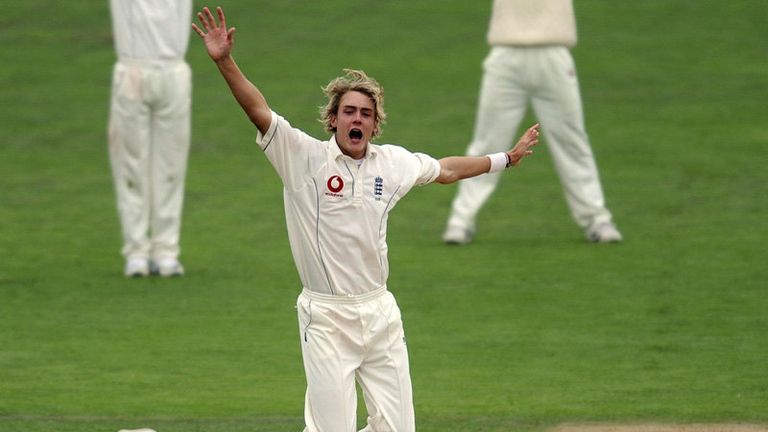
The last England player to score as many runs in a match (73) and take as many wickets in a match (5) as Stuart Broad did in Napier, was Andrew Flintoff in that memorable draw which clinched the Ashes against Australia at The Oval in 2005.
(Lack of) Runs on the board
England became the ninth team to lose their third wicket on a score of four or less batting first in a Test Match.
However, they are just the second to convert that poor start into a win, after Pakistan against India at Karachi in January 2006, who were actually nought for three!
Cow corner
Stephen Fleming went into this match, his last of course, needing a total of 113 runs to achieve a Test batting average of 40. Having successfully achieved that aim, he joined the following Kiwis who have averaged over 40 having played at least 20 Tests:
Martin Crowe (45.36); Mark Richardson (44.77); Glenn Turner (44.64); Andrew Jones (44.27); Bert Sutcliffe (40.10).
However, he failed to join Rodney Redmond as the only Kiwi to score a century in his last Test. Redmond scored 107 against Pakistan at Auckland in 1973 in a match which was also his first Test!
Andrew Strauss's innings of 177 was his 11th Test century but the first time he had managed to pass 150 in his Test career. It also bettered his first-class career-best of 176 set against Durham at Lord's in 2001. When he reached 117, he passed 10,000 first-class runs.
It was his slowest Test century, coming from 226 balls. His previous slowest was his 199-ball debut century against New Zealand at Lord's in 2004.
Young guns
When he reached 64 in his second innings, Ian Bell became the second-youngest player to reach 2,500 runs for England at the age of 25 years 348 days.
The only player to have reached the landmark at a younger age was Sky Sport's own David Gower, who was 24 years 322 days. The youngest for all countries was Sachin Tendulkar, who was 23 years 43 days.
Tim Southee at 19 years 102 days became the youngest player to play for New Zealand since his captain Daniel Vettori back in 1997 and the seventh youngest Kiwi Test cricketer of all time.
He hit nine sixes in his undefeated innings of 77. Only four players have hit more sixes in a Test innings, these being:
| NAME |
TEAM |
AGAINST |
VENUE |
SEASON |
RUNS |
6's |
| Wasim Akram |
Pakistan |
Zimbabwe |
Sheikhupura |
1996/97 |
257* |
12 |
| Nathan Astle |
New Zealand |
England |
Christchurch |
2001/02 |
222 |
11 |
| Matthew Hayden |
Australia |
Zimbabwe |
Perth |
2003/04 |
380 |
11 |
| Walter Hammond |
England |
New Zealand |
Auckland |
1932/33 |
336* |
10 |
|
Southee's half-century came up in just 29 balls to set a new Black Cap's record, surpassing Ian Smith's 34-ball effort against Pakistan at Faisalabad in 1990.
Catches win matches
When he caught Michael Vaughan in the second innings, Brendon McCullum became the third New Zealand wicket-keeper to reach 100 dismissals.
The only men currently ahead of him are Adam Parore with 200 and Ian Smith with 176 dismissals.
Benedict's bumpers
Ryan Sidebottom took his career-best bowling figures of seven for 47 in New Zealand's first innings. They were also the best figures by an England seamer against New Zealand, surpassing Matthew Hoggard's seven for 63 at Christchurch in 2002.
Sidebottom's 24 wickets in the series trail only George Lohmann's 35 against South Africa in 1895/96 and Colin Blythe's 26 against South Africa in 1907 as the most by an England bowler in a three-test series.
Monty Panesar's 23rd over of the second New Zealand innings was his 1,000th in his Test career.
Benedict answers your questions...
Benedict, When Mark Gillespie resumed bowling on day 3 of the 2nd Test I assume he was on a hat-trick ball. We all nearly over-looked Ryan's hat-trick when it was split across 2 overs, but this is over 2 innings. What is the longest recorded gap (number of balls or time) that a bowler has had to wait for a successful (or even unsuccessful) hat-trick? Thanks, Sheila
BENEDICT REPLIES: Sheila, Records are not kept for all hat-tricks regarding the longest time to complete a hat-trick, but perhaps the most unusual hat-trick was taken by Australia's Merv Hughes. At Perth in 1988-89 he completed a hat-trick in three different overs. He had Curtly Ambrose caught behind with the last ball of one over, ended West Indies' first innings by removing Patrick Patterson with his first ball of the next and more than a day later completed his hat-trick by trapping Gordon Greenidge lbw with the first ball of West Indies' second innings.
Hello Benedict, I would like know the most successful England wicket keeper in recent years and compare them with Chris Read's stats. I still think he is the best wicket keeper in England at the moment. Tony Whitehead, Mansfield
BENEDICT REPLIES: Here are the Test career records of all the men who have kept wicket for England since 2000: As you can see, Chris Read actually has the worst batting average of the lot. However, apart from Tim Ambrose, who has only played three Tests, he has the best record at conceding byes - only 38 conceded in 15 matches, or 2.53 per match.
| NAME |
M |
I |
NO |
Runs |
HS |
Avge |
100 |
50 |
Ct |
St |
| Matt Prior |
10 |
17 |
3 |
562 |
126* |
40.14 |
1 |
4 |
28 |
- |
| Alec Stewart |
82 |
145 |
15 |
4540 |
173 |
34.92 |
6 |
23 |
227 |
14 |
| Tim Ambrose |
3 |
6 |
0 |
204 |
102 |
34.00 |
1 |
1 |
11 |
- |
| James Foster |
7 |
12 |
3 |
226 |
48 |
25.11 |
- |
- |
17 |
1 |
| Geraint Jones |
34 |
53 |
4 |
1172 |
100 |
23.91 |
1 |
6 |
128 |
5 |
| Chris Read |
15 |
23 |
4 |
360 |
55 |
18.94 |
- |
1 |
48 |
6 |
|
Benedict, You have probably been asked this, but is Paul collingwood the leading catcher for England in Test cricket? If not, who is? Eddie Crane.
BENEDICT REPLIES: Paul Collingwood currently has 43 catches in the field for England in Tests. However, he is a long way behind the all-time leaders. Five men have more than 100 catches and Marcus Trescothick ended his international career with 95. The top five are as follows:
| NAME |
CATCHES |
MATCHES |
| Ian Botham |
120 |
102 |
| Colin Cowdrey |
120 |
114 |
| Walter Hammond |
110 |
85 |
| Graham Thorpe |
105 |
100 |
| Graham Gooch |
103 |
118 |
|
Email Benedict
here or fill out the comment form at the bottom of the page and he will answer your questions.