
Swann on song
Tuesday 13 January 2009 14:04, UK
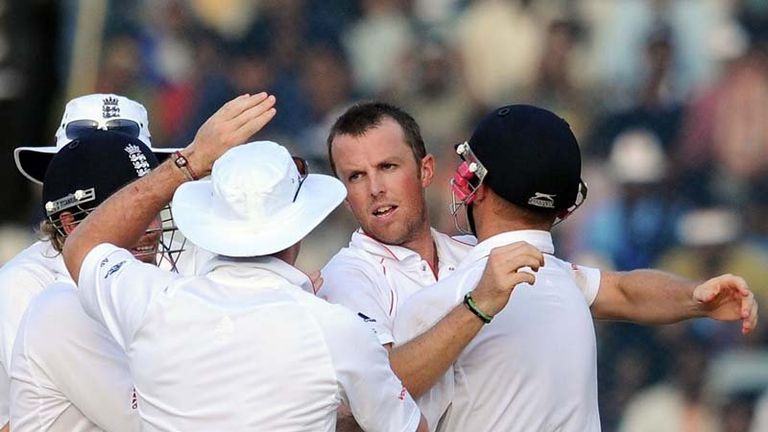
Benedict Bermange picks out the statistical highs and lows from England's Test series defeat to India.
Benedict's back with more stats and facts
Sky Sports' cricket stats man Benedict Bermange has teamed up with skysports.com to bring you all the statistical highlights from our past week of cricket coverage. The glorious game will be brought to you in numbers as Benedict unearths relevant historical facts that have arisen from the past seven days in the world of cricket. He will also be on hand to answer your statistical cricketing questions, be it about an existing record, player, team, ground, umpire or the laws of the game. If you've been stumped by a quiz question down the local or you have come across a fact or stat during Sky Sports' cricket coverage that you must have verified to cure your insanity, then Benedict's your man. Whatever has been puzzling you, just email Benedict here or fill out the comment form at the bottom of the page and he'll answer your questions.Ducking the issue
The Chennai Test between India and England was just the seventh decided Test in history where no batsman failed to score. The other Tests were:| Home | Away | Venue | Season |
| Australia | England | Sydney | 1907/08 |
| West Indies | Australia | Georgetown | 1972/73 |
| Australia | England | Sydney | 1974/75 |
| Australia | Pakistan | Sydney | 1983/84 |
| Australia | South Africa | Sydney | 2001/02 |
| Sri Lanka | Bangladesh | Colombo | 2005/06 |
The game also saw Andrew Strauss become the 100th batsman in Test cricket history to aggregate 4,000 runs in a Test career. Strauss became the tenth England player to score a century in each innings of a Test, and the first in the subcontinent. He is now the second batsman to make a hundred in each innings of a Test match for England against India. Graham Gooch (333 & 123) had made a triple century and a century at Lord's in 1990. Graeme Swann, by dismissing Gautam Gambhir and Rahul Dravid with his third and sixth balls respectively, became the second bowler after Richard Johnson (England) to capture two wickets in his first over in Test cricket. Johnson achieved the feat, against Zimbabwe in the 2003 Chester-le-Street Test. With his 32-ball fifty, Virender Sehwag set a record for the fastest Test half-century by an Indian batsman against England. Sehwag's 32-ball half-century is now the second fastest by an Indian batsman in Test cricket, next only to Kapil Dev's 30-ball fifty against Pakistan in the 1982-83 Karachi Test. Sehwag now has 65 sixes in Test cricket - a new Indian record for most career sixes, bettering Kapil Dev's tally of 61 MS Dhoni became the first Indian captain to win his first four Tests in charge. However, the draw at Mohali meant that he fell short of Percy Chapman's record of winning his first nine Tests in charge - set from 1926 to 1930. Australian Warwick Armstrong won his first eight - from 1920 to 1921. Sachin Tendulkar's 41st Test century is his seventh against England but is only his third in the fourth innings of a Test, and the first among them to feature in an Indian win. Gautam Gambhir and Rahul Dravid put on 314 for the second wicket at Mohali, India's second-best partnership stand against England for any wicket in Tests, next only to the 316 between Yashpal Sharma and Gundappa Viswanath and Yashpal Sharma for the third wicket in the 1981-82 Chennai Test.
Captain fantastic
Kevin Pietersen's innings of 144 is the highest by an England captain in India. It is the fourth century by an England captain on tour there:| Score | Name | Venue | Season |
| 144 | KP Pietersen | Mohali | 2008/09 |
| 126* | ER Dexter | Kanpur | 1961/62 |
| 125 | AR Lewis | Kanpur | 1972/73 |
| 103 | AW Greig | Calcutta | 1976/77 |
| Name | Against | Venue | Season | Runs | Balls |
| IVA Richards | England | St John's | 1985/86 | 110* | 58 |
| CG Greenidge | New Zealand | Auckland | 1986/87 | 213 | 384 |
| BC Lara | Pakistan | Multan | 2006/07 | 216 | 262 |
Prolific Proteas
South Africa's successful fourth-innings chase of 414 against Australia at Perth is the second-highest in Test history and the highest-ever by a visiting team. Two of the highest five chases have been achieved in the past couple of weeks:| Score | Overs | Team | Against | Venue | Season |
| 418-7 | 128.5 | West Indies | Australia | St John's | 2002/03 |
| 414-4 | 119.2 | South Africa | Australia | Perth | 2008/09 |
| 406-4 | 147 | India | West Indies | Port-of-Spain | 1975/76 |
| 404-3 | 114.1 | Australia | England | Leeds | 1948 |
| 387-4 | 98.3 | India | England | Chennai | 2008/09 |
Mitchell Johnson's bowling figures of 8-61 in South Africa's first innings are the best in Test history by a left-arm fast bowler, surpassing Mike Whitney's 7-27 for Australia against India also at Perth in 1992. Jason Krejza is the only bowler to start his Test career by conceding at least 100 runs in the first four innings in which he has bowled. However, six bowlers have conceded three figures in five consecutive innings.