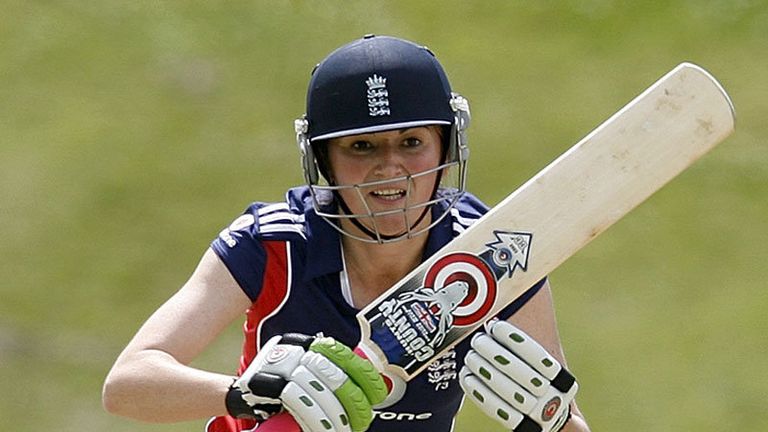
England's women embark on their ninth World Cup campaign when the action gets underway live on Sky Sports on March 9.
Watch the ninth Women's World Cup live on Sky Sports
England's women embark on their ninth World Cup campaign when the action gets underway live on
Sky Sports on March 9.
The ICC tournament, which will be played across six venues in Australia, lasts for 15 days and adopts the same format as the men's event with two group stages eventually narrowed down to the Super Six knock-out round.
England have competed in every World Cup since the competition was first staged in 1973 and have scooped the trophy on two occasions (1973 & 1993).
Captain and ICC Women's Player of the Year for 2008 Charlotte Edwards leads England Down Under in what will be her fourth assault on the coveted trophy.
Edwards' troops are in all-Asia company as they attempt to progress out of a Group B which includes sub-continent trio India, Sri Lanka and Pakistan.
With wins over West Indies, South Africa, India and Ashes joy over Australia under England's belts in 2008, Edwards & Co head to the southern hemisphere as one of the favourites to clinch their third World Cup.
Skysports.com now takes a look back in the archives at where the eight previous World Cups were won and lost.
World Cup 1973 - winner England
The inaugural Women's World Cup was hosted - and won by - England as seven teams contested the 60-over event.
Australia, New Zealand, Trinidad and Tobago and Jamaica all travelled north with an International XI and a Young England XI making up the teams.
In the round-robin league format, England faced Australia in the last match trailing the Aussies by one point. But a 92-run victory at Edgbaston helped England leapfrog Australia to become the first team to lift the World Cup.
One of England's all-time greats - Enid Bakewell - struck a fine 118 in the final to inspire England (279-3) to a 92-run win over Australia (187-9).
World Cup 1978 - winner Australia
Australia got their revenge on England five-years later as just four teams contested the 1978 World Cup in India.
Australia, England, New Zealand and the host nation battled it out in the sub-continent in a round-robin format before the Aussies went on to win what was to be the first of five World Cups while England finished as runners-up with two wins and a loss.
New Zealand managed a solitary victory and suffered two defeats while India remained winless.
Margaret Jennings of Australia was the leading scorer with 127 runs while the bowling honours went to team-mate Sharyn Fitzsimmons who took seven wickets.
World Cup 1982 - winner Australia
New Zealand staged the 1982 tournament as the same four teams from the previous World Cup were joined by an International XI.
The teams played each other three times with the top two teams qualifying for the final.
After 12 rounds, Australia were a cut above the rest with 11 wins while England won seven and lost three. New Zealand won six and lost five, India won four and lost eight and the International XI failed to win a match.
This tournament also included the first tied matches in women's cricket - England remarkably appearing in both the matches against New Zealand and Australia.
In the final, Australia (152-7) defeated England by three wickets to retain the title in Christchurch. England batter Janette Brittin was the star of the tournament scoring 391 runs, while Australia's left-arm spinner Lyn Fullston (23 wickets) finished as the leading wicket-taker.
World Cup 1988 - winner Australia
Australia celebrated their third consecutive World Cup triumph in 1988 with victory on home soil.
India opted not to participate and the International XI were also not involved but the inclusion of Ireland and the Netherlands ensured that the event retained its status as a five-team tournament.
The Aussies won seven of the eight preliminary-round matches to earn a final date with England, who themselves won six matches and lost two.
The December 18 final at the Melbourne Cricket Ground was an utterly one one-sided affair as Australia (129-2) romped to victory by eight wickets to complete a hat-trick of titles.
World Cup 1993 - winner England
The World Cup returned to England in 1993 with a total of eight teams vying for the top prize.
The tournament was staged on a single-league basis with the top two sides - England (six wins) and New Zealand (seven) - going through to the final.
India won four games, Ireland and the West Indies were victorious twice and the Netherlands and Denmark claimed a solitary win apiece.
In the final at Lord's, England regained the title with an impressive 67-run win over New Zealand. England batted first and scored 195-5 before New Zealand were bowled out for 128.
World Cup 1997 - winner Australia
The World Cup returned to India in 1997 with a record 11 teams contesting matches all across India - New Delhi, Agra, Chennai, Mysore, Hyderabad, Ghaziabad, Bangalore, Vijayada, Faridabad, Chandigarh, Pune, Mumbai, Baroda, Nagpur and Gurgaon.
With more teams involved, the format of the event was revised with the teams split into two groups with quarter-finals, semi-finals and the final.
Australia won all four of their pool matches to top Group A ahead of England while New Zealand topped Group B with three wins, followed by hosts India on two.
In the quarter-finals, Australia (223-4) beat the Netherlands (108) by 115 runs, England (105-1) beat Sri Lanka (104) by nine wickets, India (81-5) beat South Africa (80) by five wickets and New Zealand (244-3) defeated Ireland (105-9) by 139 runs.
In the semi-finals, Australia (123-7) beat India (104-9) by 19 runs in a reduced 32-overs-a-side match while New Zealand (175-6) earned a final date with Australia by defeating defending champion England (155) by 20 runs.
In the final, Debbie Hockley, who finished as the leading run-getter with 456 runs, struck 79, however it proved futile as Australia (165-5) beat New Zealand (164) by five wickets.
World Cup 2000 - winner New Zealand
New Zealand hosted its second World Cup in 2000 as the event returned to its old format of eight teams playing on a single-league format with the top two teams qualifying for the final.
Defending champions Australia were unbeaten throughout while trans-Tasman rivals New Zealand finished second with six wins, followed by India on five, South Africa with four, England with a disappointing three, Sri Lanka with two wins, and Ireland and the Netherlands with a win apiece.
In the final, New Zealand avenged their six-wicket defeat in the tournament opener to stun Australia by four runs in the most dramatic final to date.
The Aussies looked destined for victory when poised on 85-2 in pursuit of 185 for victory, however they collapsed to 150-6 before losing by just four runs. The victory also ensured Kiwi legend Debbie Hockley bowed out in style.
World Cup 2005 - winner Australia
The Women's World Cup came to South Africa in 2005 as the West Indies replaced the Netherlands in the eight-team format with the top four teams progressing to the semi-finals and then the final.
Australia, India, New Zealand and England progressed to the semi-finals before India prevented a repeat of the 2000 final being set-up after a shock win in Potchefstroom.
England were on the receiving end of a five-wicket loss to Australia and defending champions New Zealand slumped to 40-run defeat to Mithali Raj's India
The final, as many predicted, proved to be one-way traffic for Australia who went on to claim their fifth World Cup with a comfortable 98-run win.
England's Charlotte Edwards was the leading run-scorer in the tournament with 280 runs.
ICC Women's World Cup 2009 - winner ?
This year's tournament in Australia will see the world's top eight teams - holders Australia, England, India, New Zealand, Pakistan, South Africa, Sri Lanka and the West Indies - compete at six venues live on
Sky Sports from March 7-22.
Led by the influential Edwards, England also have a weapon in batter Claire Taylor who often weighs in with valuable runs at the top of the order. Promising wicket-keeper Sarah Taylor and fast bowler Katherine Brunt are also key to England's chances of success.
Tune into
Sky Sports 1 from 11pm on Monday March 9 for every ball of England's opening match against India.