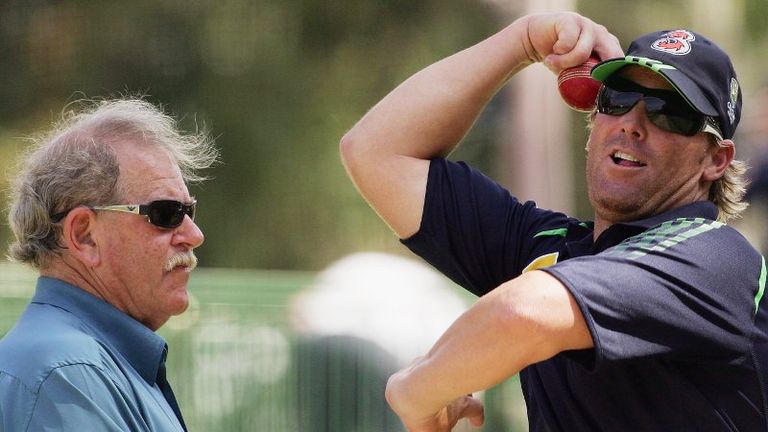
Pro coach Sam Lavery pays his own personal tribute to the late Terry Jenner in his latest coaching blog.
Pro coach Sam Lavery pays his own personal tribute to the late Terry Jenner by spreading the message of how to perfect the art of spin bowling
Following the awful news of Terry Jenner's recent passing, I thought it would be apt to spend some time thinking about spin bowling, and trying to spread the message that Terry did so successfully and passionately himself, moulding so many spin bowlers around the world, including the king himself, S. K. Warne.
So this week I've spent time talking to Mark Lawson and Andy Gray, two first-class cricketers themselves and two of
Pro Coach Cricket Academy's specialist spin coaches, who have also spent many hours working with Terry as they learnt the art of spin.
As with any part of cricket there is no set way a skill has to be executed, everyone has their own slight variation, and personal twist (or spin!) on technique which makes them who they are, and if it wasn't for this then we would be exactly the same - robotic, and in know way is that what we want to produce.
One thing Terry did believe in as a spin bowling coach however was an "ideal", a method of bowling that we should all be striving towards achieving, and from this "ideal" he had developed a set of guidelines or technical points that he'd always encourage a spinner to have.
It has often been easy to spot who has had a winter with "TJ", as he was known to many, as various traits of his work would start to appear in bowlers that were not there before.
Physical characteristics of body shape and movement in their action always showed Terry was still hard at work behind the scenes passing on his knowledge. It also illustrated the regard in which others held him around the world that so many would go to him, the 'Spin Doctor', as he became known.
This week I'm going to consider a few of those guidelines that Terry looked to encourage in spinners, which always started with "you have to spin the ball". Some simple fundamentals though, that to me make sense, and have obviously made sense to so many spinners around the world, with whom he was able to make a difference.
We'll work through the position we'd all strive to attain as we arrive at the crease, as well as thinking about how me move into this position and then what we do after we've release the ball.
Feet - the ideal for our feet as a spinner is quite simple, our back foot should be parallel to the crease, while our front foot should be angled at around 45 degrees from our target. The reason for this is a bit of a compromise between two things any good spinner needs, forward momentum, and rotation.
If our front foot was to point straight down the pitch towards our target, it would indicate we were carrying a lot of forward momentum towards the target, and also make continued movement of this energy easily channelled in this direction.
However another key element of bowling spin is rotating. "Spin bowling is a side on art" was always one of Terry's opening lines, and he was right. Getting side on gives our body the opportunity to rotate fully through 180 degrees, and so maintaining this side on position at the crease, and then rotating would actually be made easier by having our front foot parallel to the crease, in the same manner as our back foot. And so this is where the compromise lies, 45 degrees allows us to continue channelling our energy forwards in the direction we're travelling, whilst also setting us up in a position from which we can hopefully rotate effectively through 180 degrees.
The alignment of our feet in relation to each other is also key to the direction of our body weight. So if you were to imagine drawing a straight line from the tip of your big toe on your back foot as it lands, through the tip of the big toe of your front foot as it lands, and the you continue this line for another 20 or so yards, in an ideal world this line would be directly pointing towards your target area. Just quickly, the direction of our alignment here isn't actually directly at the target where we want the ball to end up, and it's often not where we want the ball to land. It is in fact the initial trajectory that we want our body weight and the ball to go, prior to any drift or spin.
Master
Alignment was always something Terry invested a lot of time in. Landing with our feet closed off not only means our weight isn't moving in the right direction, but as we strive to move towards our target our body is moving one way and our feet another, and so our feet won't remain underneath our head and body throughout our action. This makes maintaining our balance as we release the ball pretty tough, and as a result we will fall away to the off side losing accuracy. This will also often leave us bowling top spinners rather than that perfect leggie we were striving for.
Having this alignment straight towards our target with our feet, also sets an easier path for the hips to rotate through, making that all-important rotation of the body an easier process to master.
As you can imagine with a side-on action our hips and shoulders also need to be sideways on, to offer this potential for maximum rotation, so getting them side on prior to delivery is key.
You should in fact be able to draw a line through your hips and shoulders, which should point directly at your target, likely to be around middle and leg for a leggie, or six inches outside off stump for an off spinner.
From here we just want to position our arms forward in front of the body, the bowling arm and ball can be up at head height almost, fairly straight with the wrist cocked, and pointing towards our target. The front arm should again be out in front of the body and on a 45-degree angle.
This is for the same reason as the front foot being in this position, if our front arm was completely vertical it would help us generate forward momentum, where as if it was completely horizontal it would help us generate rotation, so we again look for that compromise, or trade off between the two.
The reason we look to get our arms out in front of our body is to encourage a forward lean and forward movement all the time, any movement away from this just decreases our momentum, and generating this momentum, or energy, is one of the great secrets of consistency. With momentum moving towards the target, there's less demand on the speed to come from our arm.
You'll often see bowlers with a lack of momentum towards the target, or poor alignment, having a very rushed action, where as those who are well aligned always appear a to have a little more time to bowl the ball.
It's also no coincidence that the faster you're arm is travelling at the point of release, the more precise you have to be with your point of release, and so the increased chance of error, and what does an early or late release effect... the length.
So often the downfall of a promising spinner, a short ball or a full toss can happen a little too often. To be consistent our energy needs to come from our approach, from our hips and shoulders rotating, as well as from our arms driving towards are target, and we need all of these to contribute in small amounts, rather than relying on one of them, most likely our arms, to do all the work.
Energy
Now achieving a position similar to the one I have described is pretty difficult when standing still, and most professional spinners will spend hours on end bowling from stationary to teach their bodies the ideal position from which to bowl. So, putting six or eight steps in front of it in the form of an approach and then trying to hit that position is pretty tough.
As a result the run up has to be very precise to allow us to achieve everything we need to be successful. The key points here are developing momentum, getting into a side-on position and above all being well aligned, and so the run up has to allow for all of these to happen.
There's no golden rule to how it must be but just think about a few things next time you're pacing it out. It needs to be straight enough to get us into a position where we can have a well-aligned base, however having a very slight angle does help develop the side-on position.
It needs to be rhythmical and build gradually in pace and energy with balance and control, and needs to end with a jump that drives forwards. It also needs to be big enough to allow us to rotate into a side-on position, but isn't so big that we lose all control and balance. The ideal would see a straight run-up that still let's us get perfectly side-on, however achieving this is pretty tough sometimes.
Now we've run in, we've jumped and hit our ideal side-on position, we've maintained our alignment of our feet hips and shoulders towards our target, so what happens next?
Well that's saved for next week, where we'll talk about actually bowling the ball, following through and completed our action, as well our grip... mind you that's an easy one, especially for a leggie, "2 up 2 down" TJ always used to say, referring to your index and middle fingers as the first two which you have up, or straighter, and the ring and little fingers as the second two, which were down or bent.
Just try it, put your hand in front of you, straighten the first two fingers and bend the others. "2 up 2 down... and pop the ball in the middle!!"
Spend the week experimenting on your stationary position and let me know how it goes
sam.lavery@procoachcricketacademy.com.
For information on coaching courses or sessions nationwide, visit
the pro coaching academy website or follow me on twitter
@SamLaveryPCCA.