
F1's drivers unruffled by team radio message crackdown for Singapore GP
Perez and Maldonado, however, question timing of new restrictions while Caterham's Ericsson flags up problems for teams who still use old-style steering wheels
Thursday 18 September 2014 14:11, UK
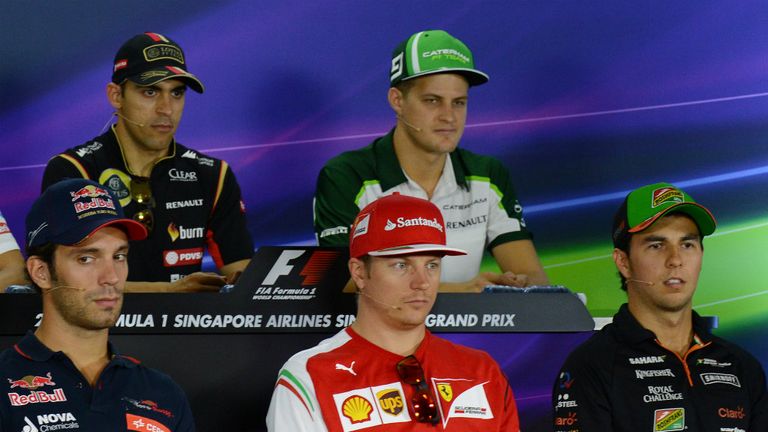
Formula 1’s drivers are braced for an increase in their workload in the cockpit in Singapore following the clampdown on team radio, but are confident they will quickly adjust to the new restrictions.
From Friday practice onwards at Marina Bay drivers will have to complete the sessions without as much input from their race engineers over the pit-to-car radio following the FIA’s decision to more stringently enforce Article 20.1 of the Sporting Regulations, which states that “the driver must drive the car alone and unaided”.
While basic communications from the pitwall related to pit strategy and gaps to other cars are still permitted, drivers are now not allowed to be told things related to performance, such as power unit settings or the status of fuel saving.
The immediate changes naturally proved the main topic of discussion when the paddock convened in Singapore on Thursday and, by and large, the drivers were largely unruffled by the new interpretation.
Ferrari’s Fernando Alonso claimed he and his engineer rarely discussed items on the now-prohibited list of messages anyway, and predicted that the changes will have little material effect on competiveness or driver performance through the grid.
“No big difference to be honest, that’s it’s going to have a huge impact in the race itself or the weekend preparations, at least in our case,” the Spaniard told reporters.
“We’ve never used the radio for any performance reasons or something like that. Just to control temperatures, to talk about traffic or decide strategies. In our case it won’t have a big impact; other teams, I don’t know how exactly they use the radio, for what purpose.
“Talking about the general rule itself, [there’s] a lot of media attention like the FRIC ban but then the final impact from the race results was not anything special. Here will be similar.
“You can talk with your players if you’re a coach in football or basketball. But at the end it’s the player that shoots the ball – or the driver that drives the car.
“Some recommendations or whatever won’t change the driving style.”

Appearing in the Drivers’ Press Conference, Force India’s Sergio Perez admitted that while the timing of the change was odd, coming as it does six races before the end of the season, drivers would adjust to the relative radio silence.
“I don’t think it’s ideal that suddenly from one race to another they change it dramatically that you cannot get certain calls. But it doesn’t influence that much,” Perez said.
“I don’t see it as a big deal. It’s sometime we as drivers need to get more used to. We will have definitely more information and we’re going to be a bit busier throughout the race to basically keep everything under control, fuel loads and engine modes and all that kind of stuff. I don’t see a problem to get used to it, it’s just a dramatic change from the last race to this one.”
While Lotus’s Pastor Maldonado suggested the changes in this year of all years was not exactly ideal– “for sure it’s not the greatest thing, especially with all the complex systems we have at the moment,” the Venezuelan admitted – Ferrari’s famously reticent Kimi Raikkonen said things would be trickier for drivers when their cars started playing up.
“Obviously we don’t speak a lot on the radio in my case