
Gearing up for 2014: The rule changes uncovered and explained - Part One
Martin Brundle and McLaren Technical Director Tim Goss talk us through F1's biggest shake-up for a generation
Thursday 6 February 2014 09:08, UK
The 2014 rule shake-up is the biggest since...when exactly?
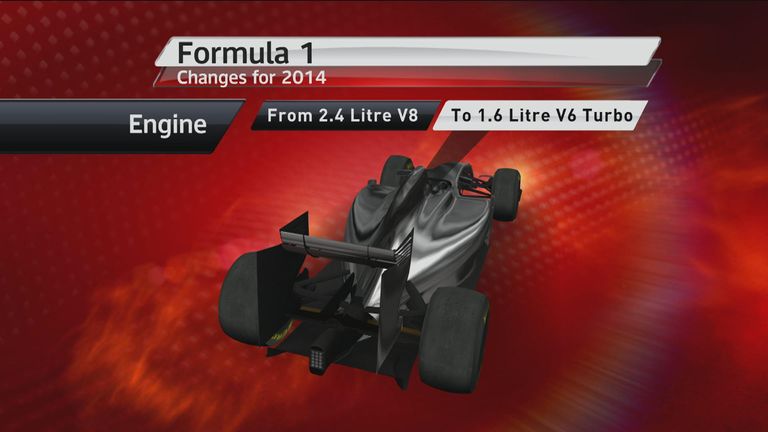
2014 - The facts EngineThe normally aspirated 2.4-litre V8 engines used from 2006 until last season have been replaced by 1.6-litre V6s with a single turbocharger and rev. limit reduced from 18,000 rpm to 15,000 rpm. The original intention was for four-cylinder turbo engines limited to 12,000rpm but that plan wilted in the face of opposition, notably from Ferrari. Fuel
Fuel is injected directly into each cylinder and mass flow is controlled according to a formula which does not allow the rate to exceed 100kg/hour. Furthermore, the amount of fuel cars will start races with comes down from around 150kg to 100kg, meaning an effective increase in efficiency of approximately 33 per cent. ERS
This is where the additional power will come from. Cars already use KERS, of course, and the device remains. However, heat energy will also be recovered from the exhaust turbine (which spins the turbo). The systems are known as Motor Generator Units (MGU-K and MGU-H respectively) and the cumulative effect will roughly be tenfold: whereas KERS in its previous guise gave an 80hp boost for 6.7 seconds per lap, ERS will offer 161bhp for 33 seconds - making the 'push to pass' button a thing of the past. A maximum of 4MJ of energy can be stored per lap. Engine + ERS = Power Unit
This is the term being applied to the combination of hydrocarbons and voltage outlined above, although whether it catches on is another matter. Depending on how good a job Mercedes, Renault and Ferrari do, it is anticipated that overall power will remain in the region of 750bhp. Something that definitely will be heard this year, however, is the actual sound of an F1 engine in the pitlane. The FIA's original intention had been for a reliance on electrical power only but this has now been put back to 2017. Only five power units will be allowed this season (eight engines were previously permitted) and any use of an additional complete power unit will result in the driver having to start the race from the pitlane. Meanwhile, any changes of individual elements, such as turbo, MGUs or energy store, will result in a ten-place grid penalty. They will therefore need to last at least 4,000km rather than 2,000km. As is currently the case, there will be a 'freeze' with power units homologated by the FIA between 2014 and 2020. However, changes will be allowed for "installation, reliability and cost-saving reasons" while manufacturers will probably also be given the chance to make up any performance shortfall. Gearboxes
Eight-speed gearboxes replace the previous seven while ratios will be fixed for the season (although they can be re-nominated in 2014 only). Gearboxes must also last for six consecutive races, an increase from the current five. Chassis
Here, too, the changes are intended to boost efficiency, yet the FIA announced in December 2012 that "changes made to bodywork design, originally aimed at reducing downforce and drag for increased efficiency, have reverted to 2012 specification". Ideas such as reverting back to ground effects - whereby a Venturi tunnel on the car's underbody generates downforce without the drag - were initially mooted but what has emerged carries, in truth, a large degree of compromise. But that's not to say the changes are insignificant. The most fundamental change is at the front of the car, where a narrower front wing