
F1 review 2011
Sebastian Vettel might have retained the world title in dominant fashion, but delve deeper into the 2011 season and there was still plenty to excite fans. Skysports.com picks out some highlights.
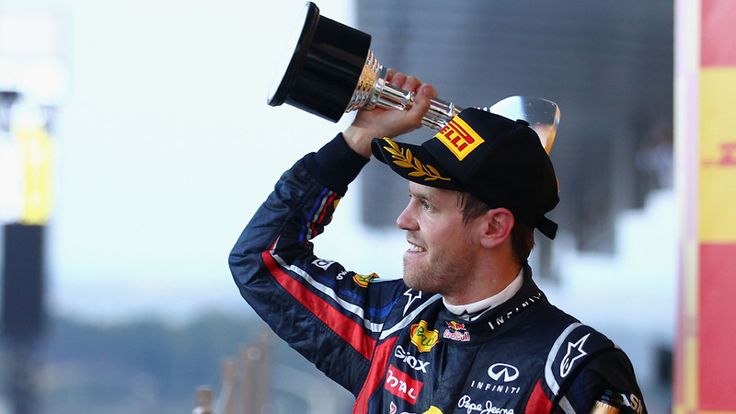
Thursday 22 December 2011 10:02, UK
Skysports.com reviews the 2011 season which saw Sebastian Vettel retain the world title.
On the face of it, a season that saw a world champion retain his title with 11 wins in 19 races doesn't sound too exciting and whilst it's true that 2011 can hardly be described as a vintage year for Formula 1, there was still plenty of interest for those who cared to give the sport more than a cursory glance. From the start, the form of Sebastian Vettel and Red Bull appeared ominous, with the German at times appearing to toy with the opposition. Rivals got a look in occasionally but in truth it never seemed likely that Vettel would stumble. At the age of 24, he therefore stands as F1's youngest double world champion and, alongside Fernando Alonso and Lewis Hamilton, arguably the most complete driver in the sport. The latter pair both endured a frustrating year, with Alonso grappling a Ferrari that failed to deliver upon its pre-season promise while Hamilton endured his worst season yet in F1. Bested by McLaren team-mate Jenson Button in the standings and bedevilled by problems both on and away from the track, Hamilton at times cut a sombre figure in the paddock. Yet he still scored three wins, two more than Vettel's own team-mate Mark Webber, who can be forgiven for feeling a little shell-shocked as the year reaches its close. Elsewhere, Michael Schumacher was again seen to struggle in comparison with his pomp - seeming a more likeable figure as a result - while Paul di Resta made a solid, if not spectacular start to his F1 career. Vettel might have walked it but all the way down the grid there were battles to be fought, intrigue to be unpicked and excitement to be had; with 12 teams and 24 competitors herded on to one 'field of play' the possibilities are many. Factor in a continuous stream of technical and tactical innovation and sprinkle some sharp political manoeuvring on top, then it's quite some recipe. Perhaps someone should come up with a dedicated TV channel to cope? Driver of the season: Sebastian Vettel Vettel's title success last year was a smash and grab affair. Having not led the drivers' championship all season, he took the final race by the scruff of the neck and delivered whilst his rivals floundered. That race in Abu Dhabi set the pattern for 2011 - one that has repeated itself so often it's almost as if, casting one's mind back, the 19 races have melded into one. In fact, Vettel won 11 times but it was the manner in which he achieved the majority of those successes which gives the 2011 season a plotline akin to that of 'Groundhog Day'. The young Weltmeister invariably failed to show his hand until qualifying, and even then it would only be in Q3 that we were left under no illusions that, once again, it was business as usual. Fast forward 24 hours and Vettel would streak clear at the lights (or bluntly chop across any rival who even dared to make a better start) before building a lead. His Red Bull's working of Pirelli's new rubber ensured this advantage was never quite that which he might have eked out in the previous two seasons and yet Vettel's ability to manage his tyres time after time, whilst keeping just out of reach of his nearest pursuer, took his success way beyond the simplest of equations i.e. the fastest driver in the fastest car. It didn't work out all the time - Lewis Hamilton passed him to win in China - while one wheel out of place in Canada was all it took for Jenson Button to take advantage. Such mishaps, though, shrivel when placed next to the wins he delivered when things did not appear to be going quite to plan: in Belgium, a race that featured eight changes of lead during the early laps but ended with Vettel on top, despite having to deal with the threat of a tyre blowout; and then in Italy. The latter victory, achieved on a track that hardly suited his car, was the German's best and might be seen as the moment of affirmation. Vettel retained his title two races later in Japan but by then the writing had long been on the wall. Race of the season: The Canadian Grand Prix Jenson Button's win at Suzuka was his fifth for McLaren but first in totally dry conditions. It came towards the end of a season in which he finished above team-mate Lewis Hamilton in the standings - a real achievement when one remembers some of the predictions made when, even as the new world champion, Button left Brawn GP at the end of 2009. Hamilton's season has, to say the least, been one of contrasts and whether or not one agrees with team boss Martin Whitmarsh's assertion that Button's form was a contributory factor (funnily enough Hamilton did not) there's no denying that the latter's 12th season is up there with his championship year. Perhaps it's been even better. As a driver noted for his smoothness, there is an irony that Button seems to excel in races that run anything but. The most chaotic this year took place in Montreal and took over four hours to complete after a storm hit the Circuit Gilles Villeneuve. By that stage Button had already been hit by Hamilton ("What's he doing?") and was then to collide with Fernando Alonso. The latter incident punted him down to 21st and last place just past half distance but as the track started to dry, there then came a response: back in the points 12 laps later, Button was up to second after passing Mark Webber and Michael Schumacher on laps 64 and 65 respectively before taking the lead when Vettel ran off the dry line on the 70th and last lap. The Chinese Grand Prix, in which Hamilton hunted down and passed Vettel during the closing laps, might have produced tension of a slower burning kind, while the latter's win at Monza was as fine an example of both guile and balls-out bravery as you're likely to see. Yet neither could match Montreal for excitement and unpredictability. Team of the season: Red Bull It's been three-and-a-half years now since Mark Webber claimed Red Bull's first front row start at Silverstone and because of how things have largely been since, there's almost a quaintness to the excitement that particular breakthrough created. Armed with successive drivers' and constructors' titles, the Milton Keynes outfit are for now big hitters; whether that stays the case will depend both on the commitment of team owner Dietrich Mateschitz as well as Red Bull's ability to maintain - indeed to add to - the key ingredients for their success. After all, were Renault not enjoying similar success five years ago? This year's RB7 was the fifth design to come from the pen of Adrian Newey and, with 12 victories from 19 races, it was his most successful yet. A record of 18 poles from 19 races tells its own story in terms of outright pace, with the car's tendency to chew rubber marginally faster than its rivals a negative only if one's business is one of splitting hairs. Its ability to generate downforce was such that Red Bull could afford to run less wing (and more DRS, particularly in qualifying) than their rivals when it suited: like at Monza where, despite still lagging behind in top speed on the speedbowl's long straights, their speed through the bends more than compensated. Its effectiveness also masked struggles with KERS, particularly at the start of the season, and while Red Bull might have dusted down the idea of a blown diffuser last year, that was only part of the reason for their success. When the use of off-throttle blown diffusers was banned at the British Grand Prix, Vettel and Webber still qualified on the front row and although Fernando Alonso beat them in the race, the advantage he enjoyed that day was arguably as much down to a botched Red Bull pit stop as it was the Spaniard's new and improved Ferrari. Other technical innovations such as the legal flexing front wing, plus strong reliability (neither of the team's two retirements was down to mechanical failure) and teamwork (Red Bull's pit crew were joint fastest in 2011) complete what has been a dominant display. But for how long can they keep it up? Controversy: Lewis Hamilton vs Felipe Massa It must be said that this so-called 'feud' was small fry in comparison with some of the flash points we've witnessed in recent years. From the McLaren/Ferrari spying controversy of 2007, to Renault causing a deliberate crash and even the relative small fry that was last year's Ferrari team orders row, F1 in 2011 brought little in the way of scandal. The ruckus that wasn't started in Monaco before further skirmishes took place in (deep breath) Monaco, Britain, Singapore (during both qualifying and the race), Japan and India - more than enough to suggest something ulterior was happening and yet the reality was more mundane. Hamilton's approach does tend to polarise opinion and it's easy to see why: when it works he's brilliant; when it doesn't, the 2008 world champion still tends to look a bit like a boy trying to do a man's job. Alas for him, the latter has more often been the case this year. Thus, given Hamilton's habit of leaving himself with much ground to make up during races, he would dispense with midfield runners before happening upon the slowest car fielded by a 'big three' team. That car would invariably be driven by Massa, who seems more on edge than ever with his Ferrari future once more open to debate. What tended to follow next would best be filed under the category of 'racing incident' and although words would be exchanged via the media afterwards, they were never particularly harsh. Indeed, each driver still insisted on the qualification of affording the other respect. Just about the worst thing Massa could say about his rival's gung-ho-edness was that it suggests he "cannot use his mind". Does that really suggest a genuine loathing? When they were team-mates at Williams, Nelson Piquet called Nigel Mansell an "uneducated blockhead with a stupid and ugly wife". Now that's fighting talk.