
Pirelli deny blaming teams after announcing immediate changes to their rear tyres
Tyre supplier to act immediately following Silverstone failures; Further changes to be introduced for Hungary; Practice of running tyres the wrong way round found to have contributed to British GP blowouts
Wednesday 3 July 2013 13:03, UK
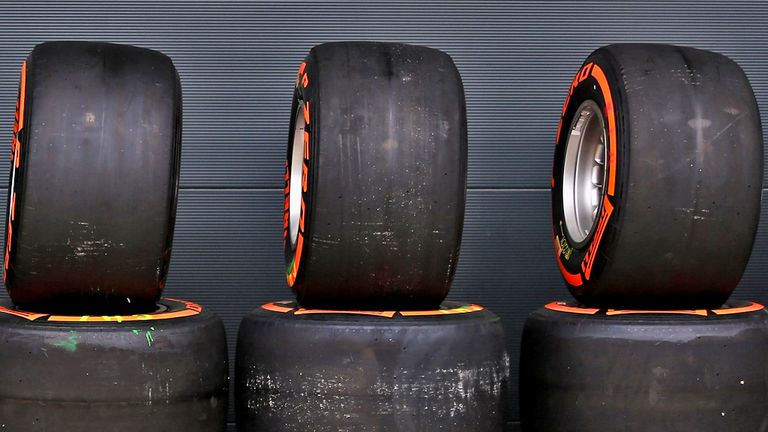
Pirelli have denied blaming the teams for the high-speed failures which marred the British GP after explaining why they will make immediate changes to their much-criticised tyres for this week's German GP.
Pirelli's statement in full'A SERIES OF DIFFERENT CAUSES LED TO THE TYRE FAILURES AT SILVERSTONE: REAR TYRES MOUNTED THE WRONG WAY ROUND, LOW TYRE PRESSURES, EXTREME CAMBERS AND HIGH KERBS 'THE 2013 TYRES DO NOT COMPROMISE SAFETY IF USED IN THE CORRECT WAY 'TO DEVELOP AND MANAGE SOPHISTICATED TYRES SUCH AS THOSE USED IN 2013, IT IS ESSENTIAL TO HAVE ACCESS TO REAL TIME TYRE OPERATING DATA. CHANGE IN THE RULES HAS BEEN REQUESTED 'ARRANGED WITH FIA WINTER TEST AND DURING THE SEASON FOR THE DEVELOPMENT OF THE TYRES THE KEVLAR BELT REAR TYRES TESTED IN FREE PRACTICE IN CANADA WILL BE USED IN GERMANY 'FROM HUNGARY THERE WILL BE A NEW RANGE OF TYRES, WHICH COMBINES THE 2012 STRUCTURES WITH THE 2013 COMPOUNDS. THESE WILL BE TESTED AT SILVERSTONE, USING THE RACE DRIVERS AND 2013 CARS, DURING THE YOUNG DRIVER TEST 'PAUL HEMBERY: "WHAT HAPPENED AT SILVERSTONE UPSETS US. WITH THESE SOPHISTICATED TYRES IT'S VITAL FOR US TO SEE DATA SUCH AS TEMPERATURE, PRESSURES AND CAMBER. WHILE WAITING FOR A REVISION TO THE RULES, WE WILL SUPPLY TYRES THAT ARE EASIER TO MANAGE." 'Milan, July 2, 2013 - After exhaustive analysis of the tyres used at Silverstone, Pirelli has concluded that the causes of the failures were principally down to a combination of the following factors: '1) Rear tyres that were mounted the wrong way round: in other words, the right hand tyre being placed where the left hand one should be and vice versa, on the cars that suffered failures. The tyres supplied this year have an asymmetric structure, which means that they are not designed to be interchangeable. The sidewalls are designed in such a way to deal with specific loads on the internal and external sides of the tyre. So swapping the tyres round has an effect on how they work in certain conditions. In particular, the external part is designed to cope with the very high loads that are generated while cornering at a circuit as demanding as Silverstone, with its rapid left-hand bends and some kerbs that are particularly aggressive. '2) The use of tyre pressures that were excessively low or in any case lower than those indicated by Pirelli. Under-inflating the tyres means that the tyre is subjected to more stressful working conditions. '3) The use of extreme camber angles. '4) Kerbing that was particularly aggressive on fast corners, such as that on turn four at Silverstone, which was the scene of most of the failures. Consequently it was the left-rear tyres that were affected. 'The only problems that had come to light before Silverstone were to do with delamination, which was a completely different phenomenon. To stop these delaminations Pirelli found a solution by suggesting that the teams use the tyres that were tried out in Canada from Silverstone onwards. When this proposal was not accepted, Pirelli found another solution through laboratory testing, with a different bonding process to attach the tread to the carcass. So the problem of delamination has nothing at all to do with what was seen in Great Britain. 'Following the conclusions of this analysis, Pirelli would like to underline that: 1) Mounting the tyres the wrong way round is a practice that was nonetheless underestimated by everybody: above all Pirelli, which did not forbid this. '2) In the same way, under-inflation of the tyres and extreme camber settings, over which Pirelli has no control, are choices that can be dangerous under certain