F1 Legends - Eddie Irvine
Sky Sports F1's Steve Rider met with Eddie Irvine to discuss his F1 career with Jordan, Ferrari and Jaguar.
Wednesday 25 September 2013 12:46, UK
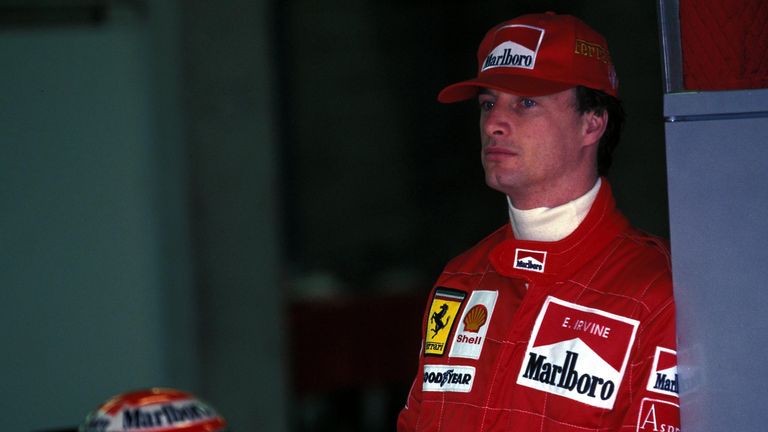
In an era when the tentacles of what is now the sport's all-encompassing PR machine were beginning to make their presence felt in the 1990s, Eddie Irvine was already something of a unique character on the Formula 1 grid.
Certainly few would have anticipated such a scenario ever arising when Irvine arrived in F1 at what by today's standards was a relatively late 27 years of age at the penultimate round of the 1993 campaign in Japan. Having begun his life behind the wheel driving his father's Edmund Sr's historic single-seaters while growing up in Newtownards, County Down, his first competitive racing experiences came in Formula Ford, first in Ireland and then in England. He won the latter series in 1987 before climbing onto the Formula 3 ladder, first in the British category and then onto Formula 3000 initially with Pacific and then Eddie Jordan's operation, with whom he finished third in the series in 1990. Three years in Japanese F3000 followed but rather than proving an effective graveyard for a nascent motorsport career, Irvine proved his worth - finishing as runner-up in 1993 after four wins - and reunited with Jordan this time in F1 at Suzuka, fittingly at the end of that year. The unheralded Briton made quite the early impression too: he qualified eighth in the Hart-powered 193 and finished sixth in the race before being punched in the face by an incensed Ayrton Senna afterwards having had the audacity to unlap himself from F1's then pre-eminent driver. It was quite the arrival... That early controversy followed him into 1994 when at the opening round in Brazil he was adjudged to have been at fault for a frightening four-car collision in which Jos Verstappen's Benetton somersaulted over the top of Martin Brundle's McLaren. Irvine was initially banned for the Pacific GP, but this was then extended to cover both the ultimately fateful weekend at Imola and Monaco after the FIA took a dim view of Jordan's appeal. On his return to the cockpit in Spain, where Irvine delivered a strong sixth-place finish, his already dramatic F1 career settled down and over the next 18 months he continued to vie for intra-team supremacy with Barrichello, even claiming his maiden F1 podium with third place in the 1995 Canadian GP. Then came the call that would define his F1 career. Despite having already been named as a Jordan driver once more for 1996, Ferrari paid compensation to bring Irvine, linked to incoming team sponsors Marlboro, to Italy to serve as number two to new superstar signing Michael Schumacher. "Michael has proved he's the best driver in the world and he will no doubt be a tough nut to crack, but I'm looking forward to the challenge," was Irvine's optimistic outlook as he prepared to join the big time. The reigning back-to-back World Champion certainly did prove a 'tough nut to crack', as did Ferrari's recalcitrant F310 in general. Although Irvine's first race weekend in scarlet appeared to bode surprisingly well as he outqualified Schumacher at the first attempt and then finished third behind the dominant Williams pair, he would only actually only see the chequered flag four more times over the remainder of the year. A depressing mid-season sequence of nine straight retirements - seven of which were for mechanical reasons - ultimately meant he finished the year just a single point better off in the standings than 12 months before with Jordan. In later years, Irvine admitted he had been in awe of how Schumacher had been able to haul that '96 car to three victories and certainly the qualifying gap between the two in that first season - an average of 0.9s and four places in the