
Mike Conley's slow start is perturbing for Utah Jazz
Watch Los Angeles Lakers @ Utah Jazz live on Sky Sports Arena in the early hours of Thursday morning (2am)
Wednesday 4 December 2019 08:23, UK
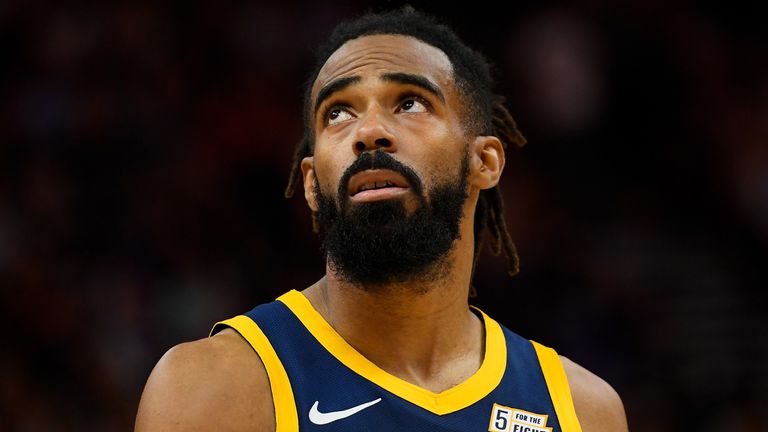
Mike Conley has endured a slow start to his Utah Jazz career and there is a shortage of positive signs that the veteran guard will revert to his previous self, writes Mark Deeks.
Live NBA: L.A. Lakers @ Utah


It was thought that the Utah Jazz had made their biggest flash of the offseason when they traded an assortment of pieces to the Memphis Grizzlies in exchange for Mike Conley.
Allowing Ricky Rubio to leave and sign as a free agent with the Phoenix Suns, the Jazz became only Conley's second NBA team in his 12-year career. With Memphis headed back to the lottery and having the fortune to be able to select Ja Morant in this past summer's NBA Draft, it made plenty of sense that he was available, and a team defined by guile, consistency and headiness hoped it had acquired one of the most heady and consistent veterans of all.
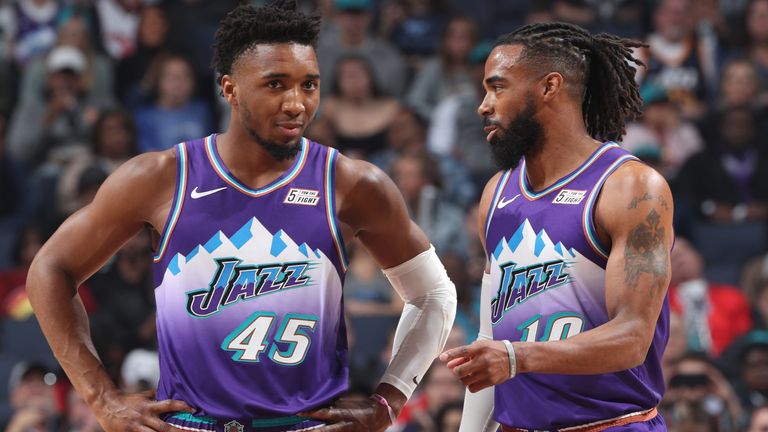
By any measure though, Conley has been a disappointment in Utah that far. He has averaged 13.9 points and 4.6 assists per game through the first 21 contests, numbers that rank below even his career averages, and far below what he has posted over his last couple of full seasons in Memphis.
It is true to say that moving to the Jazz, their motion-heavy offense and having the presence of Donovan Mitchell alongside him has changed his role from what it was in Memphis. This Jazz team features very few specialists and lots of ball-handlers, designed to defend all areas of the court (or at least be able to funnel opponents to two-time defending Defensive Player of the Year Rudy Gobert), while also having a unique bench weapon in the form of Joe Ingles, the reserve point guard and small forward at the same time.
The Ingles factor sees Utah not ever have to struggle with the all-bench line-ups that plague so many other second-tier teams, and the drive-and-kick offense can always function with him at the helm.
Consistency for both Conley and his team, though, has been absent. A streaky Jazz team that has beaten the Milwaukee Bucks and Philadelphia 76ers while losing to the Grizzlies and Sacramento Kings have needed the supposed steadiness of the perennial fringe All-Star to navigate a tough opening schedule. They have not however had it, and there is a shortage of positive signs that Conley will revert to his previous self.
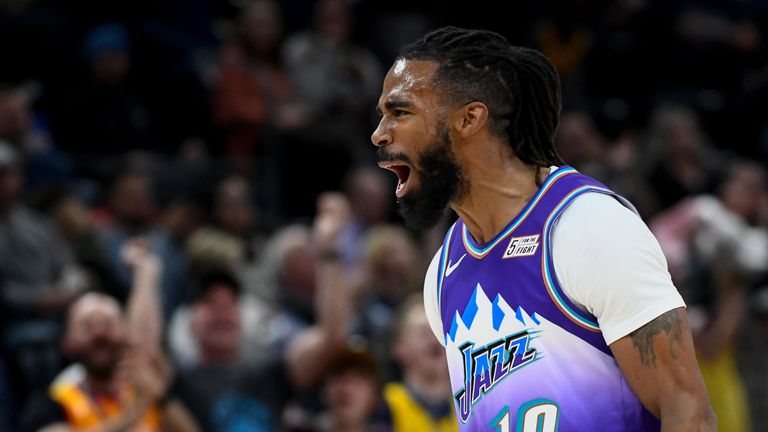
On the season so far, Utah rank 22nd in offensive efficiency. The lack of consistent overall bench contributions, particularly on that end, is a part of why they rank so low on offense. But then, the significant cost of Conley's huge salary is a large part of why they have no bench. If Utah are to achieve competitiveness in the foreseeable future, then this needs to work.
In a look at Utah last season, we specifically explored the future of the starting backcourt pairing of Donovan Mitchell and previous starting point guard Ricky Rubio. We found that starting Rubio, a pass-first ball-dominant point guard who struggles to shoot consistently, along with a starting frontcourt of two non-shooting centers in the forms of Gobert and Derrick Favors, resulted in a sometimes-severe lack of spacing that proved problematic.
The theory was that, due to his well-earned reputation over the last decade for being an excellent shooter, Conley would provide much greater defensive gravity and so room for Mitchell to operate even if his own abilities off the dribble decline. This has been true, up to a point; defenders are more likely to stick with Conley off the ball than they ever were with Rubio, and Mitchell's turnover numbers are down even though he is still as shot-happy as ever. But this is more due to reputation and results.
Teams play Conley as a multi-option threat and help off him with caution. But if he does not make them pay, they will stop. If Conley is not able to get back to where he was, the supposed advantages over Rubio will be removed.
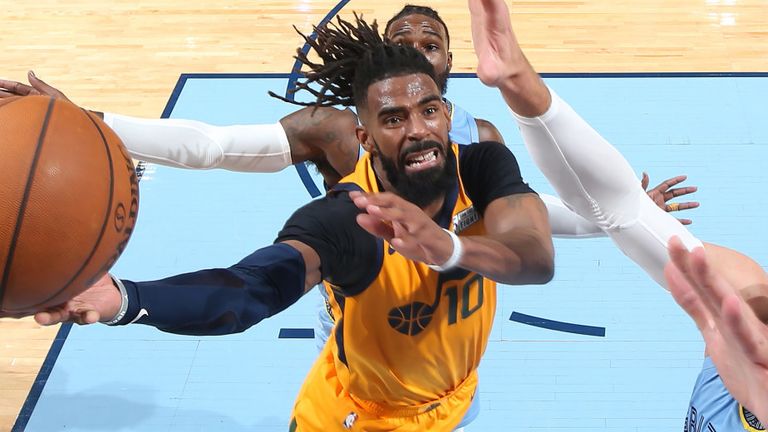
The shooting alone has not been too bad. A late flurry has seen Conley get up to 37.4 per cent three-point shooting on the season, a number entirely in keeping with the 37.5 per cent he has hit in his career. Instead, the problem comes from the fact that he is not able to work off this threat, get into the paint and make anything happen. He is rarely getting to the basket, and missing a ton of runners, floaters and lay-ups when he does so. In tandem, he is therefore taking quite a lot of the game's most inefficient shots - and hitting them inefficiently.
It would help massively if Conley had offset this with better defensive play. Dogged and determined though he is on defense, Rubio struggled with speedsters. Conley, a good-to-great defender for so many years himself, was supposed to add balance and consistency on that end as well. But he has not impressed here either. It appears he has lost his fastball, and quickly.
It also is not as though Conley is playing badly due to being smothered by opposing defenders. The Jazz's addition of Bojan Bogdanovic at the four-spot over the summer in place of Favors was done to upgrade the multi-positional shooting, and the Serbian forward has been everything it was hoped he would be. The Rubio issue vis a vis the lack of spacing with all of he, Gobert and Favors at once should not now happen, with the better balance offered by Bogdanovic.
Therefore, if the idea is that Conley makes other better with his gravity, surely the gravity of others should make him better in return?
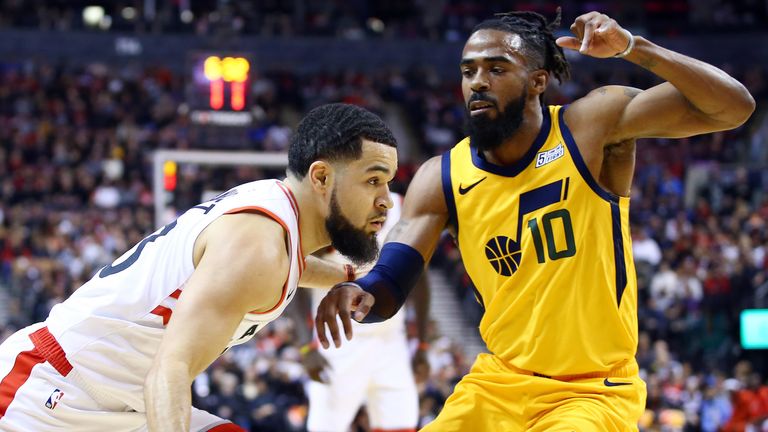
In combination, then, Conley is not impressing on defense, and gravity alone is not enough to overcome lack of impact, the lost athleticism and off-the-dribble reliance. So far on the year, he ranks only in the 36th percentile as the pick-and-roll ball-handler, down from the 81st percentile last season, and is an extremely lowly third percentile in transition down from 53rd.
Jazz coach Quin Snyder's offense does not go through the point guard - the screen, cut and pass motion offense should play well for Conley, more so than the pick-and-roll handling ball-dominant Rubio. The Jazz got bogged down often when Rubio was not in 'God' mode. The Snyder offense also played away from Rubio's strengths - his best skill is by far his passing, but on a team where there is not as much primary playmaking for the point guard to do, this skill became less valuable.
Certainly, when recent addition back-up point guard Emmanuel Mudiay comes into the game, he stops the ball and forces the action, never one to play with any great degree of offensive flow. When viewed in direct comparison to him, Conley looks better. But comparing a player only to his back-up is unfair in the grand scheme of things and excuses the fact that there were more than two options available. The Jazz chose Conley, not just over Rubio and Mudiay but also over all other available targets, and so comparing him to only those two would be disingenuous.
The size of Conley's contract can be rationalised by the fact that it is soon to expire and should not interfere with Utah's longer-term plans, but it is not irrelevant, given the aforementioned bench spending restrictions it imposes.
It has been the excellence of Bogdanovic that has provided the cure to the spacing inconsistency that Conley was supposed to. It is Bogdanovic who has provided the offensive lift and better balance to the starting line-up; it is he that has given Donovan Mitchell more room to work off the dribble.
The hope will be that the same effect can be seen in Conley over the remainder of the season as he adjusts to his new team, system and team-mates. Unmistakably, though, it has been a slow start for him, and the decline in his defense looks perturbing.