Andre Iguodala trade a win for the Miami Heat but not a home run
Saturday 8 February 2020 06:43, UK
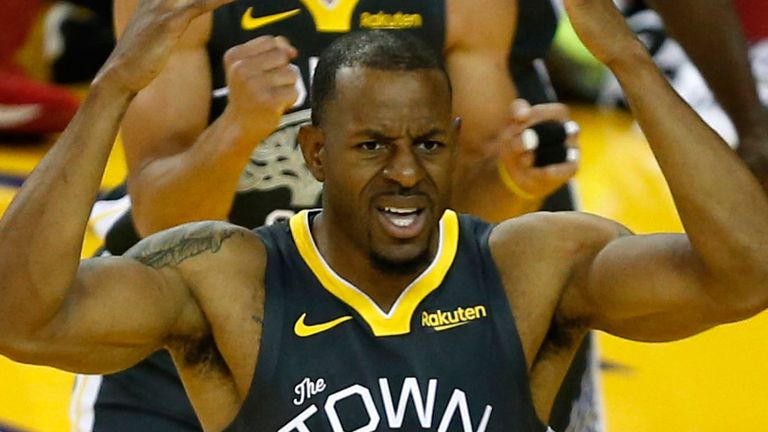
In executing a multi-player trade to acquire Andre Iguodala, the Miami Heat have saved money and improved their roster. But their decision to offer the former FInals MVP a two-year, $30m deal prevents the trade from being a home run.
In the run-up to every trade deadline, there are a few names banded about that it is expected will be dealt somewhere. But not often can we realistically anticipate where they will go.
In the case of Iguodala, previously of the Memphis Grizzlies, it was long since suspected that he would go somewhere. Memphis acquired Iguodala back in the summer from the defending champions Golden State Warriors, who gave Memphis a first-round pick in order to take on his contract.
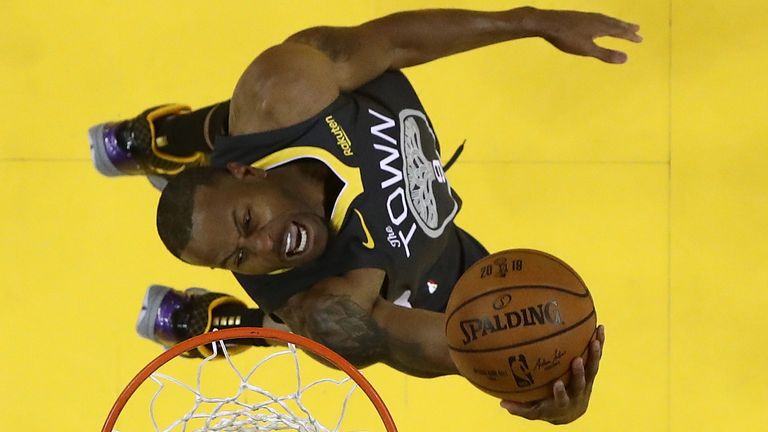
It was expected that Memphis would be near to the bottom of the NBA standings, and convention holds that universally respected veterans such as Iguodala are given their freedom from such teams in the final year of their contracts if they want it.
Iguodala did not want to play for Memphis, and didn't, staying away from the team for the entirety of the season thus far in a mutual arrangement as the Grizzlies sought to trade him to another franchise, one that will be more competitive.
But it was not expected until the final few days before the deadline that the team would be the Miami Heat.
Nevertheless, it is the Heat that he is now a member of. Dealt in Thursday's flurry of activity, Miami traded Justise Winslow, James Johnson and Dion Waiters to Memphis in exchange for Iguodala, Jae Crowder and Solomon Hill. A late amendment to the deal saw Johnson instead go to the Minnesota Timberwolves, who sent veteran big man Gorgui Dieng to Memphis. No draft picks are included, nor any draft rights or any rookie scale contract. It was a straight-up trade of veterans for veterans, only one of whom is a young veteran.
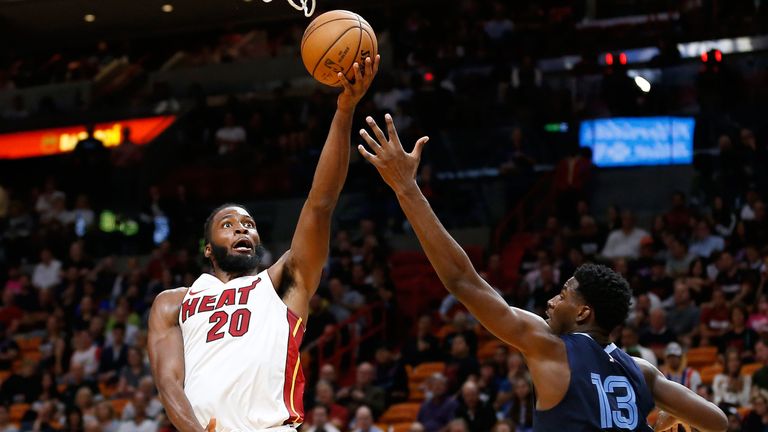
That young veteran is Winslow, and obtaining him is the reason that Memphis did the deal. Although he has battled injury a lot over his first few years in the NBA, Winslow also has a versatile game. He essentially played point guard for the Heat last season, doing so in something of a hybrid style along with Josh Richardson and (when healthy) Goran Dragic, but ultimately handling the ball a great deal in the half-court offense.
And while he also showed that he needed a smaller player alongside him with a lower centre of gravity and greater ability to get separation and collapse a defense, thus being more of a secondary or tertiary ball-handler rather than a primary one, the fact that Winslow can do these things while standing 6ft 7in and also playing good defense and finishing athletically means he chimes nicely with the modern NBA idea of the playmaking forward.
On a Memphis roster that also features Brandon Clarke and Jaren Jackson Jr, and that has Ja Morant on hand to do all the half-court creation, he will fit in nicely on the defensive end and diversify the offensive offering.
Taking him on in this way and getting something of tangible value in exchange for Iguodala has however cost Memphis. Specifically, it has cost them money. Lots of money. Waiters is on the books for $12.65m next season, Winslow will cost an even $13m and Dieng is to be paid nearly $17.3m.
Memphis have already made it clear that they do not intend to keep Waiters, and the role for Dieng as a reserve big man is going to be small, thus they will be essentially paying all this money just to take on Winslow. And considering that he has not been able to consistently take the court at any point in his career thus far, it is a large price tag on a whim, especially when considering that in lacking a high-volume high-efficiency outside shot, Winslow is also missing what is now considered to be the main skill.
Concurrent with also signing Dillon Brooks to an extension, Memphis have now committed $54m to that quarter of players, money that would likely have otherwise been cap room.
Instead, now, it figures to be the Heat who will have salary cap space and flexibility to work with. The fact that Miami were able to shift so much salary in this way while also getting some useful players for their short-term playoff aspirations makes this deal, in theory, an enormous win for them.
They were not using Johnson and Waiters, both of whom had burned through the good faith they had initially won as redemption projects, and they were not able to use Winslow because he was always injured.
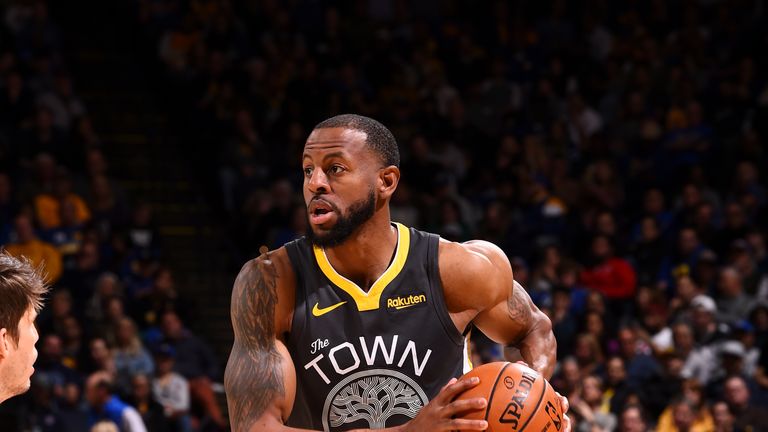
In their stead, Miami should get solid veteran contributions from Iguodala, a sporadic yet energised combination of defense and volume shooting from Crowder and potentially some minutes from Hill, who restarted his career this year as a reserve forward for Memphis.
Saving a shed-load of money on top of that (both Crowder and Hill have expiring contracts, and the Heat also were able to save some luxury tax money this season in the process) ticks both short and medium-term boxes while seeing nothing truly significant be outgoing.
Save money, get better, and lose nothing long-term except a young veteran forward who did not cohere with your roster make-up too well any longer anyway and whose injury concerns never seemed to be assuaged? Sounds good.
However, there is plenty of reason to suspect that in concurrently signing Iguodala to a sizeable extension, the Heat may already have thrown away some of those profits.
Considering that Iguodala has not played at all this season, we cannot easily make an evaluation about the player he currently is. At best, what we can do is look at the player he most recently was. In his final season with the Warriors in 2018-19, Iguodala was once again a productive and versatile player as he always has been, but what he was not was a $15m-per-year player. Given that the two-year, $30m extension he has signed with Miami, that is what he will now be paid, at least for next season (the second season of the extension is a team option).
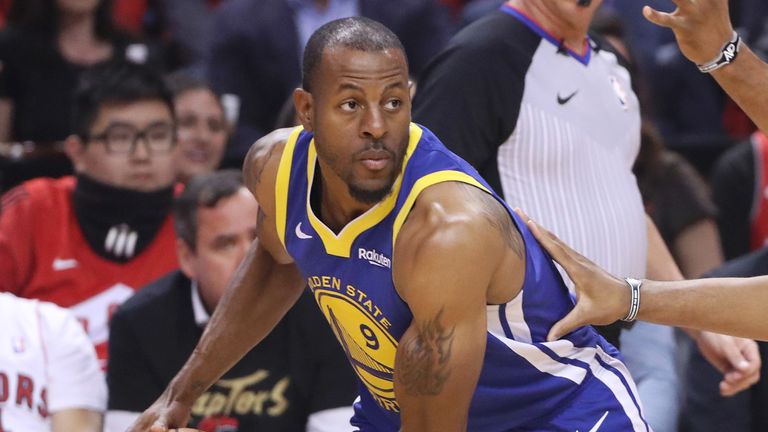
Iguodala at his best famously won the NBA Finals MVP award despite not averaging double-digits in scoring, due to his versatile contributions on both ends, particularly on defense. Large, tough, heady and committed, you could put him on anybody from point guard to power forward, and he could contain them better than your other options, being particularly useful when defending LeBron James in that series. He was a vital contributor to a perennial contender and his massive level of respect around the league is a testament to that.
However, Iguodala is also now 36 years of age, and he has been slowing down over the past few. In and out of the line-up with minor injuries that are par from the course at this age, Iguodala has also lost some of that offensive effectiveness. Although still a useful cutter and extra passer, the abilities to get out in transition and finish at the basket are dwindling, and he never was a particularly good outside shooter. That same speed also limits the defensive match-ups that he can excel in, and while he was still by any measure good, he was no longer great.
Although the past informs the future, it is not the same as it, and any new contract given out must be about future performance rather than what went on prior. And it would appear as though Miami has given Iguodala a contract representative of the player he was in 2016, rather than a realistic appraisal of the player he will be from 2020 and beyond.
Even if he only plays 50 games next season, he will still have value as the uber-Rodney McGruder in the postseason, and thus trading for him makes plenty of sense on a team that is now competitive and with an urgency to win, considering their salary cap picture, roster construction and the age of their president, Pat Riley.
But an $8-9m player is now going to get $15m. Iguodala will still make smart defensive plays, score a few and help with cohesiveness on both ends, and Crowder's contributions are not to be overlooked either, but neither will be a needle-mover, and the best value for Miami in the trade might come from the financial ramifications.
And if that is the case, then the extension will be hurtful rather than helpful.
If that was the price of doing business - ie if Iguodala would refuse to report if not given a simultaneous extension, which is the kind of power that such universal acclaim can give a player - then perhaps that was fair enough.
Once the additions of Waiters, Johnson, Hill and Crowder to the deal were announced, and it became obvious that Miami were both saving significant money and getting three contributors for the price of one, the deal went from questionable to logical.
If they were, however, able to do the deal without the extension, thus freeing up salary cap flexibility to either play in the trade/free agency market or give Danilo Gallinari that third year and concurrent extension he wanted, they would have had a home run.
As it is, Miami now stands on second base, in scoring position but needing some luck to get home.