Ian Ogg looks at the five horses who've managed to win the Coral-Eclipse in successive seasons.
So You Think aims to complete a unique double on Saturday
Before his controversial sale (for some), So You Think had joined the likes of Phar Lap, Flight and the recently passed Northerly in winning two Cox Plates and he will have the chance, on Saturday, to join an equally illustrious Northern Hemisphere list.
The Coral-Eclipse was established in 1886 with the first-running, somewhat appropriately, won by a horse carrying the name of Bendigo, a city within a hundred miles of Melbourne; where So You Think last raced in Australia.
At that time, the race was the richest to have ever been run in Britain and, consequently, attracted high-class fields from its inception with the first three home in 1903 having won seven Classics between them.
Only five horses have won back-to-back renewals of the Sandown contest and So You Think could earn his place in history this weekend by becoming the sixth.
The first to do so was
Orme in 1892 and 1893.
A member of the first crop of unbeaten Triple Crown champion Ormonde out of an unraced full sister to St Simon, he was trained by John Porter.
He made a winning debut in the Richmond Stakes at Goodwood and went on to win four of his next five starts, ending the campaign as the champion juvenile.
A warm order for the following season's classics as a result, he fell ill days before the Guineas with a vet suggesting that he had been poisoned with mercury.
Remarkably he recovered and made his seasonal bow three months later in the Eclipse where he beat Orvieto by a neck.
He failed to stay the trip in the St Leger which was won by La Fleche but gained revenge on the filly the following year when winning his second Eclipse before injury terminated his career at the end of his four year old season.
He went on to sire three individual Classic winners, including Triple Crown winner Flying Fox and Derby winner Orby who both became extremely influential stallions with Red Rum among those tracing back to the latter.
Buchan
Buchan became the second to complete the double in 1919 and 1920.
He was trained by Alec Taylor Junior who followed in the footsteps of his father in becoming a hugely successful trainer.
Based at Manton, Taylor won most of the major races in England and won back-to-back Triple Crowns in 1917 and 1918,
The Classics may have eluded Buchan although he did complete a Triple Crown of sorts having been placed in the Guineas, Derby and St Leger; he was only narrowly beaten in the first two before finishing third at Doncaster.
He had little trouble claiming his first Eclipse for which he was long odds-on in a moderate renewal but proved his worth when faced with a stronger field the following year.
He went on to become the Champion Sire in 1927, mainly due to the exploits of his daughter Book Law who was also bred by his owner/breeder Lord Astor at Cliveden Stud in Oxfordshire.
Polyphontes claimed the first of his two successes just four years on from Buchan in 1924.
The Eclipse was, remarkably, the ninth start of a season in which he'd finished unplaced in the Guineas and fifth in the Derby just days after taking on older horses at Lingfield.
He was sent off as joint-favourite at Sandown and easily justified his market position in defeating the 1923 Derby winner Papyrus.
He followed an equally diverse route to success the following year, finishing second in the Royal Hunt Cup under top-weight before returning to reclaim his crown.
He was trained at Moulton Paddocks, currently the base of Mahmood Al Zarooni, by Walter Earl who later transferred to Stanley House Stables which is now, coincidentally, also under the Godolphin banner.
From there, Earl saddled six war-time Classic winners, among them the Derby victor Watling Street as well as the brilliant stayer Alycidon, and was Champion Trainer in 1945.
Sixty Years
Remarkably over 60 years passed until the next horse was able to complete back-to-back successes in the historic heat but
Mtoto stepped up to the challenge in 1987 and 1988.
An enigmatic performer trained by Alec Stewart, he became a firm favourite with his South African jockey 'Muis' Roberts.
A late developer, like his sire Busted, he returned to Sandown for the Eclipse having already won the Brigadier Gerard Stakes to take on Derby winner Reference Point (the first Epsom winner to line up since 1971) and Triptych in his first Group One.
Restrained at the rear of the field, he employed his electric turn of foot to pick up Reference Point and get the better of a sustained duel in course record time.
He returned at five where he once again faced Triptych, who had just won her second Coronation Cup, but it was Shady Heights who posed the greatest threat, eventually going down by a neck.
Mtoto ended his career with an unlucky-in-running second in the Arc before retiring to stud where his progeny included Derby winner Shaamit, Champion Stayer Celeric and leading National Hunt stallion Presenting.
Late-Developer
The last horse to complete the double was another late-developer in
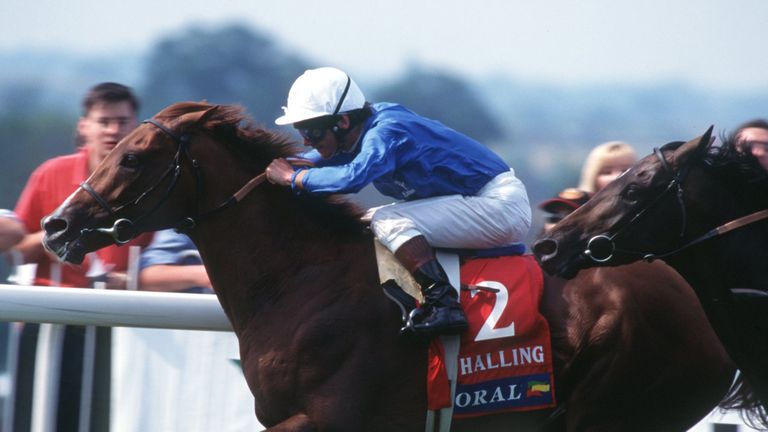
Halling who won his first race for John Gosden from a mark of just 75.
He later transferred to Saeed bin Suroor after picking up a Cambridgeshire and continued to progress throughout his four year old season.
The son of Diesis wintered in Dubai and had his first start of the 1995 season at Sandown where he made every yard of the running under Walter Swinburn to get the better of the year-younger Singspiel by a neck to record a first top level success.
He went on to win the Juddmonte International at York and won the same two races in his 1996 season with the winning margin at Sandown again a neck as the courageous performer dug deep into his reserves to repel repeated challenges.
He was retired to stud at the end of that campaign where he has enjoyed plenty of success with the likes of Opinion Poll and Cavalryman prominent among his progeny.