
The World Club Series should be viewed for what it can do for the sport, says Phil Clarke

Thursday 12 March 2015 19:42, UK
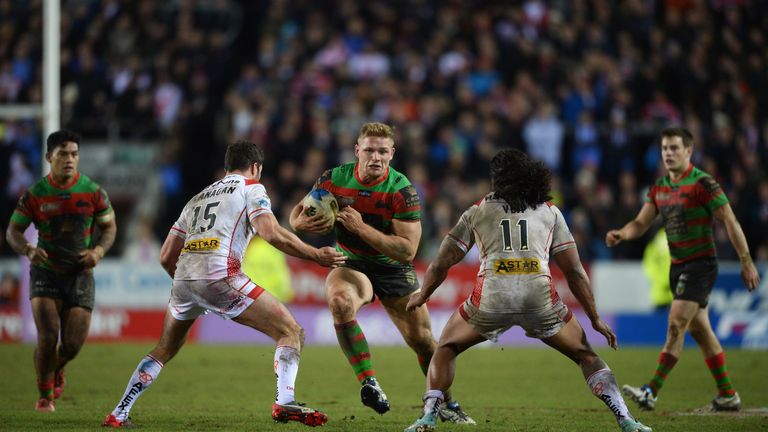
Sky Sports pundit Phil Clarke says the results from the World Club series aren't as important as the growth of the sport they encourage...
If ever there was a rugby league weekend which took you on the roller coaster ride of emotions that sport provides, it was the World Club Series last Friday, Saturday and Sunday. I’ve still not recovered but perhaps that’s what great sporting occasions are supposed to do. They make you feel happy, mad, silly and sad all in the same space of 80 minutes.

There are four seasons in a calendar year and it seems to make sense that we have four major events in a rugby league season.
The one-sided nature of the St Helens v South Sydney clash should not detract from what was a successful event. The Rabbitohs were red hot and will beat several NRL sides by a similar score line if they play that well and get the ‘bounce of the ball’ like they did at Langtree Park - John Sutton’s kick was brilliant but the bounce was freakish and Joel Reddy even laughed when he stood up after scoring. I’m not making excuses for the Saints or trying to say that Souths were not by far the best team, but some things early in the match did go their way.
It’s also worth noting that the Rabbitohs are in a ‘golden age’ at present. They’ve worked very hard and invested heavily to become the best team in the world. In the second half of the 2014 season, they beat both Manly and Brisbane by more than 20 points and embarrassed the Newcastle Knights when they scored 50 points. Even in the Grand Final they ended up 24 points in front of the second best team, the Bulldogs. There’s even a gap between them and the rest in the NRL.
St Helens had done remarkably well to beat Wigan in last year’s Grand Final without Luke Walsh but it was unrealistic to think that they’d be able to beat Souths without their most important playmaker.
Control
What did we learn from the weekend?
Well on the field we’ve been reminded just how strongly the teams from Down Under start. The three NRL teams scored quite early in their games, and the Saints - just like Wigan in last year’s World Club Challenge - were three tries down after about 20 minutes. In some ways I have to compliment the Saints for the way that they defended in the remainder of the game.
It was easy to see the difference in the ability of the teams controlling the ball when they were in possession. Just take a look at the number of errors made by the teams, and the subsequent play-the-balls that they gave to each team:
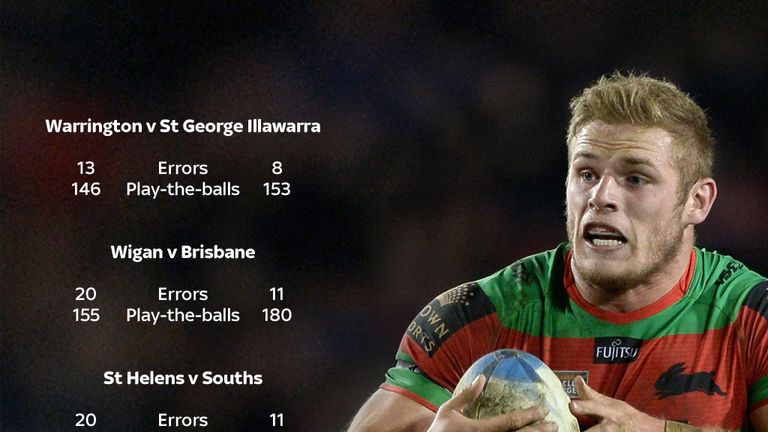
Not only did the handling errors allow the NRL teams to enjoy the majority of possession, but their superiority in the accuracy of their kicks gave them a huge territorial advantage as well. The Rabbitohs enjoyed more than twice as many play-the-balls in their opponents half of the field as the home side did. This only goes to underline how well St Helens defended to limit them to 7 tries.
Revived interest
It’s very hard to measure the atmosphere in a ground, you just know when it’s special. There is something about a visiting team from Down Under that captures the public’s interest. It was great to meet people at the games who had travelled far and wide and there seemed to be a willingness from club owners and administrators to capture that and create a landmark event in the rugby league calendar. There are four seasons in a calendar year and it seems to make sense that we have four major events in a rugby league season.

The World Club Series could be the first in the Northern Hemisphere, with the Challenge Cup Final, Grand Final and Test match series the other three major focal points in the year. We’ve never been very good at long-term planning in this sport and that must be the number one goal to take advantage of the revived interest following the 2013 World Cup and successful 2014 Four Nations tournament.
I’m not going to enter into a debate about why the NRL teams were better than their Super League counterparts. I’ve written about it often enough. I’m not being defeatist but should we expect to beat them?
They have several advantages over us, even if they give up some of these to play in the UK without much practice or game time.
I just hope that I see this event grow in its popularity, with bigger crowds as the year’s progress and as part of a long-term club and international strategy for 13-a-side rugby.