Skysports.com takes a look back at events in the world of cricket during the last 12 months.
Australia rule the world...again
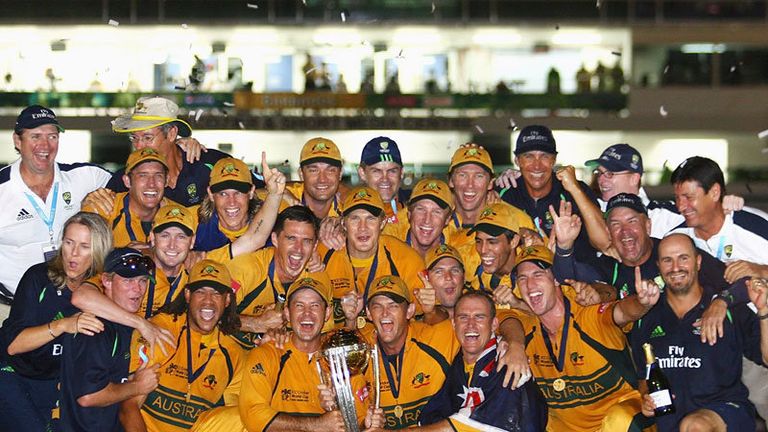
Another year of Australian dominance saw Ricky Ponting's side win a third straight World Cup in emphatic fashion.
Overall, it was a tale of two World Cups - the 50-over version in the Caribbean was an over-hyped, poorly attended flop, while the hastily arranged Twenty20 version in South Africa later in the year provided an unexpected highlight.
India prevailed in a final-over thriller against arch-rivals Pakistan to win the inaugural Twenty20 global showpiece, having beaten Australia in the semi-finals.
Needless to say, England failed to reach the last four in either tournament during a difficult 12 months that began with the last rites of an Ashes whitewash and the end of Duncan Fletcher's reign as coach.
Woolmer mystery
The World Cup was overshadowed by the death of Pakistan coach Bob Woolmer and subsequent murder investigation by the Jamaican police.
Woolmer was found dead in his Kingston hotel room the morning after Pakistan had been beaten by Ireland and eliminated from the tournament at the initial group stage.
Following a pathology report that concluded Woolmer was killed by 'asphyxia via manual strangulation', the Jamaican police launched a murder probe.
A media feeding frenzy ensued with no shortage of amateur sleuths willing to put forward their theories via the 24-hour news networks, although the police appeared to be making little progress.
In June, following three more pathology reports, the Jamaican police concluded that Woolmer had died of natural causes, although the inquest into his death recorded an open verdict.
Awesome Aussies
On the field, Australia marched to their third straight World Cup with a perfect record of 11 wins in a competition that failed to hit the expected heights.
None of those 11 matches were close and the final against Sri Lanka summed up the tournament.
It finished in farcical circumstances when the match officials - incorrectly according to the rules - insisted on play resuming in near total darkness as Sri Lanka made a forlorn attempt to chase a revised target of 282 from 38 overs.
Memorable individual moments included Adam Gilchrist's whirlwind 149 in the final, Sri Lankan paceman Lasith Malinga taking four wickets in four balls against South Africa, and Herschelle Gibbs hammering the unfortunate Dutch leg-spinner Dan van Bunge for six sixes in an over.
Gilchrist's opening partner Matthew Hayden was the outstanding batsman in the competition with 659 runs, including three centuries, while Glenn McGrath was the competition's leading wicket taker with 26 on his swansong.
India and Pakistan both exited at the group stage, while the so-called Super Eight included both Bangladesh and Ireland.
Ireland's three-wicket win over Pakistan was one of the great upsets in one-day history, although the death of Woolmer quickly put things in perspective.
For England it was another World Cup to forget as they failed to reach the semi-finals for the fourth time in a row. A partially fit Michael Vaughan was parachuted in to lead a side still reeling from their Ashes pummelling.
Morale in the camp began to sink when Andrew Flintoff, who had made way for Vaughan, was stripped of the vice-captaincy following a drunken late-night trip to sea in a pedalo two days before the group match against Canada.
England did beat Canada and Kenya to progress to the Super Eight but their uninspiring brand of cricket failed them against superior opponents and they eventually finished fifth, having been beaten by all four of the semi-finalists.
Coaching merry-go-round
The World Cup brought the end of an era for both England and Australia as respective coaches Duncan Fletcher and John Buchanan both stood down following eight-years at the helm.
Fletcher's legacy was tarnished by the Ashes capitulation and disappointing World Cup, but despite the gloomy end his reign was not without success.
The 2005 Ashes win on home soil was his side's sixth straight Test series win, while the introduction of central contracts and a more consistent approach to selection resulted in steady improvement - in the Test arena at least - for the majority of his time in charge.
Buchanan left Australia as he had found them - on top of the world in both one-day and Test cricket.
Greg Chappell (India), Bennett King (West Indies), and Dav Whatmore (Bangladesh) also vacated their jobs following the World Cup.
Split captaincy
England began the year by losing the New Year Test in Sydney, the final instalment of a 5-0 Ashes whitewash that was as one-sided as the scoreline suggests.
The World Cup debacle followed, the inquest into which led to the introduction of split captaincy for the first time since the ill-starred Michael Atherton-Adam Hollioake experiment in the late nineties.
Vaughan stepped down and was replaced by Paul Collingwood as limited-overs captain, but was retained in charge of the Test team despite lingering doubts about his recovery from the knee injury that kept him out of the Ashes tour.
That looked a shrewd decision from new coach Peter Moores - promoted from his position as head of the ECB academy to succeed Fletcher - when the Yorkshireman marked his first Test appearance for 17 months with a fine century on his home patch of Headingley against West Indies.
Kevin Pietersen also scored a double century in that match and was the most consistent English batsman with 1,007 Test runs during the calendar year, including four hundreds.
But it was the impact of Ryan Sidebottom that provided the story of the summer. The Nottinghamshire left-armer was called-up to make his second Test appearance at Headingley, six years after going wicketless on his debut.
Sidebottom responded with eight wickets in the match and went on to be an ever-present for the remainder of 2007, finishing the year as an established first-choice in all formats.
England went on to comfortably defeat West Indies 3-0 over four Tests, but Collingwood's initiation as one-day captain was not so smooth as West Indies fought back from losing the first game to triumph 2-1.
Indian summer
India were the visitors for the second part of the summer and provided a stern examination of England's progress under Moores.
Rahul Dravid's men triumphed by seven wickets in the second Test at Trent Bridge, a result that was sandwiched by draws at Lord's and the Oval to give the tourists a 1-0 success.
The home summer concluded with a seven-match one-day NatWest Series, it went all the way to the final game which England won by seven wickets at Lord's.
Unbelievable as it may sound, England's best results during 2007 came in one-day cricket, though not when it mattered at the World Cup.
The CB Series victory in February, during which England triumphed 2-0 in the finals series 2-0, briefly halted the Australian juggernaut.
And the 3-2 series win in Sri Lanka in October provided a welcome boost for Collingwood's leadership following the disappointment of an early plane home from the World Twenty20.
But England's year finished on a low, Sri Lanka turning the tables when they returned - this time with Vaughan in charge and Collingwood back in the ranks - for a three-match Test series in December.
Mahela Jayaardene's men won the series 1-0, although the scoreline flattered England, who were outplayed in all three Tests despite clinging on for draws in Colombo and Galle.