
Green and golden age
We look back at a period of Ashes history painted green and gold - apart from that one glorious summer in 2005. Dave Tickner reflects...
Monday 6 July 2015 22:52, UK
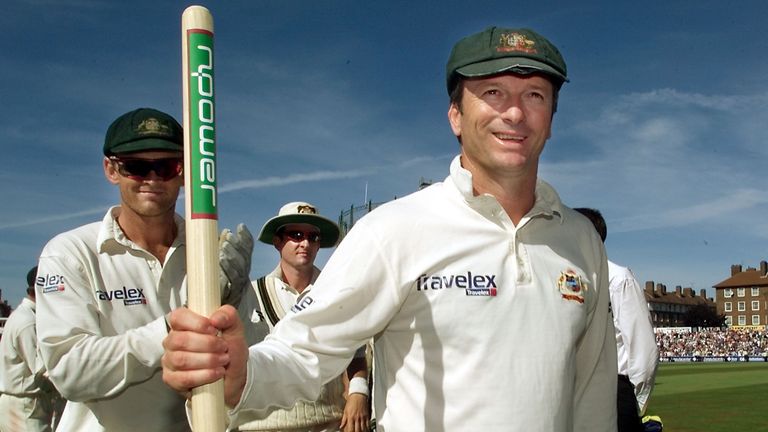
We look back at a period of Ashes history painted green and gold - apart from one glorious summer in 2005.
There was a period not so long ago when it appeared England would never get their hands on the Ashes again, such was Australia's dominance against their old enemy.
England, having won the series as outsiders in 86/7, entered the 1989 tussle as warm favourites but were humbled and would not recover from a crushing reverse for more than 15 years. Not since either side of the Second World War had Australia had such a hold on the Ashes as the one they were about to establish.
In 89 they lost 4-0. But for bad weather, it could have been 6-0.
The series provided the blueprint for the 15 years of Ashes combat. A ruthless Australia side, ably led, crushing a sporadically resilient but generally rudderless England.
The home side, in their panic, fielded 29 players in the series. Australia fielded the same XI in five of the six Tests. The statistics make painful reading for England fans.
At Trent Bridge, Mark Taylor and Geoff Marsh batted all day in compiling an opening stand of 329, breaking Hobbs and Rhodes' record for the biggest in Ashes history.
Taylor scored 839 runs in the series, a record bettered only by Don Bradman and Wally Hammond.
Terry Alderman became the first bowler to take more than 40 wickets in two Ashes series.
In 1990/1, England at least competed slightly better. An experienced batting line-up prevented complete disaster, but the bowling was far too reliant on the injury prone Angus Fraser.
Gower hit two sparkling centuries - passing 8,000 Test runs in the process - while Michael Atherton showed some of the grit that would make him a crucial figure at the top of some of the worst England teams on record.
But this served only to keep the final score down to 3-0 as Alderman once again proved England's destroyer with able assistance from Craig McDermott.
In the Sydney Test, Taylor passed 1000 Ashes runs in only his 17th innings while Mark Waugh hit a century on debut at Adelaide.
England may have been able to secure two draws, but the victory margins in the three remaining Tests - 10 wickets, eight wickets and nine wickets - tell their own story.
In 1993, things managed to get even worse for England with the arrival of bleach-blond larrikin who could apparently bowl leg-spin Quite Well.
It took English fans - and Mike Gatting - just one delivery to find out how well. Probably no Australian cricketer since Bradman has engendered such fear, panic and ultimately respect in England.
Warne's 'ball of the century' to dismiss Gatting has been replayed so often you can close your eyes and picture it instantly. The lazy, looping drift towards leg stump, Gatting's immaculate forward defensive shot, the sharp fizz of the leg break and the removal of the off bail. It was a perfect delivery, and Gatting took several moments to realise he'd been dismissed. He looked around, apparently unable to accept the physics of the whole thing.
England were dismantled. Warne took 34 wickets in the series. Merv Hughes added 25 more in just four Tests. David Boon scored 555 runs and three centuries, while Mark and Steve Waugh scored almost 1000 runs between them.
The only consolation for England - other than a debut century for Graham Thorpe - was the re-emergence of Australia's propensity to lose matches once the series is over. England's victory in the final Test at The Oval was their first over Australia since 1986/7 - 17 Ashes Tests ea