
Max Mosley Q&A: The former FIA President discusses Jules Bianchi's accident
Mosley believes everything was done as it should have been; Race Director will have given marshals permission to bring tractor onto track; Moving start time wasn't a solution
Monday 6 October 2014 13:15, UK
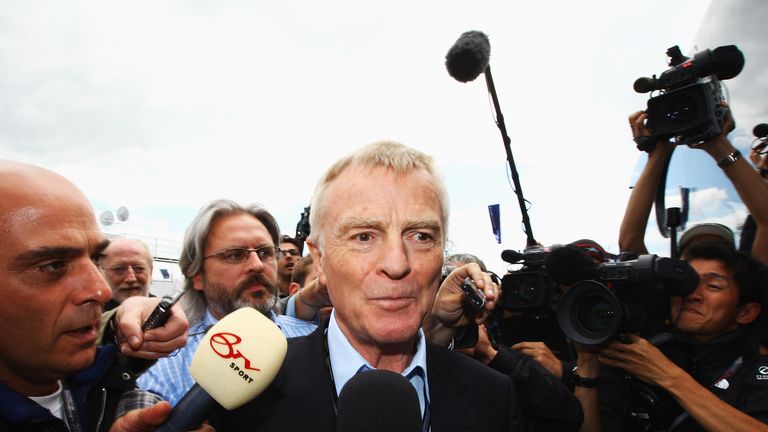
The former FIA President discusses Jules Bianchi's accident during Sunday's Japanese Grand Prix with Sky Sports News HQ.
Is Formula 1 doing everything right to secure the safety of its drivers?
Max Mosley: "I think it is. I think what happened in Suzuka was very unfortunate, a freak accident, and I can’t really fault any of the people involved – the marshals, or the race director, or any of those people. Everything was done as it should have been."
We saw Adrian Sutil’s car crash into the barriers. What is the protocol regarding the deployment of the Safety Car?
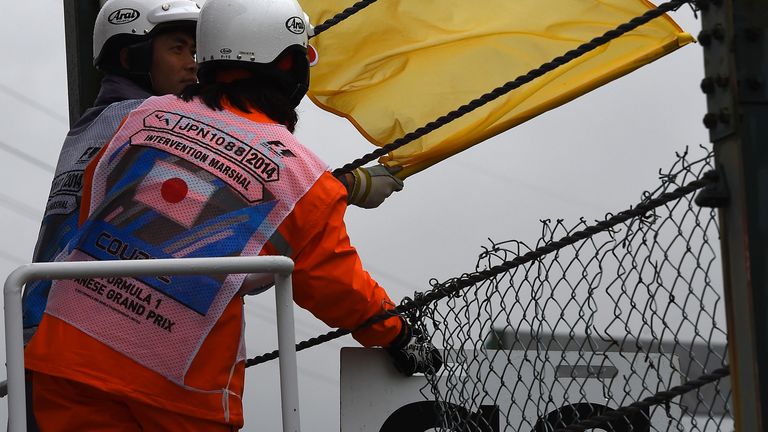
MM: "The first thing that happens when there is an accident is that your first line of defence are yellow flags because obviously there can be cars immediately behind the car that has crashed and they need to be alerted to the fact that there is a car off. So you get stationary yellow flags, waved yellow flags and then double-waved yellow flags, which are increasing degrees of caution to the drivers.
"A double-waved yellow flag means ‘slow right down and be prepared to stop’ - that happens usually for something in the track. You deploy the Safety Car if the obstruction, or the danger as such, cannot really be dealt with under double-yellow flags and you need the Safety Car.”
Do the marshals need to have permission to bring a truck onto the track?
MM: "Yes, they do and that is all done by the Race Director. But there’s pretty much an automatic procedure which is that as soon as a car goes off, that car becomes a danger to other cars because if another car going off hits it, the effects are unpredictable. So you want to remove the car as quickly as possible.
"They then send a tractor to do that but before they do that you get a succession of flags at the previous marshals’ post – a stationary, a waved and, if necessary, a double-waved yellow, to warn the drivers that this is going on and they must slow down and take every precaution because if they go off in the same place then it is, in the first instance, obviously very dangerous for the marshals."
Given the warnings about the weather, what discussions would have taken place between the FIA and the promoters about the timing of the race?
MM: "If somebody wanted to move it then there would have been a discussion. But it’s very difficult to move [a race] in those situations because if you move it two hours earlier then there is no guarantee it won’t rain then and you just might move it from a time when it would have been quite safe to start to a time when it was dangerous to start. Moving the time wasn’t really a solution."
But who would have had the final say on moving the race?
MM: "The FIA. Everything to do with safety is the FIA – even right down to cancelling the race because of the weather and postponing it to the following day. You would be very reluctant to do that but if there was any safety question you would do everything that was necessary."
The driver in question, Jules Bianchi, was taken to hospital by ambulance rather than helicopter. What do you make of that?
MM: "That’s a medical decision – if the helicopter can’t fly, the cars don’t run. When you have a head injury, sometimes it’s very danger