Explainer
The big Super League vote: Key questions on a seismic shuffle with announcement this week
Super League clubs voted to expand the competition to 14 from 2026; Sky Sports' Megan Wellens takes a look at what we know and what is still to be decided; watch every Super League game this season live on Sky Sports - including two matches in each round exclusively live
Thursday 13 November 2025 17:24, UK

The current 12 clubs in Super League have voted to extend the top flight to 14 clubs from the 2026 season onwards but how will this be decided, what are the ramifications, and what are the next steps?
What happened with the vote?
On Monday July 28, it was announced that the 2025 Super League clubs had voted to increase the top-flight competition to 14 teams for the 2026 season onwards.
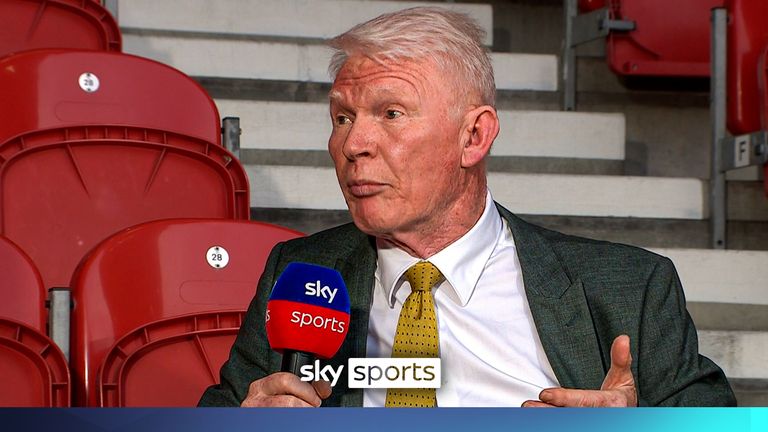
Speaking on Sky Sports' The Bench podcast, RFL chair Nigel Wood said the sport "should be following and pursuing an expansion strategy - but not recklessly".
Expansion was considered to be the long-term direction of travel, but it was met with shock that the 12 existing clubs had agreed to introduce it for the upcoming season rather than 2027 or beyond.
Of the 12 clubs that were involved, nine clubs voted in favour of the increase: St Helens, Leeds Rhinos, Leigh Leopards, Salford Red Devils, Huddersfield Giants, Castleford Tigers, Wakefield Trinity, Catalans Dragons and Warrington Wolves.
Hull FC and Hull KR both voted against the proposal, while Wigan Warriors abstained.
- Latest Super League fixtures, results and schedule
- Got Sky? Watch on the Sky Sports app 📱
- Not got Sky? Get instant access with NOW 📺
- Download the Sky Sports app
How will the 14 clubs in Super League be decided?
The vote in the meeting decided that the grading criteria introduced in 2024 would be used to decide the top 12 clubs competing in Super League from 2026 onwards.
The other two clubs to join the top flight would then be decided by "an independent panel to be chaired by Lord Jonathan Caine, who was recently elected as a member of the Rugby Football League board, and the strategic review sub-committee".
So, two clubs will join the top-ranked 12 "provided the panel judges there are two applications of sufficient merit against the set criteria", which is focused on finances.
In other words, the top 12 clubs will be decided by a grading system and then a panel will pick the other two to join them.
The automatic top 12 and the club gradings will be announced on Thursday October 16, with the panel's decision following on Friday October 17 at 10am.
That means we will know who scored 13th and 14th place via gradings but not who is necessarily in via the panel decision.
What are the grading criteria for the top 12?
The grading system has 20 points on offer for clubs. To be a Grade A club, you need to achieve at least 15 points. To be a Grade B club, you need 7.5 points.
The idea initially was that Grade A clubs automatically compete in Super League, with the best-performing Grade B clubs making up the rest of the 12 clubs in the competition.
The five pillars are:
1: Fandom (25 per cent of grade, 5 points on offer)
This sees clubs get 2.5 points based on attendance one point for viewership and 1.5 points for digital (0.2 social following, 0.8 website visits, 0.5 total engagements).
2: Performance (25 per cent of grade, five points available)
On-field performance is another key criteria for clubs, with these points on offer to clubs in the top three leagues of the men's competition.
These top 36 teams will be ranked 1-36 based on where they finished both in the league and play-offs over the last three seasons that they have played.
3: Finance (22.5 per cent of grade, 4.5 points available)
Finance is broken down into the three areas of: Revenue Diversification (3 points), Profitability (0.5 points), and Sustainability (1 point).
4: Stadium (15 per cent of grade, 3 points available)
There is 1.5 on offer for the facilities score. This means that your ground has a minimum capacity of 5,000, has a minimum of 2,000 seats, has sufficient facilities for sponsors, corporate partners, directors, broadcasters, media, and photographers. If a club's stadium does not meet these standards, they will score 0.5.
Then, a club can get a point for "utilisation" of their stadium. This is just their attendance as a percentage of their capacity. For example, a 50 per cent attendance gives a score of 0.5.
Additional points are on offer for owning your stadium (0.25), having LED advertising boards (0.125), and having a big screen (0.125).
5: Community (12.5 per cent of grade, 2.5 points available)
The 2.5 points on offer in this category are split into 1.5 points for how well the club represents its local community (population of local area divided by the number of clubs in the area) and a point for how well the club interacts with the local community (annual turnover of the club's charitable foundation).
The top 12 clubs via this system will automatically be in Super League.
What process will be used to decide places 13 and 14?
RFL non-executive director Lord Jonathan Caine will chair a panel of seven members to determine if, and who, should take up places 13 and 14 in an expanded Super League.
He will be joined by two fellow non-executive RFL directors - Abi Ekoku and Dermot Power - plus the RFL chief executive Tony Sutton and interim head of legal Graeme Sarjeant.
Rugby League Commercial's managing director Rhodri Jones and Peter Hutton, the senior independent non-executive director of RL Commercial who is also a Super League (Europe) board member, make up the panel.
In addition to the five pillars under which clubs are judged in the Club Grading System (Fandom, Performance, Finances, Stadium and Community), the panel will judge applications against a further set of criteria relating to finance and sustainability.
These include their financial performance in 2025; detailed financial performance and sustainability forecasts for the 2026, 2027 and 2028 seasons; and their ability to field a competitive team in 2026 and beyond.
For the latter, analysis will be provided by the RFL's England Performance Unit.
Who would be the top 14 using 2025 gradings?
The gradings for the 2025 season were as follows:
Grade A: St Helens (17.02), Wigan Warriors (16.91), Leeds Rhinos (16.84), Warrington Wolves (16.27), Hull KR (15.97), Catalans Dragons (15.52), Leigh Leopards (15.13), Wakefield Trinity (15.09), Castleford Tigers (15.02)
Grade B: Hull FC (14.51), Huddersfield Giants (14.48), Salford Red Devils (13.97), Toulouse Olympique XIII (13.58), London Broncos (12.65), York RLFC (12.42), Bradford Bulls (12.15) Barrow Raiders (11.22), Featherstone Rovers (10.75), Keighley Cougars (9.02), Halifax Panthers (8.79), Sheffield Eagles (8.77), Widnes Vikings (8.60), Doncaster RLFC (7.52)
Grade C: Workington Town (7.26), Swinton Lions (7.15), Dewsbury Rams (7.13), Oldham RLFC (7.00), Hunslet RLFC (6.98), Rochdale Hornets (6.47), Midlands Hurricanes (5.66), Cornwall RLFC (5.29), Newcastle Thunder (5.20), North Wales Crusaders (4.72)
That means that Toulouse and London would have been the two teams next in line, with York and Bradford among the sides hot on their tails.
Who is expected to be in the running in 2026?
Toulouse, London, Bradford and York are all teams expected to be in consideration for the 14-team league in 2026, with Widnes Vikings also signalling their intention to be considered.
It was announced by the RFL on August 27 that 12 clubs have lodged a "formal expression of interest" into joining the process. It is believed there are current Super League clubs among this 12.
Hull FC are one Super League club to have joined the process, saying it is a "proactive measure" to retain their status and have submitted the application for "reasons of prudence and good housekeeping".
With Salford's ongoing financial debacle, it is thought their score would drop in a way that could potentially see them out of the top 12 and so they are believed to have joined the application process to be considered too.
Goodbye to loops - an immediate positive?

One positive that many see from the increase to 14 teams is the removal of the loop fixtures, with each team just playing each other home and away across the season.
This is a more attractive prospect for fans and players, putting much more onus on home fixtures for clubs.
However, it could spell the end for one popular loop fixture...
What does it mean for Magic Weekend?
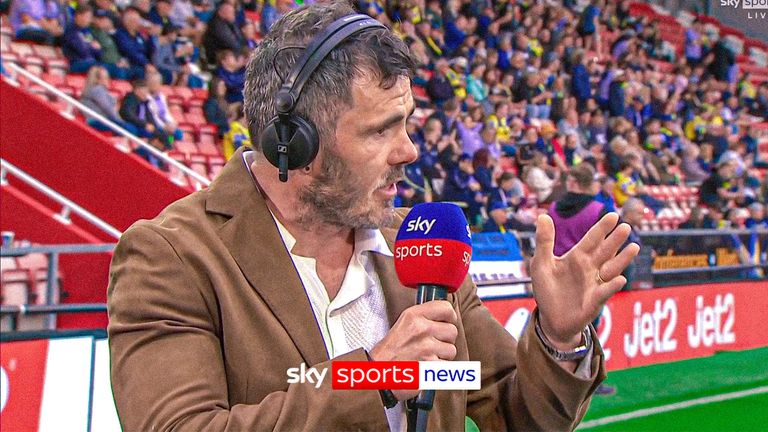
It is not yet clear, but the noise currently is that an increase to 14 teams would spell the end for Magic Weekend, a fan favourite and staple in the Super League calendar, which has been copied by the NRL.
Magic Weekend is when all the Super League clubs descend on one city, most recently Newcastle, and play their fixtures across one weekend at one stadium.
A unique selling point of the competition, it is something that club owners reportedly would see as an element that would need to make way to give clubs as many home fixtures as possible.
This would be seen as a loss by many.
How else could Super League change?
Due to the number of teams, expansion would mean an eight-team play-off - and an extra week needed to complete those play-offs matches.
This is the system the NRL uses currently.
With this format, the top four play each other in the first week and the winners of those matches go straight to the semi-finals. In that same week, teams place five to eighth will face off.
In the second week, the winners of the fifth to eighth games will play the losers from the top four, with the winners then through to the semis.
From there, week three has the semi-finals, with the winners into the Grand Final.
What questions remain?
While some things are known, many questions remain.
When will we know how the clubs coming up will be funded? Is their ability to take reduced funding compared to the other 12 Super League club a metric that will be taken into account?
How will the extra game per round work? How will this be covered to preserve the integrity of the competition?
Change is coming to Super League but only when these questions begin to be answered will a clearer picture of the vision behind this vote emerge.
Watch every Super League game this season live on Sky Sports - including two matches in each round exclusively live, with the remaining four matches each week shown on Sky Sports+ via the red button.