
Why catching Mercedes will be a tall order in 2015 for F1's distant chasing pack
Sky Sports F1's Mark Hughes assesses just how likely it is that Mercedes will be caught by the chasing pack in 2015
Tuesday 28 April 2015 13:07, UK
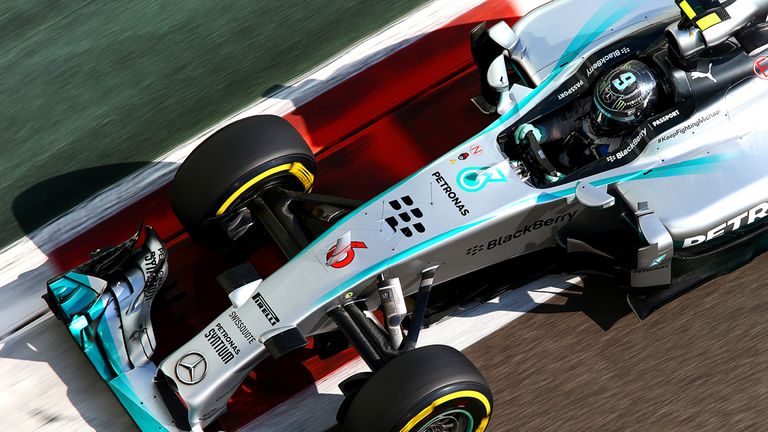
For all that we’ve enjoyed some great battles this year between Lewis Hamilton and Nico Rosberg, the hope must be that other teams can close the gap to Mercedes GP in 2015. But realistically, what are the chances of that happening?
The Mercedes W05 sometimes had a race pace advantage of 1.5s per lap over the competition. Even at its least competitive, it remained around half a second clear of the field. It’s now well understood how that pace was derived, but understanding it is one thing, replicating it something else. The advantage over the non-Mercedes-engined cars came from a power unit that began the season with something like a 70bhp head start and better fuel efficiency. This was why it was dominant even over the Red Bull RB10, the only car with comparably good aerodynamics. The advantage over other Mercedes-engined cars came from a clever way around the two most difficult challenges presented by the much more restrictive aerodynamic regulations of 2014.
So in essence the RB10 and W05 were the only two cars that had nailed the new aero requirements while the Mercedes power unit was the only one to properly meet the challenge of the new engine formula. As the only car combining both, the root of the Mercedes W05’s dominance was clear. As to how those solutions had been reached by Mercedes, it was due to better planning, deeper research and more co-ordination and motivation of the engineering talent within the organisation. The engine, chassis and aerodynamic departments worked in a much more integrated and co-operative way than elsewhere, within a ‘brains trust’ structure that had been set up by Ross Brawn and Mercedes’ engine chief Andy Cowell.
That’s how it was done. But now that the result is known, how feasible is it for the competition to incorporate those technical ideas? In terms of the engine, the Mercedes’ power advantage was mainly mechanical rather than electrical. With its compressor at the front of the engine, out of aerodynamic harm’s way, it was bigger than the rear-mounted Renault and Ferrari compressors. This involved a very demanding engineering solution however, with the shaft connecting the compressor to the rear-mounted turbine (where it has to be in order to be turned by the exhaust gases) running the whole length of the engine. This shaft is limited in diameter by regulation, turns at over 120,000rpm and drives the ersH motor which sits in the middle. The slightest bit of flex would have disastrously destroyed the bearings of the ersH and possibly the compressor. Engineering such a long and fast-spinning shaft to have zero flex within it was not the work of a moment and took Mercedes around two years to perfect. The time involved in overcoming this challenge is believed to be what has caused Renault and Ferrari to be pushing for a regulation change that would allow a mid-season change of specification.
With Mercedes consistently refusing to grant its blessing to this change and thereby thwarting the unanimous agreement needed, it’s looking increasingly likely that Renault and Ferrari will have to begin the season with developments of their current rear compressor designs. Both have identified plenty of areas where they can improve those power units and the Renault step (of its rear compressor motor) is believed to be in the order of 70bhp – which would bring it up to around the 2014 Mercedes motor. But Mercedes itself will not be standing still and is expected to have an extra 60bhp more again. This is almost certainly what is behind the politics of Christian Horner suggesting a new twin turbo format for