Estimate disqualified from Ascot Gold Cup
Thursday 25 September 2014 18:10, UK
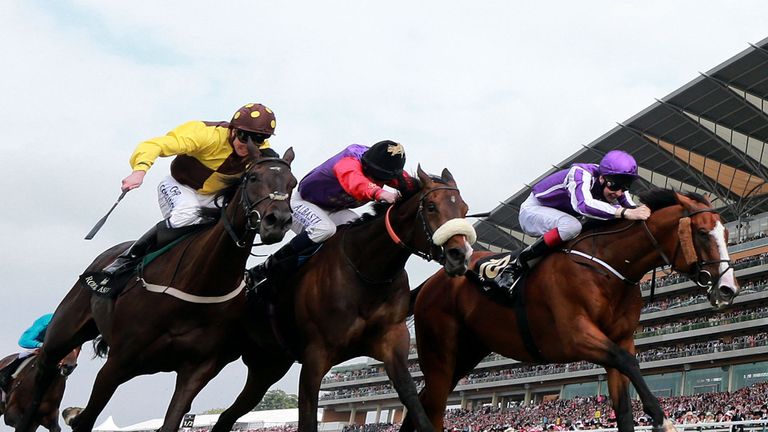
John Warren, bloodstock and racing advisor to the Queen, welcomed a "thorough and fair investigation" from the British Horseracing Authority after Her Majesty's horse Estimate was disqualified from second place in this year's Gold Cup at Royal Ascot following a disciplinary panel hearing in London.
A post-race sample containing morphine and oripavine had been produced by Estimate, although trainer Sir Michael Stoute did not face a penalty as the source of the positive test was found to be contaminated feed, with the BHA satisfied all reasonable precautions had been taken to avoid any breach of the rules.
Despite that, the rules state that horses producing a positive sample for a prohibited substance should be disqualified from relevant races.
Stoute's Russian Realm was ninth in the Buckingham Palace Stakes at the Royal fixture and was another to be disqualified.
Four other trainers - Barry Hills, Charlie Hills, Gay Kelleway and Tony Carroll - also had horses disqualified, all in the same circumstances as Stoute.
Ocean Legend (Carroll), Royal Alcor (Kelleway), Soul Intent (Barry Hills), Jolly Red Jeanz (Barry Hills) and Strath Burn (Charlie Hills) were all winners of their races.
As with Stoute, the horses were disqualified but no penalties were imposed on the trainers.
Warren said in a statement issued to Press Association Sport: "Following today's meeting of the disciplinary panel of the British Horseracing Authority (BHA), we totally accept in full the panel's findings.
"We are grateful to the BHA for its thorough and fair investigation, which concluded that the positive samples from seven horses, including Estimate, were the result of a contaminated batch of feed from an independent supplier.
"We also welcome the BHA's recognition that the five respective trainers, who include Sir Michael Stoute, took all reasonable precautions to avoid breaching the Rules of Racing; and that the accidental administration of a prohibited substance was in no way the fault of those connected to the horses.
"Since the positive test on June 19, Sir Michael has worked with the BHA and other relevant bodies to establish the facts.
"The BHA undertakes a vital role in safeguarding the integrity of British horseracing and as such, it is entirely right that its rules are applied fully, fairly and consistently."
Morphine is an opiate known for its pain relieving properties and is a prohibited substance on a raceday, while Oripavine is the main metabolite of thebaine, which is an alkaloid extracted from the opium poppy plant.
The disciplinary panel accepted that both substances originated from the opium poppy; the presence of oripavine being indicative that the morphine was of plant origin, and said that Dodson & Horrell Limited, the manufacturer of Alfalfa Oil Plus which was identified as the source of the morphine, confirmed that a component product used in the production of Alfalfa Oil Plus had been contaminated by poppy seeds which are naturally occurring sources of morphine and oripavine.
The panel was therefore satisfied that the source of the prohibited substances was a batch of feed supplement, Alfalfa Oil Plus, manufactured by Dodson & Horrell Limited.
Barry Hills has already suggested he could take legal action against the feed suppliers, and could team up with other trainers in order to do so.
He said: "I haven't spoken to anyone else, but that would seem to be the sensible thing to do.
"Owners need compensation for things like transport, and other bits and pieces."
Jamie Stier, director of raceday operations and regulation for the BHA, said in a statement: "It was BHA's position in the hearing that the source of the positive samples for morphine and oripavine was a contaminated batch of feed and that in the circumstances the trainers took all reasonable precautions to avoid breaching the Rules of Racing.
"As such BHA submitted that no penalty should be imposed on the trainers, however, in accordance with the Rules of Racing, the horses involved should be disqualified from the relevant races. The disciplinary panel today agreed this position.
"The rules are clear on the matter of disqualification. Once a horse has been found to have had a prohibited substance in its system on raceday then disqualification of the horse must be the result. The administration of the substance was accidental and no fault of those connected to the horse but, while it is unfortunate for those involved, no other approach would be acceptable when the cornerstone of our policy is ensuring a level playing field for all participants.
"Instances of feed batches becoming contaminated are, thankfully, very rare. It has been an unfortunate situation for those involved, especially the connections of all the horses affected. BHA has worked with the trainers and NTF (National Trainers Federation) throughout, as well as the feed manufacturers and their representative body the British Equine Trade Association (BETA) to control and manage the consequences of this contamination as best as possible."
An eighth horse to have produced a positive morphine sample is the Eve Johnson Houghton-trained Chepstow winner Charlie Wells.
While that is also related to feed contamination, the BHA has said there are differences in the circumstances and the case will be heard separately on October 16.