Grand National A-Z facts
Thursday 5 April 2018 17:24, UK
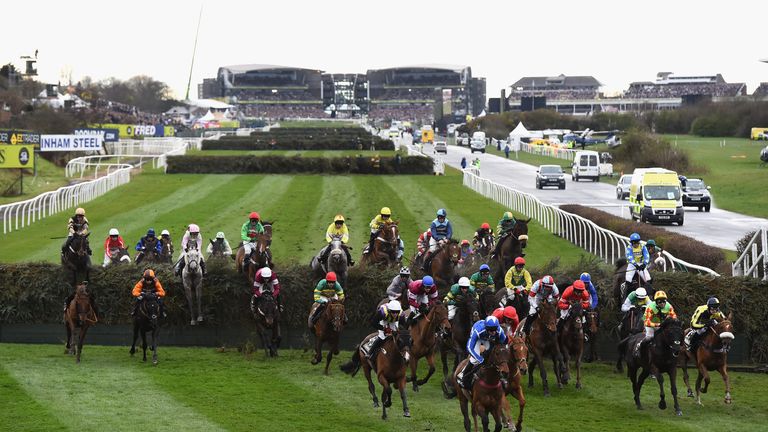
Check out our A-Z of Grand National facts ahead of the Aintree spectacular on April 14.
AMATEURS: Unlike the Derby, the Grand National often sees amateur riders taking on and beating the professionals. The big race was most recently won by a member of the unpaid ranks when journalist Marcus Armytage scored on Mr Frisk in 1990.
BECHER'S BROOK: The 1839 National gave us the legendary Becher's Brook, jumped as the sixth and 22nd fence in the great race. Captain Martin Becher fell from his horse Conrad at the ditch and crawled into the brook to escape the rest of the field jumping on him. He is reported to have said he "never knew water tasted so foul without whisky in it".
CHAIR: The Chair, the 15th fence in the race, is the biggest obstacle on the course. It is so-called because of its position alongside the 'seat' erected for the 'distance' judge.
DOUGLAS: Former British Lions rugby union international John Douglas won the Grand National as an owner in 1979. His 10-year-old Rubstic scored at 25-1 to give Scotland its one and only success in the race.
ELBOW: One of the most famous parts of the Aintree track, where many a race has totally changed complexion. After jumping the final fence, the runners must navigate a kink in the rail before straightening up again for the final thrust for glory. Red Rum overhauled the gallant Crisp after the Elbow in the 1973, while Seagram did the same to Gold Cup winner Garrison Savannah in 1991.
FAVOURITES: Rough Quest was the first winning favourite in 14 years when he scored at 7-1 in 1996 and market leader Earth Summit struck just two years later at the same odds. Golden Miller started the shortest-priced favourite ever in 1935 at 2-1 but failed to complete the course. The last favourite to win was 10-1 chance Don't Push It in 2010.
GREYS: Only three grey horses have ever won the Grand National in its 150-year history, The Lamb (1868 and 1871), Nicolaus Silver (1961) and Neptune Collonges (2012).
HOLIDAY: Holiday camp owner Fred Pontin won the National in 1971. His nine-year-old Specify got up close home to score by a neck in a thrilling finish.
IRISH: Bobbyjo ended a 24-year drought for Irish-trained horses when winning in 1999. A further six horses (Papillon, Monty's Pass, Hedgehunter, Numbersixvalverde, Silver Birch and Rule The World) have followed since then.
JOCKEYS: Ruby Walsh and Leighton Aspell are the only jockeys still riding to have won the Grand National twice - Walsh on Hedgehunter (2005) and Papillon (2000), Aspell on Pineau De Re (2014) and Many Clouds (2015).
KILMORE: Kilmore, in 1962, was the second Grand National winner as a jockey for Fred Winter, who went on to land the race as a trainer with Jay Trump in 1965 and Anglo in 1966.
LADY RIDERS: Charlotte Brew became the first woman to ride in the Grand National in 1977. Her mount Barony Fort refused at the fourth-last fence. Geraldine Rees was the first to complete the course, on Cheers in 1982. Rosemary Henderson, a 51-year-old grandmother, finished fifth on Fiddlers Pike in 1994, while Carrie Ford occupied the same position on Forest Gunner in 2005. Nina Carberry was ninth on Forest Gunner a year later and seventh on Character Building in 2010. Katie Walsh topped them all in 2012 when finishing a magnificent third on Seabass, trained by her father, Ted.
MOVIES: Aldaniti's emotional 1981 success inspired the movie 'Champions'. John Hurt portrayed Bob Champion, who fought back from cancer to land the National on a horse who overcame career-threatening injury himself.
NICKEL: Nickel Coin was the last mare to win the Grand National, in 1951. Closest to scoring for the fairer sex in recent years have been Dubacilla and Ebony Jane, fourth in 1995 and 1994 respectively, and Auntie Dot, third in 1991.
OUTSIDERS: Five horses have won the race at odds of 100-1 - Tipperary Tim (1928), Gregalach (1929), Caughoo (1947), Foinavon (1967) and Mon Mome (2009).
PLASTIC: Fences now have plastic inserts to replace the traditional timber and rubber padding 'cores' and are more forgiving on horses should they knock the top of the birch off, and in turn reduce the risk of injury.
QUEEN MOTHER: The Queen Mother looked certain to gain a popular success in 1956 when Devon Loch was clear on the run-in. But he suddenly sprawled flat on the ground yards from the winning post and ESB galloped past to steal the prize.
RED RUM: No horse can match Red Rum's Grand National record. Winner of the race in 1973 and 1974, he was second the next two years before his historic third victory in 1977. After his retirement on the eve of the National in 1978, he regularly led the parade of runners before the start. He died in 1995 and is buried by the winning post at Aintree.
START: As part of safety changes, the start of the race was moved forward by around 90 yards last year, closer to the first fence and away from the grandstands, meaning the National is now run over short of the long-standing four and a half miles.
TELEVISION: The National remains a viewing instituition as far as racing goes and is now screened in no fewer than 84 countries, with an estimated worldwide audience of over 500million. This year will be the first one broadcast on ITV since it took over rights from Channel 4.
USA: Ex-American chasers Jay Trump and Ben Nevis came across to Britain to land the National in 1965 and 1980 respectively. Uncle Merlin might well have emulated them but for unseating Hywel Davies at Becher's second time round in 1990.
VOLUPTUARY: Voluptuary, bred by Queen Victoria, had never jumped a fence before winning the National in 1884. He ended his career clearing a water jump night after night in the Grand National scene of the play 'Prodigal Daughter'.
WINTER: The late, great Fred Winter is the only man to have ridden (Kilmore 1962, Sundew 1957) and trained (Jay Trump 1965, Anglo 1966) two Grand National winners.
X-RATED: Mick Fitzgerald was overcome by his victory on Rough Quest in 1996, saying: "I've never enjoyed 12 minutes as much before. Sex is an anti-climax after that!"
YOUNGEST: Bruce Hobbs was the youngest jockey to win the National, scoring on Battleship in 1938 at the age of 17. Oldest successful rider was 48-year-old Dick Saunders on Grittar in 1982. Tim Durant was the oldest jockey to complete the course, partnering Highlandie in 1968 at the age of 68.
ZONGALERO: When Zongalero finished a length-and-a-half second to Rubstic in the 1979 National he completed an unhappy hat-trick. He had also been runner-up in the Mackeson Gold Cup and Massey-Ferguson Gold Cup and ended the season without a win to his name.