Ian Brindle looks back at his five favourite King George VI and Queen Elizabeth Stakes and it's the 1975 winner who tops the list.
'Race of the Century' provides best winner
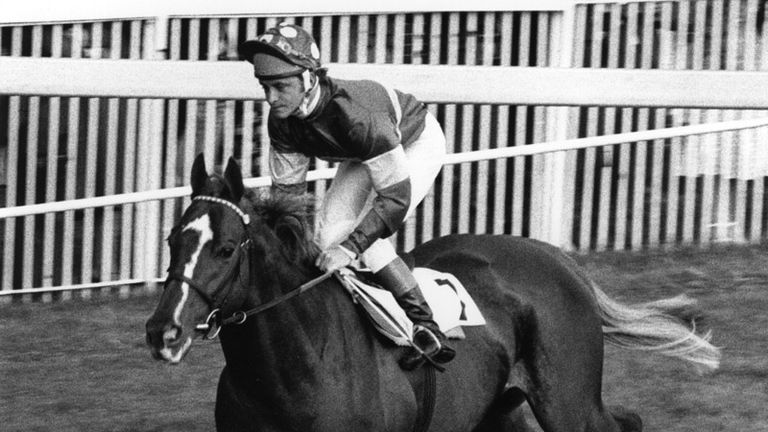
1975 Grundy
Unequivocally and universally noted as the "race of the century", the 1975 renewal of the King George is often incorrectly referred to as a match race between Grundy and Bustino but that was only half the story.
Worth just under £82,000 to the winner, the contest also featured Dahlia (who had won the race in 1973 and 1974) and Eclipse winner Star Appeal (later to win that year's Arc de Triomphe).
In the modern era, the idea of pacemakers almost passes punters by but in 1975 Dick Hern adopted the tactic of running two in order to ensure that Bustino, who had won the St Leger at Doncaster in the previous year, could make his stamina count.
With Highest leaving the stalls at almost quarter-horse pace and Kinglet taking over, the Hern plan looked to be taking shape as Bustino travelled in behind his stable companions. However, he found himself at the front with half a mile to travel and Joe Mercer was forced to commit for home.
Pat Eddery refused to panic on Grundy and as he made headway on the leader to challenge him with a furlong to travel, his partner gave willingly as Bustino battled back on instinct like a champion boxer about to be floored to the canvas. The clock stopped at two-and-a-half seconds inside the previous record.
The race is equally famous for the postscript to the horse's labours on the day. Grundy was to be beaten by Dahlia at York and was quickly retired to stud. Bustino was never to race again.
2010 Harbinger
Having witnessed the well-put-together but slightly undercooked Harbinger win a maiden on the Chester Cup undercard by three lengths, even if I had the psychic ability of Mystic Meg, I could never have predicted what the son of Dansili would show just over a year down the line.
With Derby winner Workforce starting off a well-supported odds-on favourite, all media attention was focussed on whether he could repeat the brilliance of his Epsom run, however it was the son of Dansili who was to make the headlines.
All things appeared to be going to plan for Workforce as his pacemaker, Confront, took them along with Irish Derby winner Cape Blanco slipstreaming, but as Ryan Moore began to row away on the favourite as they turned in, the eye was attracted to Olivier Peslier as he sat stone cold in the saddle aboard Harbinger.
As the field passed the two furlong pole, Harbinger made Classic winners look like mere handicappers and powered away to victory unchallenged. His Timeform rating of 142 suggesting the effort was ahead of noted luminaries such as Dancing Brave, Shergar and Sea The Stars.
1989 Nashwan
Ask Willie Carson as to the best horse he has ever ridden and "Nash The Dash" would be his instant reply.
Nashwan's 1989 season reads as a list of the best races to win in flat racing. The 2,000 Guineas in May, followed by a five length success in the Derby at Epsom and a similar margin success in the Coral-Eclipse at Sandown.
Two weeks after his victory in the Eclipse, Nashwan strode to post a 2-9 favourite for the King George in the absence of French star Old Vic.
Michael Roberts attempted to steal the race under an enterprising ride aboard the Clive Brittain-trained Top Class, but his challenge was cast aside as the denouement of a heads-up battle between Nashwan and Cacoethes ensued.
In a thrilling finish, Nashwan held on gamely to maintain his unbeaten record whilst his old rival was to later demonstrate the value of the form with victory in the Breeders Cup Turf at Belmont Park.
2000 Montjeu
The champion racehorse in Europe, Montjeu's performance at Ascot smacked of breathtaking contempt for his rivals.
It isn't too often that Group 1 races can be won by horses sitting around a dozen lengths off the pace at halfway but bearing in mind that this field included a Coronation Cup winner and a future Breeders Cup Turf winner, subsequent history puts the magnitude of this effort into perspective.
Held up in the last pair by Kinane, there was never any element of hurry from the rider as he almost metronomically ticked off the furlong markers like a exercet missile waiting to explode at a pre-defined point.
He may have refused to enter the parade ring beforehand but his journey into the winner's enclosure was made with the minimum of fuss. Produced to challenge with two furlongs to race, he filed past his rivals with complete ambivalence toward their existence.
The winning margin of one-and-three-quarter lengths bearing minimal resemblance to the ease in which it was obtained.
1994 King's Theatre
For a Group 1 event, it is somewhat unusual to see that Sir Henry Cecil's name appears on its role of honour just three times. The third of those saw him take the race with Craven Stakes winner King's Theatre.
The race was not without its drama as Ezzoud was to play a major part in the contest though not as was perhaps envisaged.
Sir Michael Stoute's colt, who had built up a reputation as a quirky individual, unshipped Walter Swinburn out of the stalls, and, wearing his customary visor, he galloped on unaware of his surrounds and was to be an equine time bomb for the rest of his rivals.
With Urgent Request and St Leger winner Bob's Return generating the early fractions, one could easily crab the level of opposition, though this effort makes the top five on account of the performance of his jockey Michael Kinane.
There are many races where the Irish champion had utilised his uncanny knack of being in the right place at the right time but this was a master class in how to ride at Ascot.
Always travelling just off the leaders, Kinane kept him far enough off the rail to avoid trouble but also without allowing him too much daylight. Races can often be won in split seconds and showing plenty of awareness of the loose horse hanging directly into his path, the rider was able to negotiate his presence and allow his mount to do the rest.