Grand National: Jockey Club CEO Nevin Truesdale says protests 'no doubt' impacted horses
Dr Mark Kennedy, senior scientific manager for equines at the RSPCA, calls for British Horse Racing Authority to conduct a full and transparent review into the three horse fatalities at Aintree; Hill Sixteen suffered a fatal fall in the Grand National after a 15-minute delay to the race
Monday 17 April 2023 18:14, UK
Nevin Truesdale, Jockey Club CEO, believes that the protests by animal rights protesters that delayed Saturday's Grand National "no doubt" had an impact on the horses.
Hill Sixteen suffered a fatal fall at the first fence of the race and was one of three fatalities across the festival, following on from Dark Raven earlier on Saturday afternoon and Envoye Special who died on Thursday.
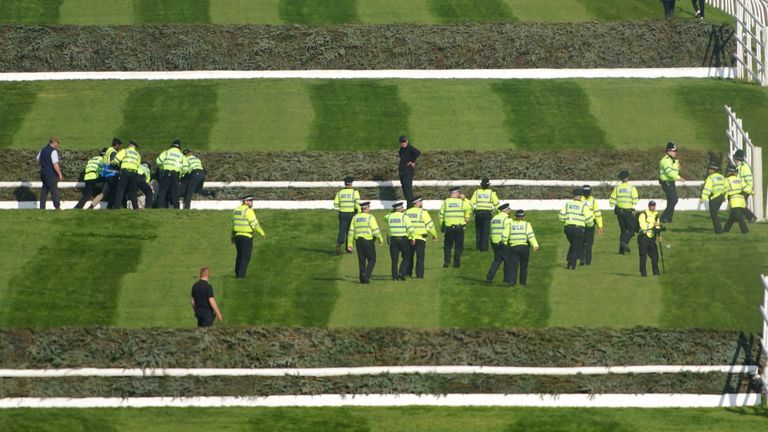
The Grand National was delayed by 15 minutes at Aintree after several protesters attempted to enter the racecourse itself and fix themselves to fences and railing.
- Trainer blames 'ignorant' protesters as BHA review Grand National death
- Corach Rambler wins Grand National after protests delay start
- Third horse dies at Grand National meeting | 118 arrested over protests
Merseyside Police confirmed on Sunday that a total of 118 people were arrested on April 15. Those arrested included men and women aged between 18 and 66 on suspicion on a number of offences including conspiracy to cause public nuisance, obstructing highways and possession of controlled drugs.
Of those arrested, 65 were taken into custody and are being processed and will be bailed.
Hill Sixteen trainer Sandy Thomson subsequently blamed "ignorant" protestors for getting the horse "so bloody hyper" ahead of the race, telling the Racing Post: "They [protesters] just cause more problems than they ever solve."
Truesdale told Sky Sports News: "Peaceful protesters, expressing their opinions, we have absolutely no problem with that. Unfortunately, some decided to take the law into their own hands and break the law.
"Let's be clear, that is what happened at Aintree on Saturday at about 4.50pm, before the start of the race. And there is no doubt that there is a link between the delay to the race, the impact on the horses and the views of Sandy, who I spoke to on Saturday evening.
"Like any trainer, when you lose a horse, he was absolutely gutted and sad.
"For example, at the first two fences on Saturday we saw eight fallers, as opposed to 17 in the nine years before that at those same two fences. I don't think that's a coincidence."
Truesdale: There is always more we can do
Truesdale does, however, admit there is more the sport can do to make it safer but added that great strides have been made already over the last few years.
"We can't ignore what happened in terms of the fatalities. Every fatality in racing is one too many," he said.
"That's obviously a concern for all of us across the whole sport, because we in racing - race course officials, owners, jockeys, stable staff - really care about these equine athletes, these heroes.
"It's something we will be analysing and reviewing. But the fact is the 99.8 per cent of horses across all of racing come back from their races safely. That fatality rate has come down by a third in the last 10 years.
"The sport is safer. And the Grand National is probably safer than it has ever been. But that does not mean that we will stop in terms of our relentless drive to improve welfare standards."
Truesdale added: "You will never eliminate risk completely.
"We will continue to do that and continue to work with charities like the RSPCA and World Horse Welfare, who have helped us with constructive suggestions about how we can continue to evolve the sport, move with the times and change.
"There is always more we can do."
Animal Rising: Death was what protest aimed to prevent
Animal Rising, the group which organised the protests at the Grand National, hit back at Thomson's claims their actions at Aintree contributed to the death of Hill Sixteen and vowed they will continue to take action this year.
"Firstly, we want to offer our deepest condolences to anyone connected to Hill Sixteen, Dark Raven, and Envoye Special or impacted by their deaths," a statement from Animal Rising read. "The death of the first horse was precisely what Animal Rising's actions on Saturday aimed to prevent.
"It is a scandal that the British Horseracing Authority cannot acknowledge and accept blame for the horrors of their sport. The fact that neither Envoye Special, Dark Raven, nor Hill Sixteen was mentioned by name in their statement speaks volumes about the importance of these horses to the organisation.
"Horse deaths and injuries are an unavoidable consequence of the way we use animals for sport, not dissimilar to the way we cause billions of animal deaths in our food system. The only way to prevent more harm from coming to these beautiful creatures is by completely re-evaluating our connection to them and finding a way of loving them that doesn't harm them.
"We'd welcome dialogue with Sandy Thomson or [Hill Sixteen's owner] Jimmy Fyffe about how to move forwards together and really transform our relationship with horses and, indeed, with all animals and nature.
"In reality, Hill Sixteen's death was entirely caused by the fact that horse racing has never, and can never provide, a safe place for these beautiful creatures to live their lives free from harm. The only way to have prevented their death would've been if they had never run the race in the first place. Horse racing claims to put animal welfare first but if, as they claim, Hill Sixteen was 'hyper' then they should never have been forced to run.
"We are facing a climate and ecological crisis, and our fractured relationship with other animals and nature is at the heart of that. Animal Rising is acutely aware of the deaths of animals, not only on racetracks but in our food system too. The real ignorance here is that of continuing to use and exploit animals when we know this doesn't represent who we are as people.
"This summer Animal Rising will continue to take action for all life. The only way we'll stop horses from dying every two-three days on racetracks, or the billion for food in The UK, is by transforming our relationship to animals and the natural world."
'Three dead horses not an acceptable level of risk'
Dr Mark Kennedy, senior scientific manager for equines at the RSPCA, is keen to ensure the British Horse Racing Authority conducts a full and transparent review into the three deaths from the three-day event at Aintree.
"Clearly, nobody could argue that it is acceptable to end a three-day festival of racing with three dead horses," he told Sky Sports News. "There is no way that could be seen as an acceptable level of risk.
"What we are asking British Horse Racing Authority to do now is to carefully, fully and transparently review the circumstances of these three deaths and see what we can learn about them - to see if there are any factors that may have influenced them and work out how we can move forward.
"The RSPCA is an evidence-based organisation. What we don't want to do is contribute to the huge amount of speculation that is floating about."
Dr Kennedy added: "We engage with the British Horse Racing Authority, with our sole focus being the welfare of the thousands of horses involved in horse racing.
"I think we need to be ambitious. Rather than saying, 'well, you can never eliminate all risk'."