
Stuart Barnes says that players should not be banned for accidental acts
Monday 11 May 2015 23:54, UK
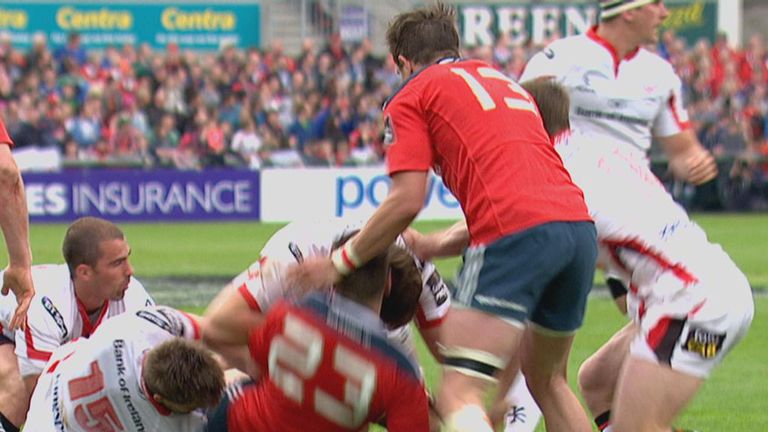
Stuart Barnes says that players should not be banned for accidental acts after Iain Henderson was red-carded for Ulster...
Ulster will have to appeal the red card of Iain Henderson. Leicester, in the starkest contrast, will accept whatever fine comes the way of Seremaia Bai. Both red cards occurred in high pressure league matches, both occurred at the breakdown but that is where the similarity ends.
The Leicester centre sprinted in from a distance and threw himself with reckless abandon into the melee of bodies, presumably to clear out the outstanding Nathan Hughes who was, to use parlance, making a nuisance of himself at the breakdown. Head on head, it was sickening to see and both men are fortunate not to have suffered damaging head injuries.
Henderson’s incident was head-on-head but whether it was both careless and reckless as Nigel Owens stated is contentious. Careless, possibly, reckless, I don’t think so. Fifteen minutes earlier with the aid of technology I had been praising Henderson for 'cleaning out’ a breakdown and securing quick ball for Ulster.

The red card incident was well-nigh identical bar the fact that the flanker, instead of knocking his opponent backwards and out the way found Ronan O’Mahony already falling away from the breakdown. Henderson was on a downwards trajectory by the time he bashed heads with the Munster reserve winger, no longer in control of his movement.
But if he was 'out of control’ was he not both careless and reckless? Maybe so but if that is the right verdict there are more reckless and careless interventions at the breakdown than there are legitimate ones.
Day of the jackal
Players are supposed to bind at the breakdown, to drive opposition off the ball but the game has changed in a way the rules simply do not reflect. The 'jackal’ position is – relatively speaking – a new concept and one that demands immediate action on the part of the opposing team if the jackal is to be stopped from either winning turnover, a penalty or slowing the ball down.
The counter to the jackal is the immense hit on the fringe of the ruck, the judo throw of the jackal, it is more often than not an individual action and an immediate one; far more than the scrum, the most dangerous place to now be a rugby player is in and around the breakdown.
The laws of the game are almost universally ignored in the interests of both empathy and fluency and because of that the red card for the Ulsterman is harsh. In terms of the letter of the law it is understandable but when referees do not referee according to the letter of the law in so many other instances it is no real defence against Ulster’s forthcoming appeal.

The sport has been so lax for so long at the breakdown that the very thought of players binding before attacking the area is anathema to the vast majority, old laws for a modern age that has evolved in another direction.
The breakdown, because of the jackal and the determination to seal the ball off with short, squat geniuses like David Pocock and Steffon Armitage, has lost all momentum; it is a fight over the ball but a static one. The theory of the contact area through the history of the game has been not to play the ball on the floor.
Dangerous play
Occasionally a side will attack the breakdown on their feet in numbers (Leicester did it superbly at times against Wasps) and drive the defenders off the ball but when the limpets get over that tackled man it takes much to move them, often it has to be the judo throw or the first man hitting them in often exposed back and rib cages. It is dangerous and it is understandable. The laws are not a reflection of the reality at ground level.
The sport has been so lax for so long at the breakdown that the very thought of players binding before attacking the area is anathema to the vast majority, old laws for a modern age that has evolved in another direction. The evolution has been so rapid because officials have given up trying to police the breakdown. We are now in a position where it is dangerous and illegal on many occasions.
When you see something as obviously reckless at Bai’s act the decision is a straightforward one and Wayne Barnes did well with the help of his officials to upgrade from yellow to red. Whether Owens got it right by playing the careless and reckless card, well that is up for debate.
The word that has disappeared from the official’s vocabulary is ‘intent’. Instead ‘outcome’ has become the voguish alternative and I am sure that this is an error in need of rectification. To swap one for the other is to bring the accidental into the red card formula, caught up in the net of reckless and careless.
Players should not be sent from the field and banned for accidental acts.
I would love to hear your thoughts on it folks,
Stuart answers your questions...
Got a question for Stuart? Email him at skysportsclub@bskyb.com, tweet @SkySportsRugby #askskyrugby or use the feedback form at skysports.com.
Hi Stuart, I agree with you regarding Toulon being the best team we've seen in European rugby competition, but I've got serious reservations about the future of rugby in Northern Hemisphere, in that we may be heading down the path that the round ball game has taken in the guise of what Real Madrid achieved with the aid of there so called Galacticos, which in turn has been the root cause of bankrupting football.
My fear is that should other rugby clubs attempt to match the spending of Toulon and other French clubs, then our great game could find itself on the same slippery slope.
Also on a playing front, in my humble opinion, it's unfair to compare teams like Leicester " made up of almost all English players, "and Leinster " with mostly Irish " as against Toulon " a team made up with players from all over the world! I'm wondering what you think the future holds for rugby at large if this trend continues?
Mike Reidy.
STUART REPLIES: Mike, I think the bird has flown. Clubs like Bath and Saracens want to expand and compete. The game is growing at a club level and this development has always been inevitability. It changes the balance between club and country and challenges every status quo the game has ever known.
There will be traditionalists who fear such movement and a new generation who care for club over country who find the prospect exciting. The trend will continue and clubs will grow, maybe not into Real Madrid proportions and perhaps that should be remembered before hubris trips a few people over.
Hi Stuart, what did you make of Nigel Owens sending off Iain Henderson for leading with the head or forearm when hitting the ruck? Did he get it wrong and if not does it change the breakdown as we know it?
Jeremey Fines
STUART REPLIES: Jeremy, See my column above... the thought is much on my mind...
Stuart, are we seeing a shift in the way some of the South Africa teams are playing the game? The likes of the Lions, Stormers and Cheetahs seem to be opting for skill over brawn? The Sharks and Bulls still seem to be obsessed with size but I am pleasantly surprised to see some smaller and more skillful players in the SA conferences.
Mark Deysel
STUART REPLIES: Mark, A better balance will make South Africa all the more formidable come international rugby – as if the Springboks aren't tough enough opponents already! Like you watching SA teams has been an improved experience for me this season. Bet they are tighter come a World Cup although the transition from Super to Test rugby might not be immediate.