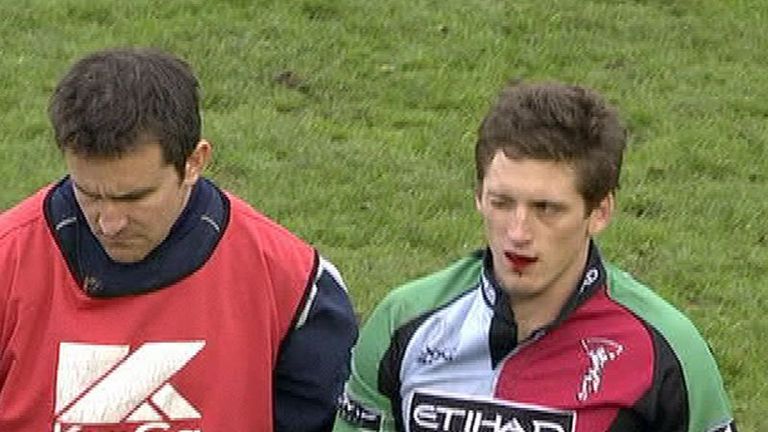
Tom Williams has revealed the pressure Harlequins placed on him not to disclose the full extent of events surrounding 'Bloodgate'.
Williams offered improved contract plus perks in return for limited appeal
The player at the centre of the so-called 'Bloodgate' scandal has revealed for the first time the pressure Harlequins placed on him not to disclose the full extent of events surrounding the affair.
Tom Williams told an independent appeals committee last week the Guinness Premiership club had offered him a new four-year contract plus other benefits in return for revealing only a limited version of events.
The winger was initially handed a 12-month ban - reduced to four months after appeal - for chewing a fake blood capsule during Quins' Heineken Cup game against Leinster in April in order to allow specialist kicker Nick Evans to return to the field.
Williams, 25, said he had initially accepted the offer of a new contract - and admitted making further demands - after the club's chief executive, Mark Evans, told him they could face expulsion from the Heineken Cup if he proceeded with a full disclosure appeal.
However, he ultimately decided to tell all, a decision that resulted in director of rugby Dean Richards being banned from coaching for three years and physio Steph Brennan being handed a two-year suspension, while the club were fined just under £260,000.
The committee decided they did not have any jurisdiction in the case of club doctor Wendy Chapman, even though Williams said she had deliberately cut his mouth in order to cover up the offence.
Williams' testimony was made public on Tuesday when European Rugby Cup published the full written decision of the appeals committee, which convened for almost 14 hours in Glasgow a week and a half ago.
Compensation
In it, he explained he had met club chairman Charles Jillings on the morning of August 5, around two weeks after he decided to appeal his 12-month ban.
Williams said: "He started by apologising to me for the position I had been placed in. I am sure he was sincere.
"Charles then laid out a compensation offer to me. This consisted of payment of my salary while I was suspended, an assurance that I would be selected for the team on merit once my suspension ended, a two-year contract extension, a testimonial, a three-year employment opportunity with the club after I retired from playing, and an assurance that he would take a direct interest in my post-rugby career.
"He asked me what I was planning to do in relation to an appeal.
"Charles told me that he thought I should appeal, but that it should be on a limited basis focusing on the sanction and not the findings of fact.
"Charles said that if the ERC decided to convene a personal hearing and questions were asked of me that might incriminate other parties, I could simply refuse to answer those questions."
Williams went back with a counter-offer in which he demanded an apology, a contract extension on improved terms and that the club pay off the mortgage on his house.
He added that, in response, Quins offered an apology, a new-four year contract and extra holidays.
Williams also recalled a conversation he said he had with Evans in which the chief executive tried to convince him of the consequences of any decision to reveal all.
"In that meeting, Mark was very friendly but outlined the consequences of my appealing on a full-disclosure basis," Williams said.
"He told me this route could result in the club being expelled from the Heineken Cup, they would lose sponsors, that Wendy and Steph could be struck off for life and would in turn sue the club. He said it would be worse than relegation. I assumed he was speaking in a financial sense."
Williams claimed his team-mates had also encouraged him not to tell the whole truth.
He said Chapman had been placed in an "extremely hostile and tense environment" when he arrived in the physio room and added that they agreed to say he had cut his own lip in order to protect her.
Pressure
Furthermore, Williams said he had been placed under pressure to lie before July's original disciplinary hearing, explaining he was asked to sign a statement to back up the club's version of events.
He said: "The way in which Dean presented it to me made it very clear that I had no real choice in the matter, and that I was expected to sign the club's statement and to toe the club's line."
Richards denied in the hearing that the player had no choice; however, Williams insisted in his testimony he had felt unable to challenge the coach's authority.
He claimed the Leinster game was the first time he had been asked to fake an injury in such a way and that he had no prior knowledge of blood capsules being used.
Richards and Brennan have admitted employing the tactic on previous occasions.
Williams added: "If I had refused to bite the capsule, Dean would have seen that I had disobeyed him and might refuse to play me again. This could have spelt the end of my career at Harlequins.
"And how would I face my team-mates if my refusal to come off was blamed by Dean for losing us the game?"
The Rugby Football Union later expressed "concern" at the contents of Williams' testimony.
However, it said it would wait until the ERC publishes details of its appeal against the original sanctions placed on Quins before deciding whether to take further action.
Disciplinary officer Jeff Blackett said: "Today's statement introduces new information into the equation which we were not aware of.
"The material we reviewed over the weekend related only to the additional four occasions on which fake blood was used.
"On these new allegations, difficult though it might be, we must have the full information before we decide on next steps."
Blackett said on Monday the RFU would take no further action against Quins players allegedly involved in previous instances of using fake blood.
Evans declined on Tuesday to comment on Williams' testimony, saying he had yet to read the appeals committee's full written judgement.