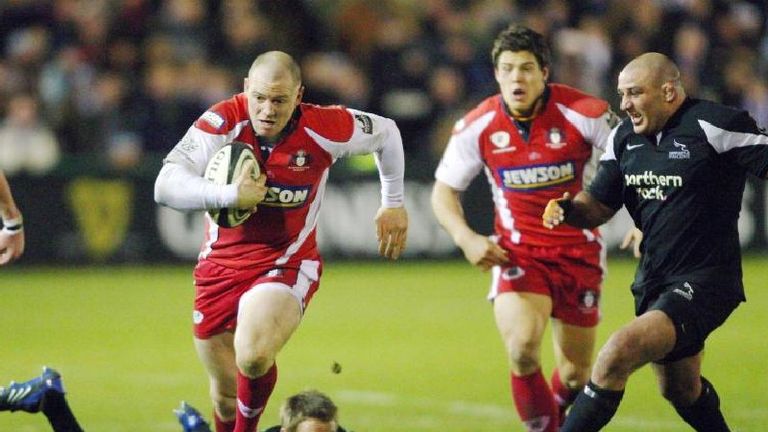
The 2008 Six Nations is upon us! Can France defend their crown or will there be a new champion? Let's assess England's challenge...
Can Ashton's men build on their World Cup glory...
The 2008 Six Nations is upon us! Can France defend their crown or will there be a new champion? Let's assess England's challenge...
How the worm has turned. A mere year ago, England were facing up to the challenge of a new year on the back of a disastrous November that featured a first ever defeat to Argentina at home. What's more, Brian Ashton - a caretaker coach in everything but name - had just taking reception of history's most horrendous hospital-pass. How surprising, then, that this was all followed by a feeble tilt at Six Nations glory - England's fourth consecutive balls-up at that.
All indicators suggested that the defence of their world crown would be over before it had barely begun, and a shambolic 36-0 defeat to South Africa in the group stages of World Cup duly sent England fans scuttling behind sofas.
The something remarkable happen. In the space of two weeks, England grew a backbone. In true Churchillian style, they rolled up their sleeves and got down to the nitty-gritty of winning at rugby. Australia buckled and France followed suit, both sides full of fancy footwork but unable to match England for heart and muscle. Somehow, England had made it to the Final, they had 'shocked the world' as they had planned - and then came within a shoe size of sending it into cardiac arrest.
So where does that leave England now? It's hard to tell. The World Cup represented the end of a woeful four-year period and, with the departure of not a few of the old hands, the sense is that a new leaf has been turned. But what they can carry over from last year is the one element that has conspicuous by its absence since Martin Johnson took his leave: confidence. Ashton is
finally in full control of his side and no longer wears the face of a man sentenced to swing. What's more, a new generation of free-wheeling prodigies has got the media talking about a 'Golden Era' for English rugby.
This optimism is sure to morph into better performances on the paddock, but 2008 is a starting point rather than a final destination. It will take time for Ashton to realise his vision of an England side that features as many sculptors as gargoyles, and one sense that England fans will, once again, be asked to show a little patience.
Fixtures:
Sat, 2 Feb: England v Wales, London - 16:30 GMT
Sun, 10 Feb: Italy v England, Rome - 15:30 (14:30 GMT)
Sat, 23 Feb: France v England, Paris - 21:00 (20:00 GMT)
Sat, 8 Mar: Scotland v England, Edinburgh - 15:15 GMT
Sat, 15 Mar: England v Ireland, London - 15:00 GMT
Coach
Former Bath stalwart Brian Ashton succeeded Andy Robinson as England coach after the disastrous November Test series of 2006, inheriting a team in flux. Ashton, who had a year as Ireland coach in 1996/7 before leaving to be first England attack coach and then Bath coach, is reputed to be one of the finest backs coaches in operation, is regarded as a brilliant developer of young talent and is a passionate advocate of wide, adventurous rugby. As a canny scrum-half, Ashton travelled widely, representing the likes of Fylde, Orrell, AS Montferrand, Roma and Milan - but he never represented England, the closest he came was as an unused replacement against Scotland in 1975. Ashton was criticised for his leadership during the World Cup, with some players admitting to be irked up his
laissez-faire attitude. But he was reappointed to the position after a unbecoming inquest and is now finally free to impose his true will on the team.
Captain
Wasps prop Phil Vickery bounced back from three years of injury hell in 2006 to reclaim his place in England's front row - and the captaincy. A brooding and assured character, the 'Raging Bull' is one few remaining old heads in the side and his experience should provide the perfect coil to the young minds that are sure to surround them. Not that leadership is the only thing on his mind at present - Vickery hasn't had much game-time this season and his place in the side is under serious threat from the likes of Matt Stevens. Team man to a fault, Vickery has vowed to step aside should it be in England's best interests.
Key Man
As usual, it's hard to look past Jonny Wilkinson. The Newcastle superstar has had a good run of games and will be looking to put his rather unspectacular World Cup behind him. With Wilko set to concentrate on getting his own engine ticking, the marshalling of a young backline will fall to Mike Tindall. The veteran centre missed the World Cup through injury but has been in fine form for Gloucester. His knowledge of the game and his ability to get over the gain line will be crucial to England's cause.
New Hope
Wasps playmaker Danny Cipriani is undoubtedly the man of the moment, but he is unlikely to get much game time unless he is selected at full-back or Ashton is brave enough to shift Jonny Wilkinson out to inside centre - or onto the bench. It's Cipriani's club colleague, James Haskell, who is sure to catch the eye of the uninitiated. Tipped as a future England captain, the young loose forward is reminiscent of a young Lawrence Dallaglio - but he's actually more than that. Unlike big Lol, Haskell can morph from a pawing grizzly into a gazelle within a stride, and has the vision and hands of a full-back. And he's got lungs: he once beat Olympic cyclist Rob Hayles in a charity sprint cycling race.
Strengths
Huge physicality, strength in depth in almost every position, a rock-solid scrum, confidence stemming from the World Cup and the current form of the domestic clubs on the European stage.
Weaknesses
What has happened to England's line-out? Once the main weapon of their arsenal, it stuttered and spluttered all over the World Cup. And is Ashton's free-flowing vision of English rugby actually feasible? How can 137 years of forward-dominated fare be wrong? The demands of the clubs in the 'off' weekends will, as usual, cause a few problems.
Prediction
England should get off to a good start. Wales have not won at Twickenham since 1988 whilst Italy away is a mission that will not be taken lightly, but trips to Paris and Edinburgh will prove to be tough assignments. Ireland, on the rebound off the back of a woeful World Cup, will prove a hard nut to crack on the final weekend. Another third-place finish beckons for the English - call it a work in progress.
Squad
Forwards: Steve Borthwick (Bath Rugby), Tom Croft (Leicester Tigers), George Chuter (Leicester Tigers), Louis Deacon (Leicester Tigers), Nick Easter (Harlequins), James Haskell (London Wasps), Michael Lipman (Bath Rugby), Ben Kay (Leicester Tigers), Lee Mears (Bath Rugby), Lewis Moody (Leicester Tigers), Luke Narraway (Gloucester Rugby), Tim Payne (London Wasps), Tom Rees (London Wasps), Mark Regan (Bristol Rugby), Simon Shaw (London Wasps), Andrew Sheridan (Sale Sharks), Matt Stevens (Bath Rugby), Phil Vickery (London Wasps, captain).
Backs: Iain Balshaw (Gloucester Rugby), Daniel Cipriani (London Wasps), Mark Cueto (Sale Sharks), Toby Flood (Newcastle Falcons), Andy Gomarsall (Harlequins) , Charlie Hodgson (Sale Sharks), Paul Hodgson (London Irish), Jamie Noon (Newcastle Falcons), Paul Sackey (London Wasps), David Strettle (Harlequins), Mat Tait (Newcastle Falcons), Mike Tindall (Gloucester Rugby), Richard Wigglesworth (Sale Sharks), Jonny Wilkinson (Newcastle Falcons), Lesley Vainikolo (Gloucester Rugby).
Championship History:
Grand Slams: 12
Championships: 25
Triple Crowns: 23
Most championship appearances: Jason Leonard (1991-2004) - 54
Most championship tries: Cyril Lowe (1913-1923), Rory Underwood (1984-1996) - 18
Most championship points: Jonny Wilkinson (1998-2007) - 429
Biggest championship win: England 80 Italy 23, 2001
Biggest championship defeat: Scotland 33 England 6, 1986