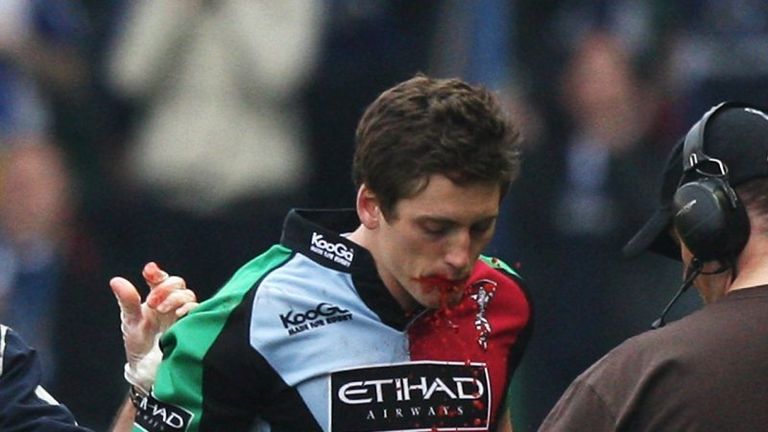
The RFU will discuss the possible introduction of rolling substitutions on a trial basis in the Guinness Premiership.
Governing body keen to eliminate cheating
The introduction of rolling substitutions on a trial basis in the Guinness Premiership is being considered by the Rugby Football Union (RFU) in a bid to eradicate cheating.
The potentially divisive proposal is one of 16 recommendations published by an RFU task force following a month-long review into the state of the game in the wake of the 'Bloodgate' scandal at Harlequins.
The 13-man panel, which included former England captain Lawrence Dallaglio and the RFU's elite rugby director Rob Andrew, found no evidence that cheating is systemic in rugby.
But there were enough incidences of "inappropriate behaviour" to suggest that action needs to be taken to close loopholes in the regulations, such as that which allowed the 'Bloodgate' situation to occur.
The panel received evidence from 129 professional players, 10 percent of whom had either seen or participated in the faking of a blood injury at club level at least once.
That figure rises to 41 percent for players who had either witnessed club-mates feign injuries to force uncontested scrums or done it themselves.
Rolling substitutions would help eliminate both those issues and from a player welfare perspective they would also assist medics in diagnosing potential concussion.
Harlequins revealed at the European Rugby Cup disciplinary hearing that one of their incidences of faking a blood injury had been to allow medics more time to diagnose the severity of a head injury.
Rugby league already operates a system of rolling substitutions, where each side may make 12 interchanges from a four-man bench.
Option
The RFU's task force accepts rolling substitutions would affect the fabric of the game - but they concluded the game must look closely at the option.
"There is a recommendation that once this has been discussed by the relevant governing bodies that we introduce a trial next year at the top level, which would mean the Guinness Premiership," said Dallaglio.
"The safety of the players is paramount. We are involved in a high-impact, high-collision, fast game.
"As laws currently stand, a medical officer only has 90 seconds to assess a player who takes a bang on the head. If he is not bleeding he has to leave the field permanently and that is not in the best interests of the game at large.
"I have been involved in situations where it would have been far better for me to be removed from the game and be assessed. We are tempting teams to go beyond the laws by certain loopholes.
"We also recognise that saying rolling substitutions must be introduced will fundamentally change the dynamics of the game and therefore that is not something we can say.
"It needs to be discussed and it needs input from people who would know how fundamentally it would change the game.
"But you have to say that from a safety aspect the benefits far outweigh the drawbacks."
The RFU set up the panel in the wake of 'Bloodgate' and the drugs affair at Bath, two episodes which dragged the image and reputation of the sport through the mud.
The task force has no authority and their recommendations are discussion points at present but Dallaglio insisted it was not just a "talking shop" and that the global game could eventually benefit.
"This will address some of the issues that exist and hopefully all the recommendations will be embraced by the game," he added.
Guidelines
The RFU panel want the International Rugby Board to establish guidelines on how much blood is required before a player has to be temporarily replaced to undergo treatment.
The IRB will also receive proposals designed to protect the role of medical professionals within the sport by detailing that their own professional code of conduct supersedes a contract of employment.
Dr Wendy Chapman, the Harlequins match-day doctor who became embroiled in the 'Bloodgate' scandal, has been suspended by the General Medical Council pending investigation into her conduct.
This also includes a recommendation that the IRB change the regulation which currently prohibits the use of local anaesthetic on match day.
Despite being banned, it is a widespread practice because there is no test for it and medics are often put under pressure to use it by players who do not want to be ruled out of the game.
On a domestic level, the RFU will create a specific regulation covering cheating, gamesmanship and foul play with "severe sanctions" associated.
"We want to remove the temptation for cheating," said RFU chief executive Francis Baron.