
Head injuries in rugby: World Rugby to introduce instrumented mouthguards to detect player concussion
New mouthguard technology allows medical staff to monitor head impacts in real-time and improve player safety; WXV will debut instrumented mouthguards this month; World Rugby plans to roll out technology across grassroots game
Friday 13 October 2023 08:27, UK
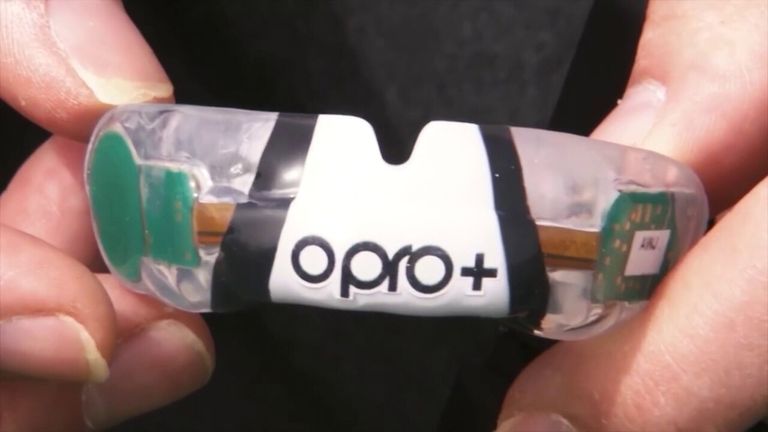
World Rugby will introduce mouthguard technology to monitor G-forces experienced by players during head impacts to detect, and prevent, concussion.
The instrumented mouthguards will be used for the first time in the inaugural edition of the WXV - a global women's competition - this month, and integrated into the Head Injury Assessment (HIA) protocol from January.
The Rugby World Cup is taking place against the backdrop of a lawsuit filed against several governing bodies, including World Rugby, by over 200 former players suffering from neurological impairments.
- George: England's experience key for Fiji quarter-final
- Is hair a barrier to sport for Black women?
- Rugby World Cup: Full fixture list
"An instrumented mouthguard is a piece of technology... which measures head motion, and that head motion is called a head acceleration event," said Dr Eanna Falvey, World Rugby Chief Medical Officer.
"That acceleration event is how the head accepts an impact event. So you can tell the number and the magnitude of those head acceleration events that occur in the acute setting in the game.
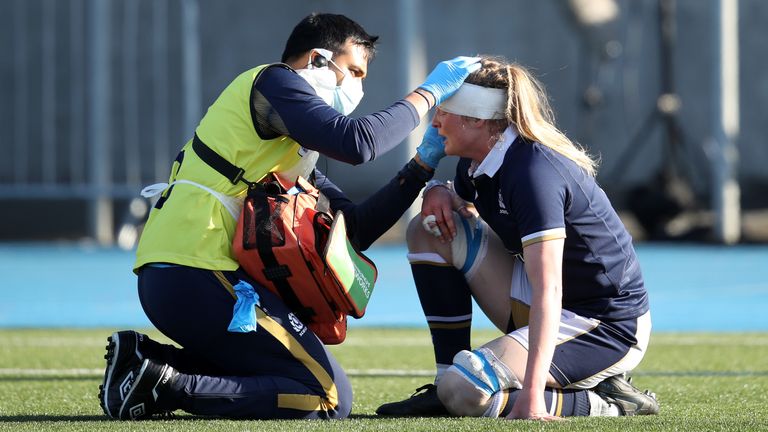
"It can tell us if an event has occurred which warrants an on-field assessment. So if a high impact and intensity event has occurred the players mouthguard will alert the matchday doctor.
"If a male player experiences an impact above 70g and 4000 radians per second squared, he will automatically be removed from the pitch and subject to a head injury assessment. In the women's game, where the technology will be used in the WXV this month, the threshold is 55g and 4000 rad/s².
"In the more longer term, it's also allowed us to understand the number and magnitude of events that occur across a player's week, month and career," said Dr Falvey.

"We understand what the average should be in the game right now, and we know for example that there will be players who will exceed that average, and those are players that we would like to manage differently in terms of the the exposure that they have."
The technology uses Bluetooth, allowing medical staff to monitor the head impacts of players in real-time.
"Currently in the game, about 15 per cent of the concussions we see happen after the game, or two days later at the HIA3 stage," said Dr Falvey.
"For us, that means these are events that occurred that we weren't able to manage at the time, perhaps because the player didn't have a clinical manifestation, but also because there's a decision made to play on by the player themselves."

World Rugby also want to roll out instrumented mouthguards in the grassroots game, ensuring all levels of rugby are as safe as possible.
"I see this going over the next couple of years in a community setting, I think will be really, really interesting," said Dr Falvey.
"We're able to, at the moment, understand the thresholds above which we need to look at somebody, and we hope to be able to create these across all levels of the game.
"So that this instrumented technology, which is becoming more and more cost viable, will be available to people across the community and allow a safer management of players as they play."