
Pep Guardiola's plan to stop Barcelona wasn't so wrong

Tuesday 1 November 2016 07:42, UK
Pep Guardiola's Manchester City got closer to stopping Barcelona last time than the 4-0 scoreline suggested. There were encouraging signs even in defeat, argues Adam Bate...
If goals change games they can certainly transform perceptions of managers. These managers know it too. Pep Guardiola has been known to lie awake at night plotting his latest tactical plans. Maybe it's not possible to plan for an epiphany but this is a man who likes to try.
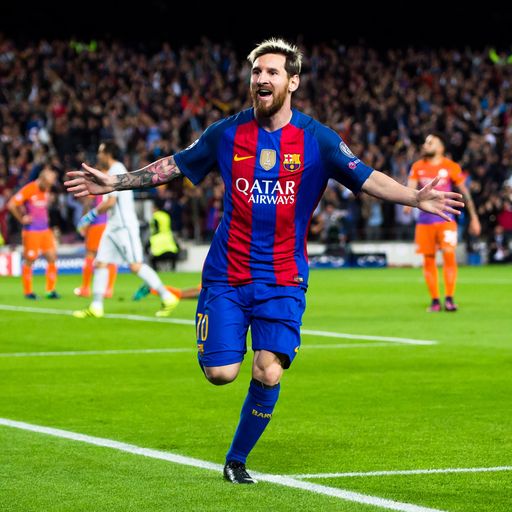
On his return to Barcelona, Guardiola was once again accused of overthinking it. Sergio Aguero was dropped, Manchester City were beaten 4-0 and Lionel Messi scored a hat-trick. Guardiola has now conceded seven without reply on his two trips back to the Nou Camp.
He courted ridicule two years ago by going man for man at the back. "I can't think of any other coach who would employ these tactics," Gary Neville told Sky Sports at the time. Jamie Carragher wondered whether the decision to do so was brave or mad.
Ultimately, it didn't work. Barcelona scored three late goals and the tie was lost. It was a different approach but it was the one that made sense to Guardiola. "Pep would rather die going forward than stay alive defending," said his former player Thierry Henry.
Despite the disappointment, for the man who says "it is not possible" to change his philosophy, it remains the best way to go about stopping Barcelona. And intriguingly, even after coming out on the wrong end of another result, he can still take some encouragement.
Consider some of the underlying numbers prior to Claudio Bravo's red card early in the second half. Barcelona's fabled front three had found it unusually difficult to get on the ball. When they did, Messi completed only nine of 19 attempted passes in the first 53 minutes.
Luis Suarez found a team-mate with only eight passes in that period. For Neymar, it was just seven. That's 24 completed passes for the trio. Meanwhile, City's front three of Raheem Sterling, Nolito and Kevin De Bruyne had completed 41 passes at the same stage.
Passes aren't everything but Guardiola is obsessed with the build-up play being right. It's all about delivering the ball to the final third as efficiently as possible. This mantra never changes. So it follows that the aim against Barcelona would be to disrupt that build up.
That's what he did by pressing them high up the pitch, while swamping the midfield. In explaining the decision to drop Aguero, Guardiola noted the need for another body in the middle. The result was that it hampered Barca's progression of the ball to their front three.

Forced to look longer than they would have liked, Barcelona were even starved of possession far more than they are accustomed to. Luis Enrique's Barca don't keep the ball so relentlessly as they used to do but their domination of possession remains a huge weapon.
Over the past two seasons in the Champions League, only Arsenal had restricted Barcelona to less than 70 per cent of possession at the Nou Camp but even the Gunners were forced to surrender 64.4 per cent of the ball to the home side.
Against City, even with a one-man advantage for the best part of 40 minutes, it was different. Barcelona only marginally edged the possession 52.8 per cent to 47.2 per cent. If Guardiola wanted a basis for delivering a successful away display this was the platform.
It didn't work due to individual defensive errors. Fernandinho's slip proved costly for the game's opening goal and Bravo's failure to deal with a ball over the top that he should have coped with comfortably eventually resulted in his red card.

It was only after these setbacks that Neymar and the rest really started to enjoy themselves. As a result, while Guardiola will be well aware the mistakes must stop, he's entitled to be confused by talk of tactical errors. "Until 10 against 11 it was open," he said afterwards.
"We were competing against a team with a big personality. We were there, we were in the game. We were pressing, we had the possession and we made the chances. We did it but we didn't take the chances and you have to do that to win the game."
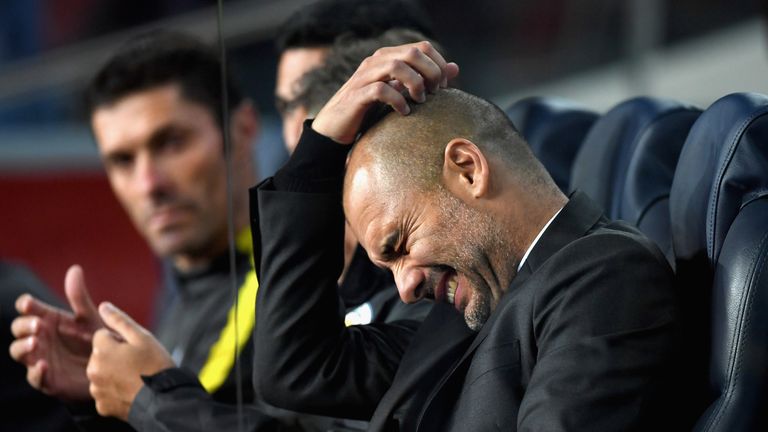
We were there, we were in the game. We were pressing, we had the possession and we made the chances.
It's a fair assessment and one worth remembering when City take on Barcelona for the sixth time in their history on Tuesday. So far it's five games and five defeats. That the last of those was the heaviest of the lot makes it easy to argue that there has been no progress.
But don't expect Guardiola to see things that way and don't expect him to drastically alter his approach. That's partially because he's a man committed to his way of playing. But it's also because that method was closer to working than that 4-0 scoreline suggested.