FA respond to Fancy Bears hack detailing use of TUEs in football
Tuesday 22 August 2017 16:49, UK

The FA is working to discover the extent of the Fancy Bears hack which made revelations about football's anti-doping procedures.
The Russian hackers have previously published details of therapeutic use exemptions (TUEs) - essentially a doctor's note permitting the use of an otherwise-banned substance to treat a medical condition - in Olympic sports.
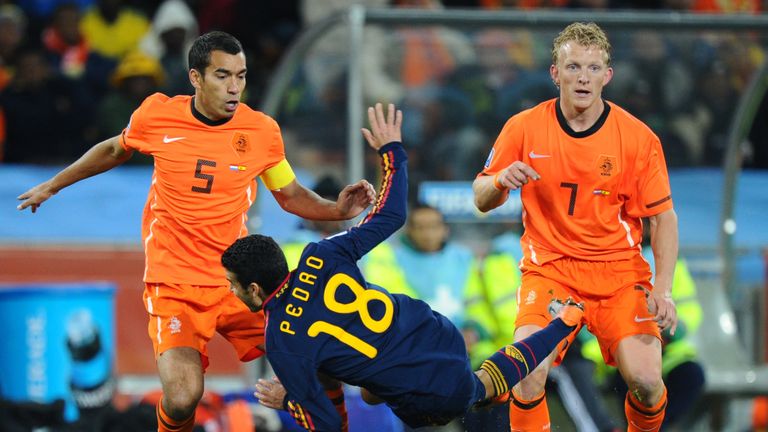
But on Tuesday the Fancy Bears published hacked data on football for the first time, with Carlos Tevez, Juan Veron and Dirk Kuyt named as three of 25 players permitted to use otherwise-banned medicines during the 2010 World Cup.
The latest hack includes an email from the FA's head of integrity, Jenni Kennedy, to world governing body FIFA regarding four anti-doping cases in May 2017.
The governing body said it was "disappointed" the information had been leaked as two of the cases are ongoing, relating to two non-league footballers.
Of those resolved, one shows Middlesbrough's George Friend received triamcinolone through a "legitimate method", with UK Anti-Doping determining no anti-doping rule violation had occurred.
The other shows Zesh Rehman, then a Gillingham player, received a retrospective TUE for prednisolone. It was prescribed due to urticaria, or hives, which is a bumpy and uncomfortable rash.
The FA said: "The Football Association is disappointed that strictly confidential information has been released into the public domain. The details of ongoing cases cannot be discussed or disclosed until due legal process has been completed.
"In the event that an Anti-Doping Rule Violation has been committed, full details will be published on The FA website in line with The World Anti-Doping Code.
"Additionally, it is inappropriate to publish information relating to personal medical conditions or medications and we will work alongside our partners to ascertain the extent of this matter."
Fancy Bears also claimed there were 160 adverse analytical findings - or positive doping tests - in 2015 in football. Of the four UK failures, three were for cocaine and one for ecstasy.
Tevez and Veron are two of five Argentinian players listed in a document which details TUEs and declarations of use of medicines during the tournament in South Africa more than seven years ago.
No England players were listed and there is no suggestion of wrongdoing on the part of those named.
Tevez, who has played for Manchester United, Manchester City and West Ham, former Chelsea and United playmaker Veron and ex-United defender Gabriel Heinze all declared the use of Betamethasone, a corticosteroid with a variety of uses.

The Football Association is disappointed that strictly confidential information has been released into the public domain
It does not feature directly on WADA's prohibited list, but is banned dependent on the concentration detected.
Former Liverpool and Netherlands forward Kuyt was revealed to have used dexamethasone, apparently for pain relief due to dentistry issue with his root canal.
Mario Gomez was one of four Germany players listed. Gomez received a TUE for salbutamol, a common asthma medication.
Ex-New Zealand, Blackburn and QPR defender Ryan Nelsen - listed as 'Nelson' on the published form - declared the use of prednisone, another corticosteroid.
The hackers also published correspondence regarding a TUE for triamcinolone to treat Arda Turan, the Barcelona and Turkey winger, for a back problem in June 2017.